Real Estate Data · Last updated: June 2026
Best Real Estate Data Providers in 2026: Buyer's Guide
Choosing a real estate data provider is not just about finding the biggest database. The right provider depends on what you need the data for, how fresh it must be, which country or market you cover, how you want to receive the data, and whether you can legally use it in your product, dashboard, research workflow, or internal system.
Most provider lists give you names. This guide helps you choose the right type of provider: API, bulk dataset, marketplace, commercial real estate platform, public record provider, or custom real estate data extraction partner.
Nenodata helps businesses collect, clean, monitor, and deliver real estate data from websites, portals, public sources, APIs, PDFs, and custom data feeds.
Above-fold CTA for visitors who already know what data they need.
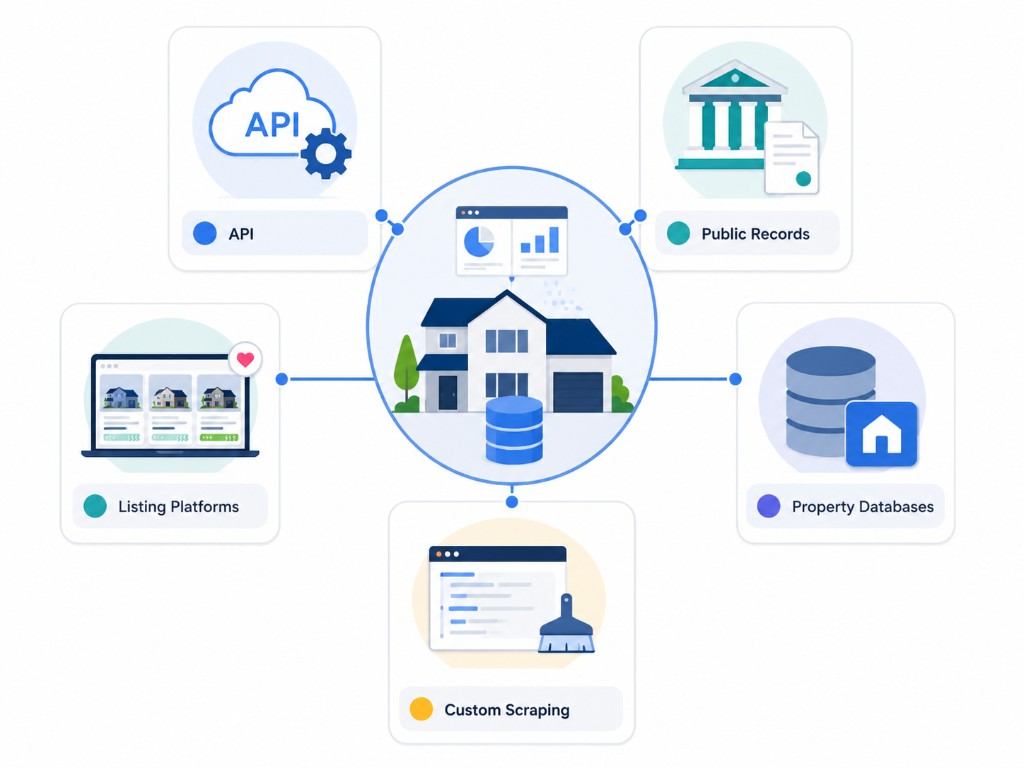
Quick Answer: What Is a Real Estate Data Provider?
A real estate data provider collects, cleans, structures, and delivers property-related data such as listings, ownership records, sales history, rental estimates, valuations, mortgage data, foreclosure data, parcel data, and commercial real estate intelligence.
Businesses use real estate data providers to power investment analysis, property search, underwriting, price monitoring, rental tracking, lead generation, market research, commercial real estate intelligence, and PropTech products.
There is no single best real estate data provider for every business.
For U.S. property records, ownership, tax, deed, foreclosure, and valuation data, companies often compare ATTOM, CoreLogic/Cotality, PropertyShark, and HouseCanary. For commercial real estate intelligence, buyers usually compare CoStar, Reonomy, Crexi, LoopNet, MSCI Real Capital Analytics, Trepp, and Green Street. For rental estimates and property APIs, RentCast, HouseCanary, ATTOM, and similar API providers are common options.
For businesses that need data from specific websites, countries, listing portals, competitor pages, PDFs, or custom fields, a custom extraction partner such as Nenodata may be a better fit.
[Source needed: latest provider product availability, coverage, delivery methods, and pricing.]
What Is a Real Estate Data Provider?
A real estate data provider gives businesses structured access to property-related information: listings, sale prices, ownership, parcel data, tax and mortgage records, rental estimates, foreclosure data, CRE listings, tenant and lease information, agent data, market trends, valuation signals, and source timestamps. Some specialize in public records; some in CRE intelligence; some in APIs; some in downloadable datasets; others build custom pipelines from specific websites, portals, or PDFs. The best provider depends on your workflow, not just the brand name.
Quick Comparison: Best Real Estate Data Providers in 2026
Use this table as a starting point. Pricing, coverage, API access, and product features can change—verify details with each provider before buying.
Methodology note: This comparison is organized by provider type, common buyer use case, delivery method, and likely fit. It is not a ranking of one universal "best" provider because real estate data needs vary by geography, freshness, fields, compliance, and delivery format.
| Provider | Best For | Main Data Types | Coverage | Delivery | Pricing | Best-Fit Buyer |
|---|---|---|---|---|---|---|
| ATTOM | U.S. property records and analytics | Ownership, tax, deed, mortgage, foreclosure, AVM, parcel, risk | Mainly U.S. | API, bulk data, cloud, files | Trial/API and custom quote | Lenders, insurers, PropTech, investors |
| CoreLogic / Cotality | Enterprise property intelligence | Property, valuation, hazard, mortgage, imagery, risk | Mainly U.S. | API, reports, files, cloud | Enterprise quote | Mortgage, insurance, risk teams |
| CoStar | Commercial real estate intelligence | CRE listings, comps, tenants, market data | Strong CRE coverage | Platform/dashboard | Subscription/enterprise | CRE brokers, investors, asset managers |
| PropertyShark | Ownership, comps, foreclosure research | Property records, ownership, permits, foreclosure, comps | Selected U.S. markets | Platform, reports, exports | Subscription | Brokers, appraisers, investors |
| Reonomy | CRE ownership and property intelligence | CRE assets, ownership, debt, sales | U.S. CRE-focused | Platform/API options | Enterprise quote | CRE prospecting and research teams |
| HouseCanary | Valuation and property APIs | AVM, comps, rental estimates, market forecasts | Mainly U.S. | API, analytics tools | API/subscription | PropTech, lenders, investors |
| RentCast | Rental and property data API | Property records, rent estimates, listings, market trends | U.S. | API | Free tier/paid API plans | Rental analytics, PropTech apps |
| Bright Data | Pre-built and custom datasets | Listing data, property fields, portal data | Global sources | CSV, JSON, Parquet, S3, Snowflake, SFTP | Dataset/subscription/custom | Data teams needing flexible datasets |
| Datarade | Marketplace discovery | Multiple real estate datasets | Global marketplace | Depends on vendor | Depends on vendor | Buyers comparing many vendors |
| Crexi | CRE marketplace and intelligence | CRE listings, sales, comps, market data | U.S. CRE | Platform/export | Free and paid plans | CRE brokers and investors |
| LoopNet | CRE listing discovery | Commercial listings | U.S. CRE | Platform | Subscription/advertising | CRE listing search |
| MSCI Real Capital Analytics | CRE transaction intelligence | Capital markets, transactions, investor data | Global CRE | Platform/reports | Enterprise quote | Institutional CRE investors |
| Zillow / MLS-related sources | Listing and market visibility | Listings, prices, agent data, market signals | Market-dependent | Platform/API/feeds vary | Varies | Listing discovery and market research |
| Nenodata | Custom real estate data extraction | Listings, prices, agents, ownership, rentals, PDFs, custom fields | Country/source-specific | CSV, JSON, API, database, S3, dashboard | Custom project or ongoing pipeline | Teams needing custom, fresh, structured data |
[Source needed: current provider pricing, delivery options, and product claims.]
After comparison table—buyers may need help choosing.
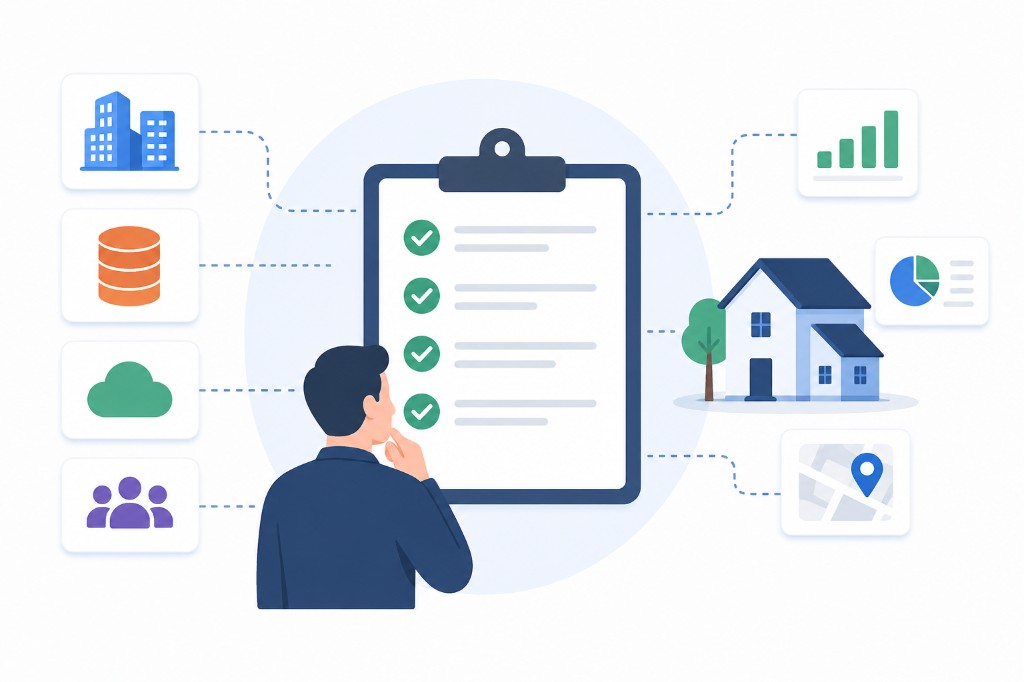
5 Types of Real Estate Data Providers
A real estate API, a CRE research platform, a data marketplace, a public record provider, and a custom scraping provider are not the same thing—they solve different problems.
1. Public Record and Property Data Providers
Examples: ATTOM, CoreLogic/Cotality
Choose when: Ownership, tax/assessor records, sale history, mortgage/deed, foreclosure, parcel data, valuation inputs, risk indicators.
Best for: Lenders, insurance, investors, PropTech, risk teams.
Watch out for: Country limits, county field gaps, update delays, licensing, enterprise pricing.
2. Commercial Real Estate Intelligence Platforms
Examples: CoStar, Reonomy, Crexi, LoopNet, MSCI RCA, Trepp, Green Street
Choose when: CRE comps, tenant/lease data, listings, market reports, cap rates, debt/transaction history.
Best for: CRE brokers, asset managers, institutional investors, developers.
Watch out for: High subscription costs, seat limits, export restrictions, coverage gaps.
3. Real Estate API Providers
Examples: HouseCanary, RentCast, ATTOM API
Choose when: Programmatic access, address search, AVM, rental estimates, comps, market trends, CRM enrichment.
Best for: PropTech, lender portals, investor dashboards, internal analytics.
Watch out for: Rate limits, overage charges, schema gaps, coverage restrictions.
4. Data Marketplaces
Examples: Datarade and large platform marketplaces
Choose when: Multiple vendors, samples, niche datasets, one-time purchases, global comparison.
Best for: Market research, procurement, analysts exploring new sources.
Watch out for: Inconsistent quality, licensing differences, hard-to-compare pricing.
5. Custom Real Estate Data Extraction Providers
Examples: Nenodata
Choose when: Specific websites/portals, custom fields, country/city coverage, daily/hourly monitoring, competitor tracking, PDF extraction, deduplication, custom API/database feeds.
Best for: Marketplaces, PropTech, investors, lead gen, price intelligence outside major U.S. datasets.
Watch out for: Website terms, source restrictions, maintenance, anti-bot changes, legal review, QA.
See our privacy policy and consult counsel for web scraping compliance considerations.
How to Choose the Right Real Estate Data Provider
Start with the business outcome, not the vendor name.
- Define the use case — PropTech app, underwriting, listing monitoring, CRE research, CRM enrichment, etc.
- List exact fields — listing URL, price, beds/baths, parcel ID, owner, cap rate, agent name—not just "property data."
- Decide freshness — hourly/daily for listings; weekly/monthly for public records; static for historical backfills.
- Choose delivery — API, CSV, S3, Snowflake, database, webhook, or custom internal API.
- Check licensing — internal use, product display, resale, model training, historical snapshots.
- Request sample data — real rows, null rates, timestamps, duplicates, address normalization.
| Use Case | Typical Freshness | Why It Matters |
|---|---|---|
| Listing price monitoring | Hourly or daily | Prices and availability change fast |
| Rental listing tracking | Daily | Rental inventory changes quickly |
| Lead generation | Daily to weekly | Opportunities lose value over time |
| Public ownership records | Weekly to monthly | Public records update slower |
| CRE market research | Monthly or quarterly | Market signals move slower |
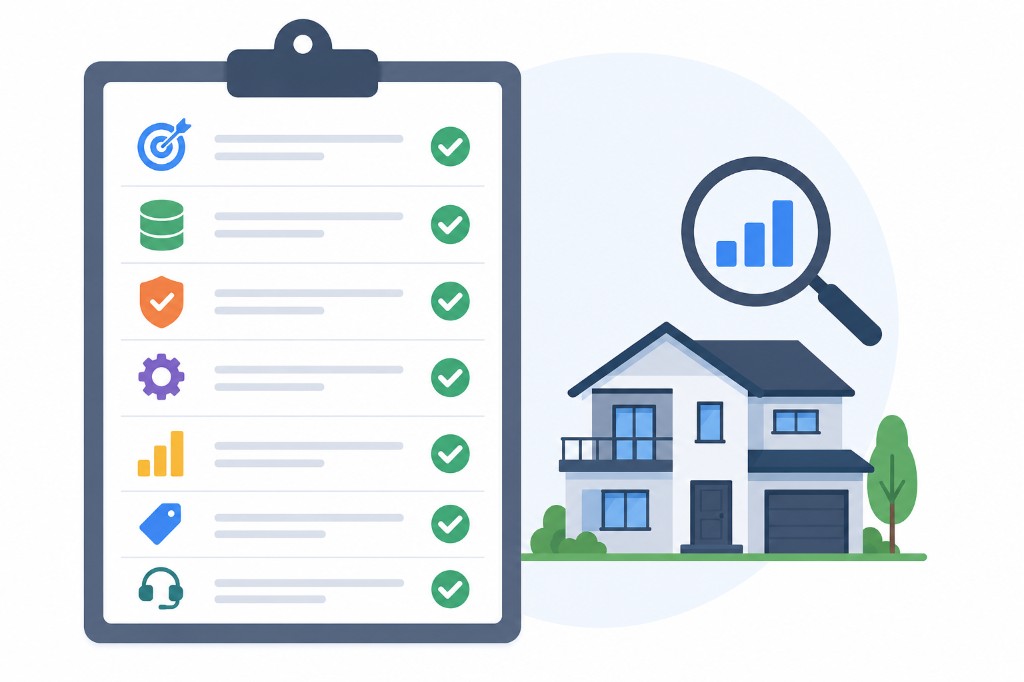
Best Real Estate Data Providers by Use Case
Buyer shortcut—provider type and vendors to compare (not a duplicate of the five types section above).
| Use Case | Best Provider Type | Vendors to Compare | Why |
|---|---|---|---|
| U.S. property ownership records | Public record provider | ATTOM, CoreLogic/Cotality, PropertyShark | Strong property and public record coverage |
| Property valuation and AVM | API/data provider | HouseCanary, ATTOM, CoreLogic/Cotality | Valuation models need structured property history |
| Rental analytics | API or rental data provider | RentCast, HouseCanary, Dwellsy IQ, custom extraction | Rental markets need fresh listing and rent data |
| CRE underwriting | CRE intelligence platform | CoStar, Reonomy, MSCI RCA, Trepp, Green Street | CRE requires transaction, tenant, lease, and market intelligence |
| Listing price monitoring | Custom extraction provider | Nenodata, Bright Data, scraping/API vendors | Freshness and portal-specific fields matter |
| PropTech app data feed | API or custom pipeline | RentCast, HouseCanary, ATTOM, Nenodata | Apps need stable schemas and repeat delivery |
| Market research | Marketplace or custom dataset | Datarade, Bright Data, Nenodata | Research teams often need flexible one-time or periodic datasets |
| Investor lead generation | Property data + enrichment | BatchData, PropertyShark, ATTOM, custom extraction | Leads need ownership, distress, contact, and freshness signals |
| International property data | Custom extraction or marketplace | Bright Data, Datarade, Nenodata | Major U.S. providers may not cover every country deeply |
| Agent or broker database | Custom extraction | Nenodata | Agent pages, directories, and portals often require custom collection |
Related: property listing scraping, real estate price monitoring, commercial real estate data, rental data scraping.
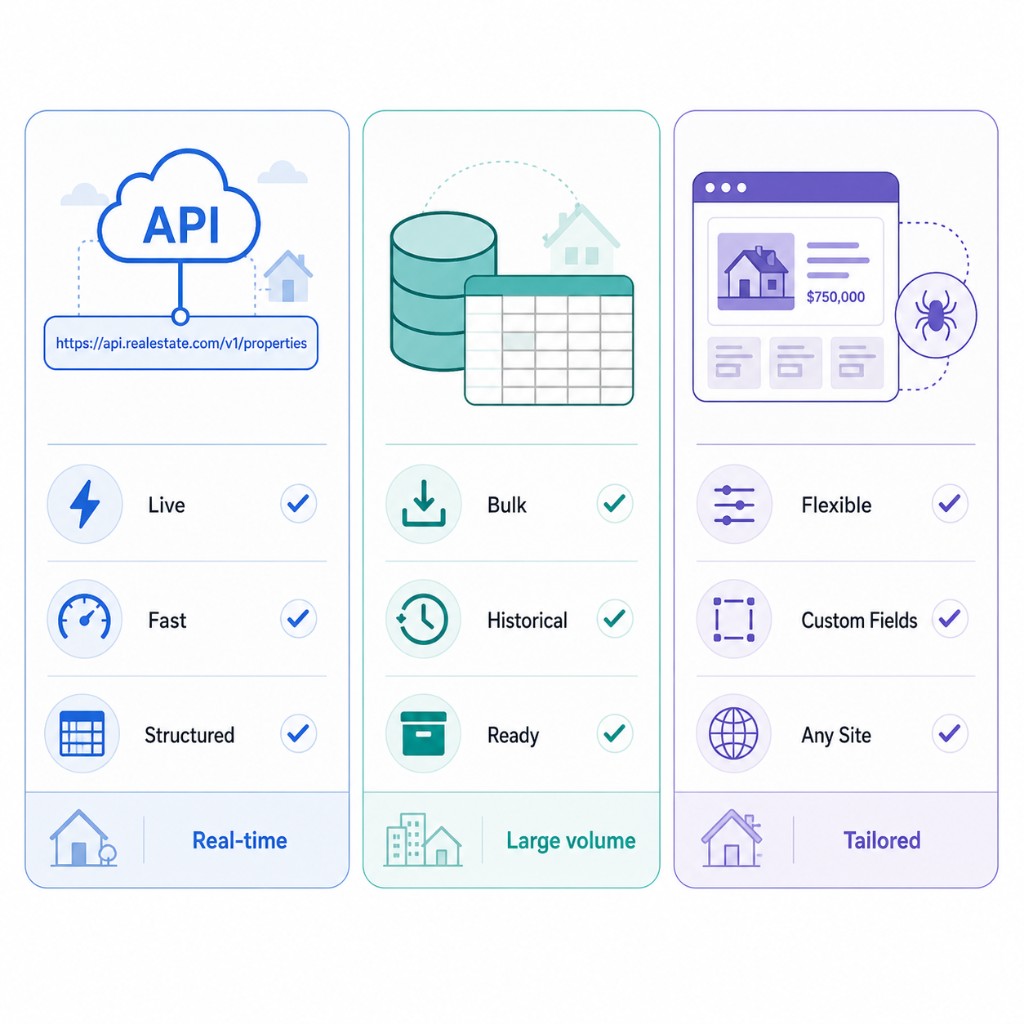
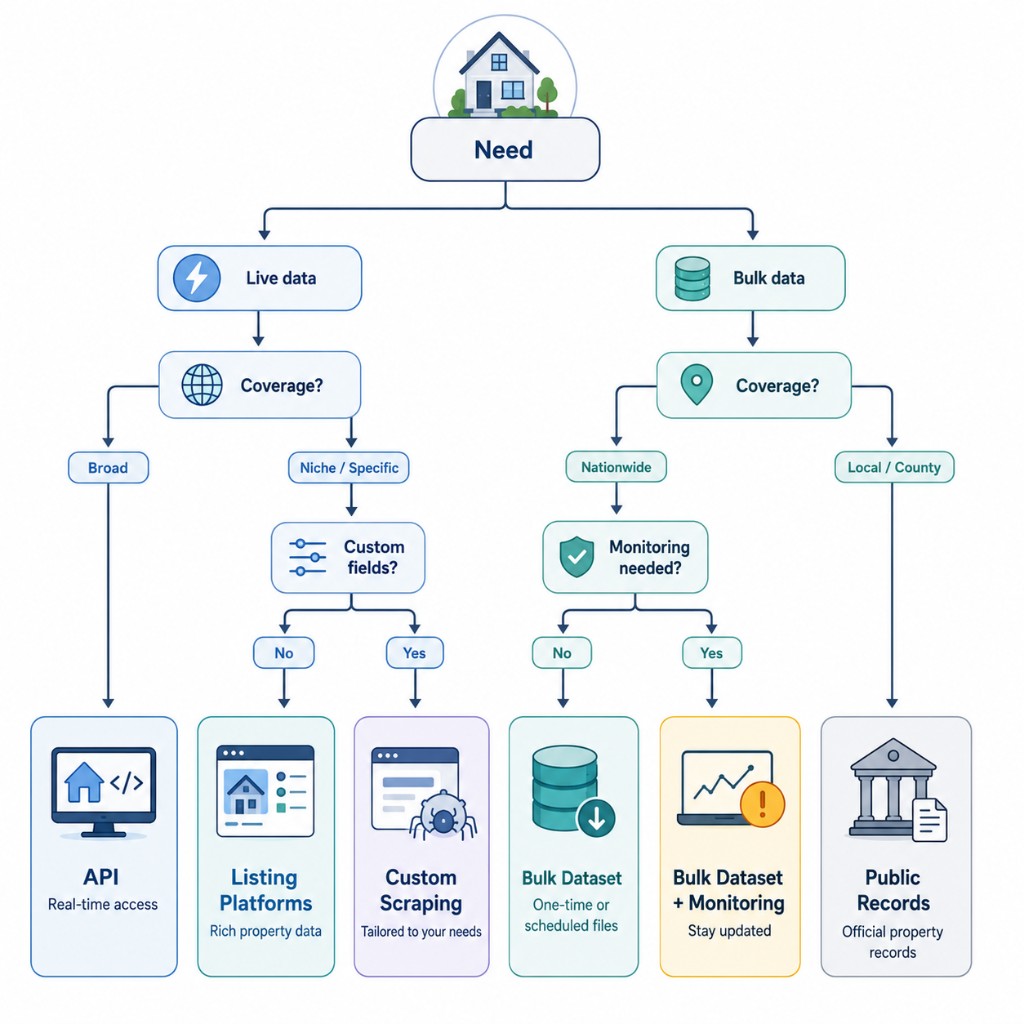
API vs Dataset vs Marketplace vs Custom Scraping
| Option | Best For | Pros | Cons | Choose When |
|---|---|---|---|---|
| Real estate API | Apps, dashboards | Fast integration, structured | Rate limits, fixed schema | Live data inside a product |
| Bulk dataset | Analysis, backfills | Large volume, storable | Can go stale | Historical or large-scale analytics |
| Data marketplace | Vendor discovery | Many providers, samples | Quality varies | Still exploring sources |
| CRE platform | CRE research | Rich CRE workflows | Expensive, limited export | CRE deal teams |
| Custom extraction | Specific sites/fields | Flexible, tailored schema | Needs maintenance | Packaged providers don't fit |
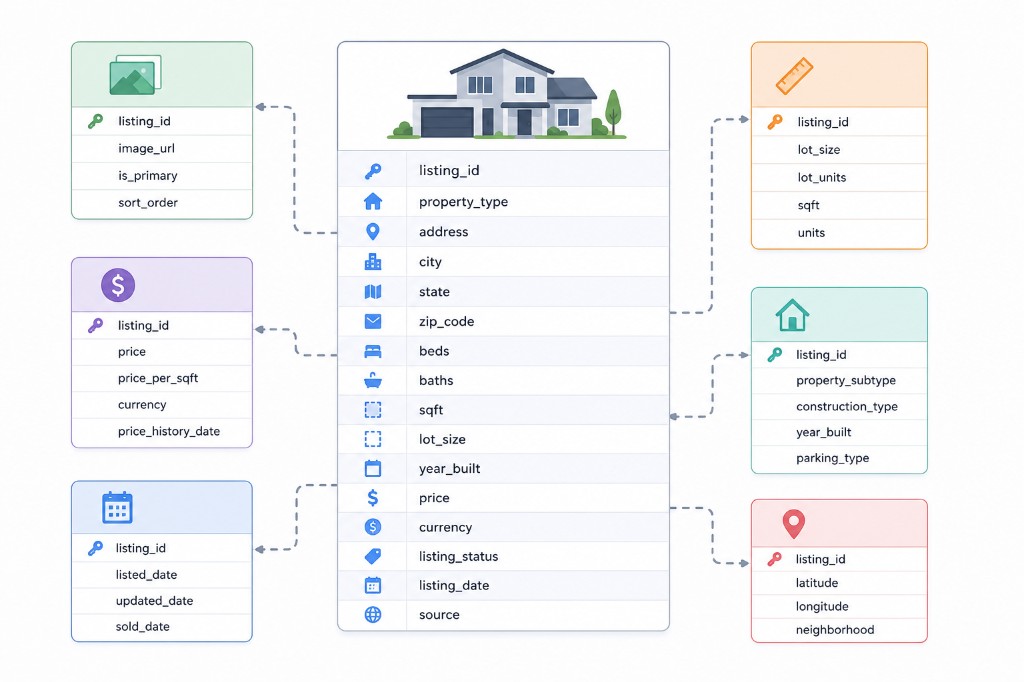
Real Estate Data Fields You Should Expect
| Category | Example Fields |
|---|---|
| Listing data | listing_url, price, status, listed_date, description |
| Property basics | address, property_type, beds, baths, sqft, year_built |
| Ownership | owner_name, mailing_address, ownership_type |
| Transaction | sale_date, sale_price, deed_type |
| Rental | rent_estimate, rental_yield, active_rent_listing |
| Commercial | tenant, lease_term, building_class, cap_rate, NOI |
| Source tracking | source_url, collected_at, last_seen_at |
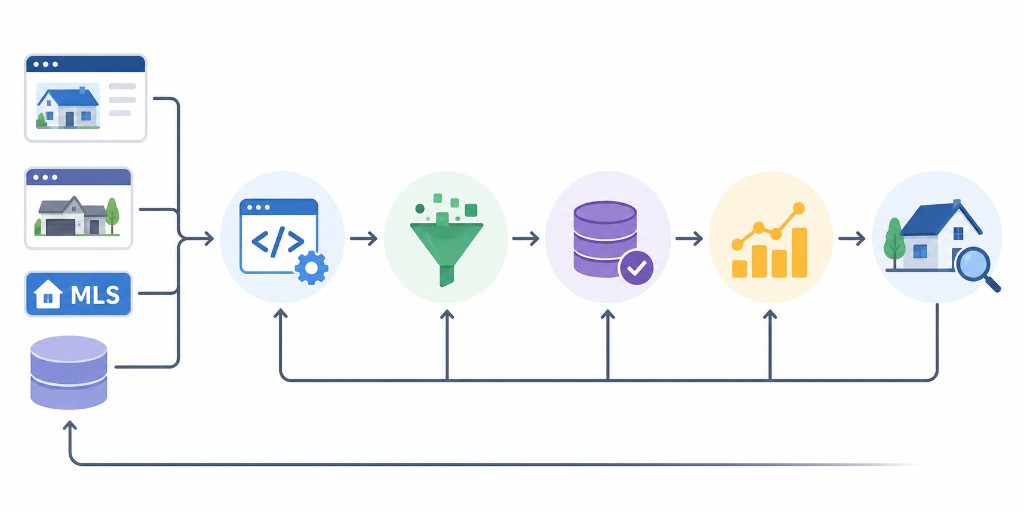
Data cleaning and deduplication often matter as much as collection.
Data Quality Checklist Before You Buy
- Coverage — geography, rural markets, CRE vs residential separation.
- Freshness — refresh cadence, last-updated timestamps, removed listing detection.
- Accuracy — address normalization, duplicates, cross-source matching.
- Field completeness — % of records with price, owner, rent, agent fields.
- Delivery & licensing — API/S3/Snowflake, documentation, allowed use cases.
- Support — onboarding, account management, issue handling.
Natural lead capture at checklist section—link to contact for delivery.
Pricing Models and Hidden Costs
Enterprise quotes, API overages, per-record pricing, one-time datasets, and ongoing custom pipelines all behave differently. Ask: Is pricing by records, API calls, seats, sources, or refresh frequency? Are updates and historical data included? What is the minimum contract term?
[Source needed: current provider pricing pages and API plan details.]
When Custom Real Estate Data Extraction Is Better
Choose custom extraction when packaged providers cannot match your portals, geography, fields, or refresh schedule—e.g. monitoring 12 regional listing portals daily for price changes, agent details, and removed listings.
Real estate price monitoring and portal-specific scrapers are common starting points; custom pipelines scale beyond a single source.
Highest-converting Nenodata service-fit section.
Compliance and Data Sourcing
Review source permissions, website terms, licensing, privacy laws, redistribution rights, and retention rules before buying or scraping. Public records are not always free to reuse commercially. Listing portals often restrict republishing. Owner and agent contact data may trigger GDPR/CCPA obligations—confirm with legal counsel.
[Source needed: GDPR/CCPA official guidance and legal review.]
Common Mistakes When Choosing a Real Estate Data Provider
- Choosing by brand name only—missing niche geography or fields.
- Ignoring refresh frequency for price or rental monitoring.
- Not validating sample data (nulls, duplicates, bad addresses).
- Confusing platform access with bulk/API data rights.
- Underestimating cleaning and entity matching work.
- Forgetting usage rights for display, resale, or AI training.
- Buying more fields than the workflow needs.
Step-by-Step: Build Your Real Estate Data Provider Shortlist
- Write your data goal in one sentence.
- Separate must-have vs nice-to-have fields.
- Define geography (country, state, city, portals).
- Set freshness (hourly, daily, weekly, one-time).
- Pick delivery (API, CSV, S3, database, custom feed).
- Match provider type: public records, CRE platform, API, marketplace, or custom extraction.
- Request 100–1,000 sample records; test quality and licensing.
- Start with a pilot before a large contract.
Final Recommendation
U.S. property records: compare ATTOM, CoreLogic/Cotality, PropertyShark, HouseCanary. CRE intelligence: CoStar, Reonomy, Crexi, LoopNet, MSCI RCA, Trepp, Green Street. Rental/API apps: RentCast, HouseCanary, ATTOM API. Vendor discovery: Datarade or dataset platforms. Specific websites, custom fields, international portals, daily monitoring, or custom feeds: contact Nenodata for custom real estate data extraction.
Send your target websites, fields, country, and refresh frequency—we'll recommend the best approach and provide a sample where possible.
Final consultation CTA.
FAQs
What is a real estate data provider?
A real estate data provider collects, cleans, structures, and delivers property-related data such as listings, ownership records, sales history, rental estimates, valuations, mortgage data, foreclosure data, parcel data, and commercial real estate intelligence.
What are the best real estate data providers in 2026?
Common providers include ATTOM, CoreLogic/Cotality, CoStar, PropertyShark, Reonomy, HouseCanary, RentCast, Bright Data, Datarade, Crexi, LoopNet, and MSCI Real Capital Analytics. The best choice depends on your use case, geography, delivery method, and data freshness needs.
How much does real estate data cost?
Real estate data may be priced by subscription, enterprise contract, API call, record count, dataset purchase, or custom pipeline. Many enterprise providers use quote-based pricing. Always verify current pricing with the vendor.
What is the difference between a real estate API and a real estate dataset?
A real estate API gives programmatic access to data through endpoints. A dataset is usually a file or table delivered in formats such as CSV, JSON, Parquet, Excel, S3, Snowflake, or database export.
Which provider is best for property ownership data?
For U.S. property ownership data, buyers often compare ATTOM, CoreLogic/Cotality, PropertyShark, and similar public record or property data providers. Coverage and field availability vary by market.
Which provider is best for commercial real estate data?
For commercial real estate data, buyers often compare CoStar, Reonomy, Crexi, LoopNet, MSCI Real Capital Analytics, Trepp, and Green Street.
Which provider is best for rental data?
For rental estimates, rental listings, and rental market analytics, buyers often compare RentCast, HouseCanary, Dwellsy IQ, and custom extraction providers for portal-specific rental feeds.
When should I use custom real estate data extraction?
Use custom extraction when you need data from specific websites, countries, portals, PDFs, custom fields, daily refreshes, competitor monitoring, or delivery into your own database or API.
Is real estate data scraping legal?
It depends on the source, data type, jurisdiction, website terms, privacy laws, and intended use. Publicly accessible data still needs legal and compliance review before commercial use.
What fields are included in a real estate dataset?
Common fields include listing URL, price, address, property type, bedrooms, bathrooms, square footage, lot size, owner name, parcel ID, sale date, sale price, rent estimate, valuation, agent details, and source timestamp.
Written by the Nenodata data extraction team. We build custom web scraping, real estate data extraction, price monitoring, data cleaning, and API delivery pipelines for businesses that need structured data from websites, portals, documents, and public sources.