Product identity
- Product title
- ASIN
- Brand
- Category
- Product URL
- Marketplace label
Amazon Ecommerce Data
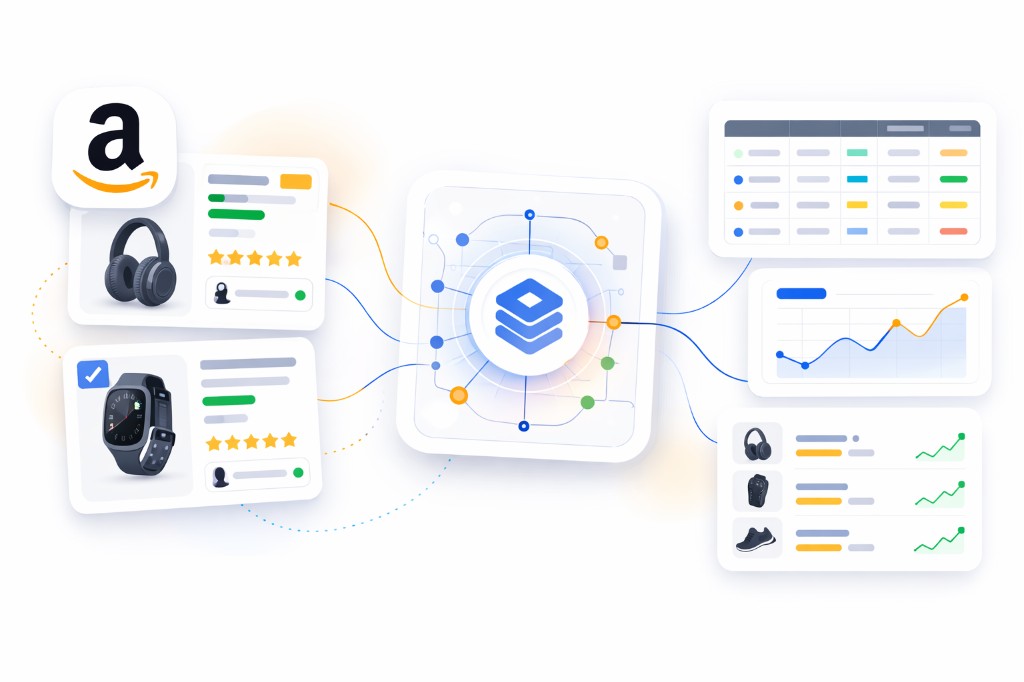
Amazon Data Scraping Services for Ecommerce helps pricing, ecommerce, and marketplace teams collect structured Amazon product, offer, seller, availability, and promotion signals from agreed public pages.
The Problem
Amazon offer visibility changes quickly across sellers, promotions, and listing states. A value copied manually in the morning may no longer match the visible offer when pricing, catalog, or category teams review it later.
Manual tracking becomes difficult when teams monitor large ASIN sets, compare seller changes, preserve historical snapshots, and repeat checks across categories. Fragile scripts introduce new risk when page behavior changes and maintenance consumes engineering time.
Teams need stable field definitions, consistent collection schedules, and outputs that can move directly into analysis, reporting, and operational workflows without rebuilding the dataset each cycle.
Illustrative offer change
Not live Amazon data.
ASIN · Example ASIN
Time 1
Price · Example value
Seller · Example seller
Availability · Example status
Time 2
Price · Example value
Seller · Example seller
Availability · Example status
The Service
Nenodata provides managed Amazon marketplace extraction scoped to the inputs and fields your team defines. You can start from product URLs, ASINs, keywords, categories, or monitored product sets, then review a sample before larger rollout.
Depending on approved scope, outputs can include product identifiers, prices, offers, seller context, availability, ratings, review counts, and promotion indicators where those elements are publicly visible and included in the agreed schema.
Scope confirmed before rollout
Coverage, refresh cadence, and delivery formats are confirmed during scoping. This service does not guarantee access to every listing, seller view, category, or restricted source without feasibility review.Amazon Data Scope
Inputs
Outputs
Sample Output
| Title | ASIN | Price | Seller | Availability | Rating | Reviews |
|---|---|---|---|---|---|---|
| Example product | Example ASIN | Example value | Example seller | Example status | Example value | Example value |
Swipe the table sideways to see all columns.
{
  "product_title": "Example product",
  "asin": "Example ASIN",
  "price": "Example value",
  "seller_name": "Example seller",
  "availability": "Example status",
  "rating": "Example value",
  "review_count": "Example value",
  "sponsored_flag": "Example flag",
  "marketplace": "Example marketplace",
  "product_url": "Example public URL"
}Get this shape of data for your Amazon inputs
Schema & Outputs
Applications
ASIN · price signal
Track pricing and listing changes across monitored ASIN sets to support category and pricing decisions.
Seller A → Seller B
Monitor seller-visible changes and offer context where publicly displayed so teams can review marketplace movement.
Category → Products → Pricing
Compare current visible prices and promotion signals across target product sets on agreed collection schedules.
ASIN + Seller → Catalog
Add marketplace identifiers, seller details, and listing context to internal catalogs for stronger downstream analysis.
Rating · Reviews · Time
Load structured outputs into recurring reporting workflows for pricing, assortment, and marketplace visibility.
Offers · Seller · Availability
Analyze offer and seller-related fields where available to understand listing dynamics beyond simple price snapshots.
Learn more in our ecommerce price scraping guide.
Audience
This service fits ecommerce pricing teams, marketplace operators, catalog owners, analysts, and product teams that depend on recurring Amazon offer and seller visibility.
It also supports organizations that need managed extraction workflows instead of maintaining brittle internal scripts.
Built for
Workflow
Share target inputs, required fields, schema expectations, and refresh needs so Nenodata can scope the workflow.
Nenodata configures extraction against agreed public targets and captures the defined field set for sample review.
Collected records are standardized, reviewed for completeness, and mapped to the agreed schema before delivery.
Receive structured outputs once or on a recurring schedule in formats confirmed during scoping.
Why Nenodata
Define the exact fields, identifiers, and structure that match your pricing, catalog, and monitoring workflow before extraction begins.
Validate fields and structure with representative data before committing to broader recurring workflows.
Start with product URLs, ASINs, keywords, categories, or monitored product sets based on how your team works today.
Outputs are prepared for recurring analysis and downstream workflows instead of one-off manual cleanup.
Projects are scoped around publicly visible business fields; private, restricted, and protected data remains out of scope.
Nenodata manages configured collection and delivery operations so internal teams can focus on interpretation and action.
Delivery
Use spreadsheet outputs for manual review, reporting, and commercial collaboration workflows.
Receive flat or nested JSON suited to engineering pipelines and internal processing.
Prepare records for programmatic consumption where API-style payloads are confirmed during scoping.
Prepare structured files for downstream cloud or database workflows where this delivery path is confirmed.
See pricing or contact Nenodata and review how Nenodata works.
FAQ
Next Step
Share representative inputs, required fields, preferred output format, and refresh expectations when you contact Nenodata so the team can scope the next step.
Request Free SampleProject Checklist
Tell us what you need. We'll build a custom scraping solution and deliver a free proof-of-concept within 48 hours.