Web Scraping Services for AI Training Datasets
AI teams do not simply need more web pages. They need relevant source content converted into consistent, traceable records that fit a defined training, retrieval, or evaluation workflow.
Nenodata helps organizations scope approved web sources, discover relevant pages, extract required information, apply agreed data-quality rules, and deliver structured datasets without making the AI team maintain the entire collection pipeline internally.
Share representative URLs, required fields, and your preferred delivery format to evaluate a sample before planning full production.
Request a Sample Dataset
What this service provides
A web scraping service for AI training datasets turns selected website content into structured records for a specific AI use case.
Depending on the agreed scope, a Nenodata project can include:
- Approved-domain crawling
- URL and path boundaries
- Page-relevance filtering
- Inclusion and exclusion rules
- Page classification
- Duplicate handling
- Structured field extraction
- Data cleaning and normalization
- Crawl-outcome reporting
- Scheduled collection
- Delivery through agreed files, APIs, webhooks, databases, or connected pipelines
Nenodata's enterprise web crawling services are designed around approved domains, crawl boundaries, relevance rules, outcome reporting, revisit schedules, and connected extraction workflows. For end-to-end dataset cleaning, validation, and ML-ready delivery, see AI training data collection services.
When custom web data is useful for AI
The appropriate dataset structure depends on what the AI system must do. A corpus for model development, a knowledge feed for retrieval, and a changing market-data feed have different requirements.
Domain-specific corpora
A domain corpus may contain approved technical documentation, public reports, articles, product information, research material, or other content relevant to a defined subject.
The number of pages is not a sufficient success measure. A smaller, clearly scoped corpus may be more useful than a much larger collection containing navigation pages, duplicates, irrelevant categories, and unclear source history.
RAG source-data feeds
Retrieval-augmented generation systems need source material that can be found, refreshed, and traced. A source record may include main page content, original URL, source domain, page title, publication or update date, collection timestamp, language, content type, stable record identifier, and content hash or version field.
Nenodata can support the collection and structured-delivery stage of this workflow. Chunking, embedding generation, vector indexing, retrieval configuration, and model integration are outside the verified service scope unless they are separately agreed.
Evaluation and research datasets
Web extraction can gather candidate records, but it does not automatically make them a valid evaluation set. Dataset design and evaluation methodology remain separate responsibilities.
Recurring data feeds
Some AI applications depend on changing web information rather than a static corpus. These projects need stable identifiers, collection timestamps, failure reporting, and a defined refresh schedule. Exact cadence must be established during technical scoping.
Crawling and scraping are different stages
Web crawling discovers and organizes pages. Web scraping extracts selected information from the accepted pages.
- Starting with approved domains or seed URLs
- Discovering pages within defined boundaries
- Applying inclusion and exclusion rules
- Classifying accepted page types
- Identifying duplicates or repeated URLs
- Extracting required content and metadata
- Normalizing records into an agreed schema
- Running validation checks
- Delivering the dataset and crawl report
- Repeating the process when scheduled updates are required

How to scope the dataset
Most dataset-quality problems begin before collection. They occur when the intended use, approved sources, output fields, and acceptance rules remain unclear.
Define the intended use
A more useful requirement than “collect technology content for our AI system” is: collect English-language documentation about selected cloud-security products for an internal source-cited retrieval system, excluding support forums, account pages, general marketing pages, and obsolete product versions.
Approve the source scope
| Requirement | What to define |
|---|---|
| Approved domains | Websites that may be included |
| Allowed paths | Sections relevant to the project |
| Excluded paths | Account, search, tag, legal, or unrelated areas |
| Page types | Documentation, articles, reports, products, or other types |
| Languages | Accepted content languages |
| Geography | Countries or markets in scope |
| Time period | Current, historical, or date-bounded content |
| Refresh cadence | One-time, daily, weekly, monthly, or custom |
| Review owner | Person responsible for approving each source |
Technical accessibility alone does not determine whether content is appropriate for a particular AI use. The Robots Exclusion Protocol is one consideration in source governance, not a complete legal determination.
Design the output schema before collection
The schema is the contract between the collection workflow and the downstream data system. The table below is an editorial example, not a verified Nenodata production schema.
| Field | Purpose |
|---|---|
| record_id | Stable identifier for the record |
| source_url | Original page location |
| source_domain | Domain-level source grouping |
| page_title | Page or document title |
| content | Extracted main content |
| published_at | Publication date where available |
| collected_at | Collection timestamp |
| language | Content language |
| content_type | Documentation, article, report, product, or another type |
| category | Project-specific classification |
| content_hash | Supports duplicate or change review |
| duplicate_of | Related duplicate record, where applicable |
| crawl_status | Accepted, excluded, duplicate, or failed |
| quality_status | Result of agreed validation checks |
| schema_version | Version of the delivery contract |
Illustrative record
{
  "record_id": "doc_0001",
  "source_url": "https://example.com/docs/sample-page",
  "source_domain": "example.com",
  "page_title": "Example technical documentation page",
  "content": "Cleaned main content from the approved source page.",
  "published_at": null,
  "collected_at": "2026-07-28T10:30:00Z",
  "language": "en",
  "content_type": "technical_documentation",
  "category": "approved_example",
  "content_hash": "example_hash",
  "duplicate_of": null,
  "crawl_status": "accepted",
  "quality_status": "illustrative",
  "schema_version": "1.0"
}
This record is included only to explain how a source-linked output could be structured. Replace it with a reviewed Nenodata sample before describing the page as supported by original company evidence.
Share representative URLs and your required fields. Nenodata can review source structure and field availability before production is confirmed.
Test Your Target SourcesWhat data cleaning should accomplish
“Clean data” should describe visible transformations, not function as a vague quality claim. A project may retain page title, main text, relevant code or table content, source URL, publication metadata, and collection timestamp while removing repeated navigation, cookie banners, generic footer text, and unrelated recommendations.
The exact cleaning logic varies by page type and intended use. It should be demonstrated with a real before-and-after sample rather than summarized only with words such as “processed” or “AI-ready.”

Define measurable quality checks
Quality requirements should be attached to fields and batches. Measure completeness by field rather than reporting a single unexplained accuracy percentage.
- Required-field completion
- Empty-content count
- Invalid source URLs
- Exact duplicate count
- Date-parsing success
- Character-encoding validity
- Accepted-language count
- Schema-validation status
- Extraction-failure count
- Unsupported-page count
- Manual sample-review results
- Missing-value treatment
Failed and excluded pages should not disappear without explanation. A useful crawl report can distinguish accepted, intentionally excluded, duplicate, unsupported, temporarily failed, and permanently inaccessible pages.

Preserve source context
Source metadata makes it easier to trace records, investigate extraction errors, filter sources during testing, and compare dataset composition. At minimum, consider retaining the original URL and collection time.
One-time dataset or recurring feed?
| Requirement | One-time collection | Recurring feed |
|---|---|---|
| Initial research corpus | Suitable | Optional |
| Historical dataset | Suitable | Optional updates |
| RAG knowledge freshness | Becomes stale | Often more appropriate |
| Reproducible evaluation snapshot | Suitable when versioned | Requires controlled batches |
| Product or market changes | Limited | More appropriate |
| Monitoring workflow | Limited | Usually required |
Choose the appropriate collection model
| Model | Best suited to | Customer still owns |
|---|---|---|
| Internal crawler | Teams with scraping engineers and stable sources | Infrastructure, maintenance, extraction, QA, and delivery |
| Scraping API | Engineering teams that want access infrastructure | Crawl orchestration, schema logic, validation, and monitoring |
| Generic web corpus | Broad research and exploratory filtering | Source filtering, cleaning, schema design, and governance |
| Managed custom collection | Teams that want an agreed dataset rather than crawler ownership | Intended-use approval, model engineering, and final governance decisions |
Read enterprise web scraping for data teams and best website crawlers for LLMs for a broader comparison of managed extraction versus internal maintenance.
Define the service boundary
A clear division of responsibilities prevents the collection project from being confused with model development.
| Nenodata collection scope | Customer or AI implementation scope |
|---|---|
| Source-feasibility assessment | Approval of the intended data use |
| Approved-domain crawling | Model architecture |
| Crawl boundaries | Fine-tuning strategy |
| Page discovery and filtering | Embedding-model selection |
| Structured field extraction | Vector-database design |
| Agreed cleaning and normalization | Prompt and retrieval design |
| Supported duplicate checks | Model evaluation |
| Quality and crawl reporting | Production deployment |
| Scheduled delivery where scoped | Final legal and governance decisions |
How a Nenodata dataset project can proceed
- 1
Submit representative sources
Provide three to five representative URLs, required fields, intended AI use, languages, scale, refresh requirement, delivery format, and known exclusions.
- 2
Review source feasibility
Nenodata reviews source structure, page types, boundaries, and required fields before confirming production feasibility.
- 3
Create and review a sample
The sample should reveal available fields, cleaning behavior, duplicate behavior, excluded pages, and known limitations.
- 4
Approve the data contract
Confirm mandatory and optional fields, inclusion rules, normalization, quality checks, output format, failure reporting, and refresh schedule.
- 5
Run production collection
Nenodata operates the approved crawling and extraction workflow.
- 6
Validate and deliver
Delivery may include structured records, schema documentation, batch summary, crawl-outcome report, failure report, and collection timestamps.
- 7
Maintain recurring collection
For recurring feeds, document schedule, source-change handling, schema changes, duplicate rules, failure escalation, and support terms.
Provide representative sources, required fields, and delivery goals to begin a scoped feasibility review.
Discuss Your Dataset RequirementsQuestions to ask before choosing a provider
- Will the provider test representative source pages before committing?
- How are approved and excluded pages documented?
- Which fields are mandatory, optional, derived, or unavailable?
- How are extraction failures reported?
- What duplicate checks are included?
- Which source metadata accompanies each record?
- How are website changes and schema changes handled?
- What delivery formats and destinations are supported?
- Which parts of the AI workflow are not included?
- Can the provider show a real sample and transformation example?
A provider that cannot explain exclusions, failures, and limitations may deliver a large file without delivering a dependable dataset. Explore broader data extraction services.
Related services for source-linked datasets
Combine website extraction with broader dataset collection, cleaning, and delivery—or add structured real-estate sources when your AI use case needs property evidence.
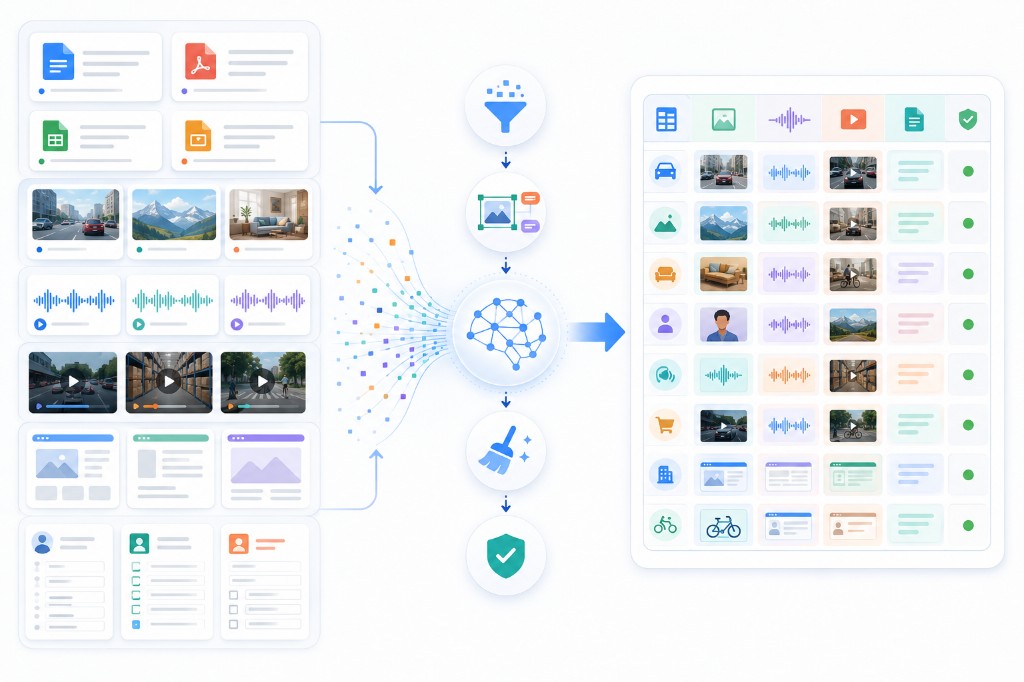
AI Training Data Collection Services
End-to-end dataset scoping, cleaning, validation, and ML-ready delivery beyond extraction alone.
View service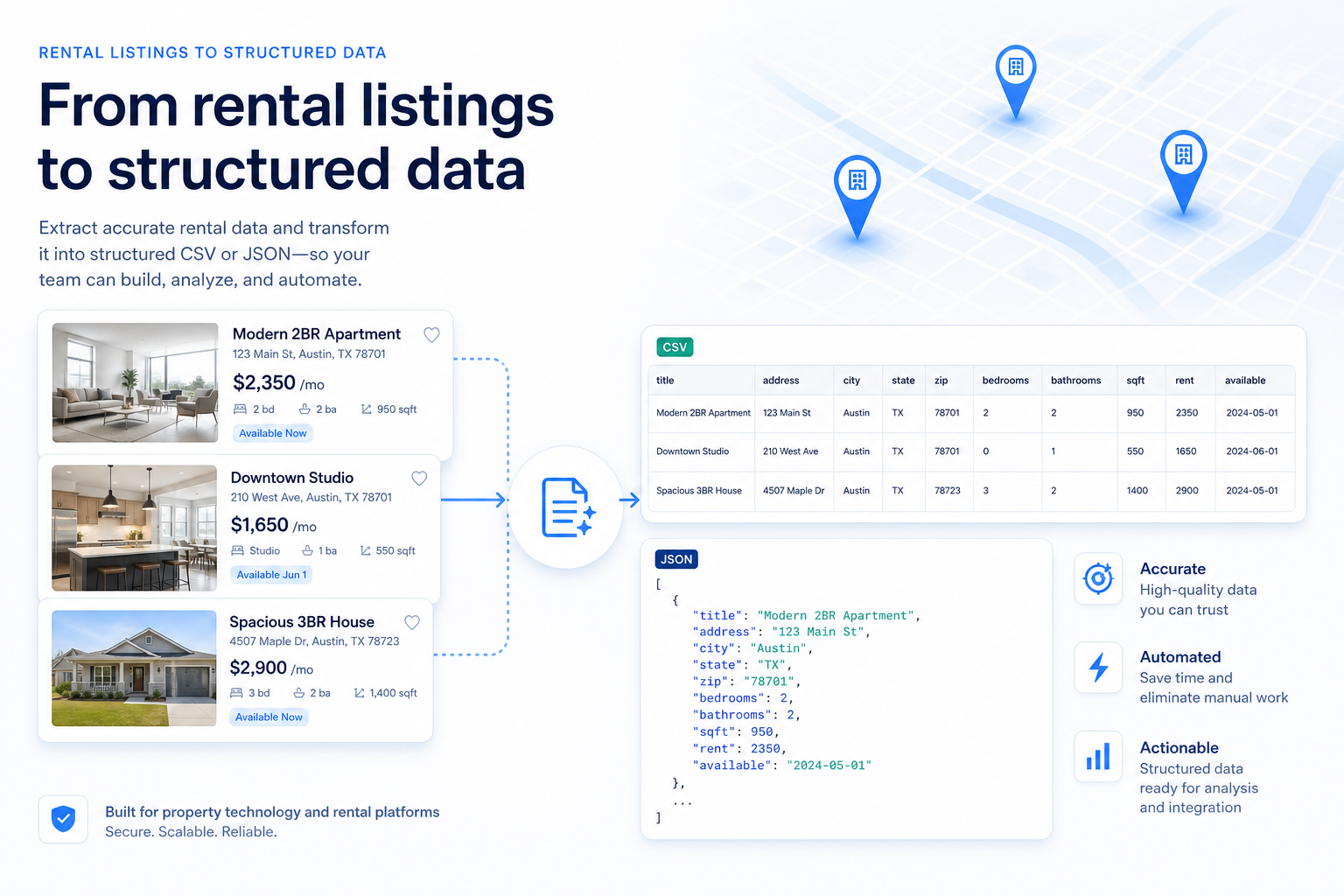
US Rental Property Data Scraping
Asking rent, availability, and change-history fields for structured rental feeds.
View service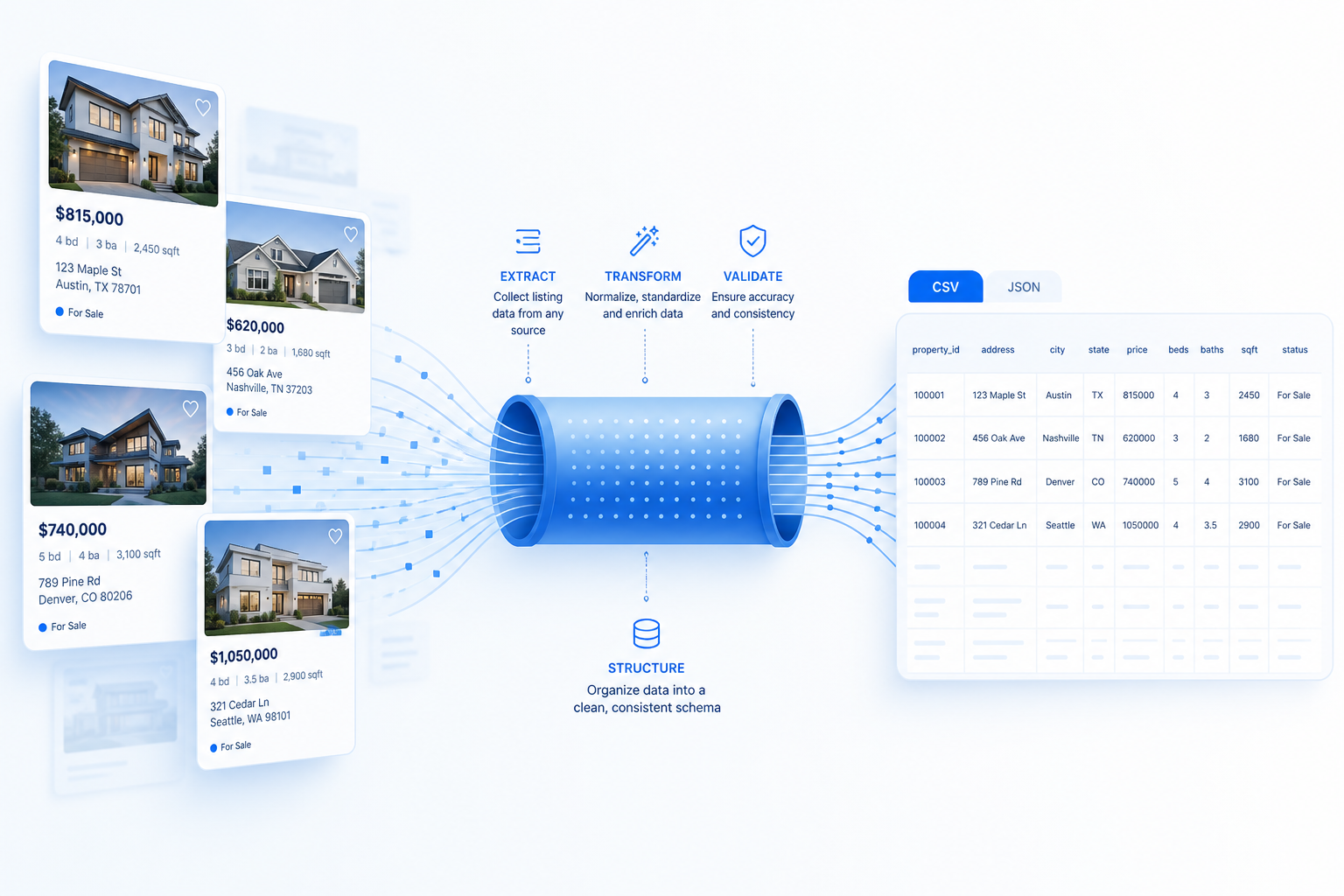
Zillow Data Scraping
Structured Zillow property records for monitoring, normalization, and downstream delivery.
View serviceFrequently asked questions
Start with representative sources
The right starting point is not a target record count. It is a defined use case, an approved source set, a clear schema, and measurable acceptance rules. Share several representative URLs, the information you need, and the way the dataset will be used.
Request an AI Dataset Sample