What Are Enterprise-Grade Web Scraping Solutions?
Unlike lightweight scripts, enterprise solutions are built for:
Large-scale extraction
High request volumes, broad site coverage, recurring refresh cycles across multiple sources.
Difficult target environments
JavaScript rendering, anti-bot controls, rate limiting, dynamic content.
Ongoing maintenance
Breakage, selector drift, schema changes, and monitoring so teams are not fixing scrapers every week.
Quality-controlled delivery
Cleaned, validated, structured data in usable formats for downstream systems.
Why Data Teams Need Enterprise-Grade Web Scraping
Data teams usually do not struggle with writing a parser. They struggle with sustaining a reliable pipeline over time.
Basic scraper → operational burden
Website changes
Parser breaks
Data quality risk
Engineering intervention
Downstream disruption
- 01
Websites change constantly
When sites redesign or alter structure, in-house jobs can fail without warning.
- 02
Reliability matters more than extraction alone
Incomplete or inconsistent data is often worse than no data for analytics and ML.
- 03
Infrastructure gets expensive
At scale, scraping requires proxy rotation, browser automation, concurrency controls, and failure handling.
- 04
Internal engineering time is expensive
Engineers should focus on models and analytics, not constant scraper repairs.
Common Use Cases for Data Teams
Commercial Intelligence
Pricing intelligence
Track competitor prices, promotions, availability, and assortment changes with automated competitor pricing data.
Market Intelligence
Market and trend monitoring
Monitor category shifts, consumer signals, product launches, content patterns.
Data Enrichment
Product and catalog enrichment
Improve product attributes, normalize listings, enrich catalogs with competitive fields.
Data Enrichment
Lead generation and sales intelligence
Structured data from directories and marketplaces for prospecting.
Commercial Intelligence
Competitive benchmarking
Monitor competitor pages, content changes, announcements, hiring activity.
AI / ML
AI and machine learning inputs
Feature generation, training datasets, retrieval pipelines, model evaluation.
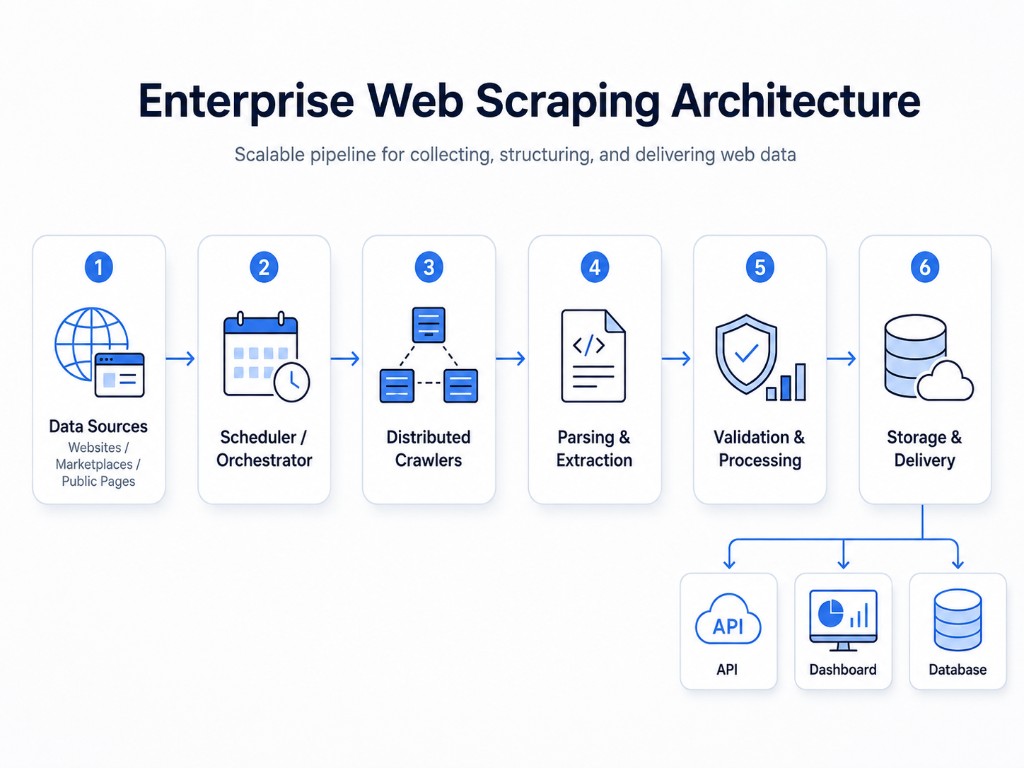
What Makes a Web Scraping Solution Truly Enterprise-Grade?
- 01
Collection Layer
Reliability on protected and dynamic websites
JavaScript rendering, anti-bot systems, CAPTCHAs, geo-restrictions.
- 02
Quality & Operations Layer
Monitoring and maintenance
Breakage detection, retries, alerting before bad data spreads.
- 03
Quality & Operations Layer
Data quality assurance
Schema validation, duplicate checks, anomaly detection.
- 04
Enterprise Layer
Business-ready delivery formats
JSON, CSV, APIs, cloud storage, warehouse-ready feeds.
- 05
Enterprise Layer
Compliance and governance support
Reviewable processes, clear ownership, responsible collection.
- 06
Collection Layer
Scalability and throughput
Support for average workloads and peak periods.
- 07
Quality & Operations Layer
Operational ownership
Clear accountability when data breaks.
APIs vs Managed Services vs Hybrid Models
Web scraping APIs are best for teams with engineering capacity who want flexibility. They reduce infrastructure burden but the team owns orchestration, parsing, and QA.
Managed services are best when the goal is data delivery, not scraper ownership. The provider handles QA, compliance, and maintenance.
Hybrid models work well for mature data teams—the provider handles difficult targets, the internal team manages transformations and warehouse integration.
API
Best for teams with engineering capacity who want flexibility. They reduce infrastructure burden but the team owns orchestration, parsing, and QA.
Managed service
Best when the goal is data delivery, not scraper ownership. The provider handles QA, compliance, and maintenance.
Hybrid
Useful when workloads vary by source complexity. The provider handles difficult targets; the internal team manages transformations and warehouse integration.
Choose API-led if your team wants control; managed service if you want outcomes; hybrid if workloads vary by source complexity.
How Data Teams Should Evaluate Enterprise Web Scraping Vendors
Target difficulty fit
Can the solution reliably access your actual target sites?
Question to ask
Does it work on the sites you actually need?
Time to first usable dataset
How fast from onboarding to production?
Question to ask
How quickly can you get a usable dataset?
Data quality workflow
Validation, QA, monitoring systems.
Question to ask
How is quality checked before delivery?
Refresh frequency support
Daily, hourly, or event-based refresh without degrading quality.
Question to ask
Can refresh match your operating cadence?
Delivery integration
Fit with warehouse, lakehouse, reverse ETL, ML pipeline.
Question to ask
Does delivery fit downstream systems?
Transparency
Failure modes, schema changes, incident handling.
Question to ask
How are failures and schema changes handled?
Cost predictability
Evaluate per-successful-page economics, not surface pricing alone.
Question to ask
What is the cost of usable output?
Compliance support
Responsible public web data collection approach.
Question to ask
How is responsible collection supported?
A Practical Implementation Framework for Data Teams
- 01
Step 1: Define the business question
Pricing, enrichment, market monitoring, training data, lead gen, benchmarking.
- 02
Step 2: Prioritize source tiers
Mission-critical vs important vs exploratory.
- 03
Step 3: Design the output schema first
Warehouse-ready fields, primary keys, deduplication, freshness.
- 04
Step 4: Set quality thresholds
Null rates, freshness windows, completeness, anomaly tolerances.
- 05
Step 5: Choose the right operating model
Fully managed, API-driven, or internal.
- 06
Step 6: Build monitoring into the pipeline
Success rate, schema drift, freshness, downstream load.
- 07
Step 7: Review ROI quarterly
Engineering time saved, decisions enabled, reliability gains.
KPIs That Matter for Enterprise Web Scraping
These are evaluation metrics for data teams comparing pipelines and vendors. They are not performance claims for any single provider.
Extraction success rate
How often the pipeline returns valid data.
Freshness SLA attainment
Data arrives within agreed refresh window.
Schema stability
How often site changes require remapping.
Completeness rate
Share of expected fields populated.
Time to recovery
Speed of restoring broken sources.
Cost per usable record
More helpful than raw request cost.
Engineering hours saved
Key when comparing managed vs internal.
- Reliable extraction
- Fresh data
- Stable schema
- Complete records
- Fast recovery
- Efficient cost
- Lower engineering burden
Common Mistakes Data Teams Make
Treating scraping as a side script instead of a production pipeline
Better framing
Treat it as production data infrastructure
Optimizing for cheapest access instead of usable output
Better framing
Evaluate cost per usable record, not surface pricing alone
Ignoring maintenance costs
Better framing
Plan for monitoring, selector drift, and ongoing maintenance
Underestimating anti-bot complexity
Better framing
Require reliability on protected and dynamic websites
Failing to align schema with downstream consumers
Better framing
Design the output schema first for warehouse and analytics use
FAQ: Enterprise Web Scraping for Data Teams
What are enterprise-grade web scraping solutions?
Enterprise-grade web scraping solutions are platforms or managed services that extract public web data at scale while handling reliability, anti-bot defenses, QA, compliance, monitoring, and business-ready delivery.
Why do data teams need enterprise web scraping instead of basic scripts?
Because enterprise workloads require stable, repeatable, high-quality data pipelines. Basic scripts often break when websites change or when scale, refresh frequency, and validation requirements increase.
What is the difference between a scraping API and a managed scraping service?
A scraping API gives your team a technical endpoint for extraction. A managed service owns more of the lifecycle—maintenance, QA, delivery, and operational responsibility.
What features should data teams prioritize?
Success rate on target sites, data quality controls, monitoring, delivery formats, compliance support, refresh frequency support, and clear operational ownership.
Are enterprise web scraping solutions useful for AI and analytics?
Yes. They can supply fresh public web data for analytics, pricing intelligence, enrichment, market monitoring, and AI or ML workflows.
How should enterprises evaluate providers?
Test providers against real target sites, compare quality workflows, measure usable-output cost, confirm refresh support, and understand who owns failure recovery.
Related Services
Conclusion
Enterprise-grade web scraping solutions are no longer just technical tools. For data teams, they are infrastructure choices that affect analytics quality, model performance, pricing visibility, and decision speed.
The strongest solutions are defined by how consistently they deliver trusted data with minimal operational drag.
If your team depends on public web data, the real question is not whether you can scrape a site. It is whether you can keep that data pipeline accurate, fresh, scalable, and useful over time. Contact us to learn how our enterprise web scraping solutions can support your data team.