FMCG Data Extraction Service for Retail Market Intelligence
Nenodata helps FMCG and CPG teams collect clean product, pricing, stock, promotion, and assortment data from public grocery, quick commerce, ecommerce, and retail sources — delivered in formats your team can use.
Why FMCG teams need structured retail data
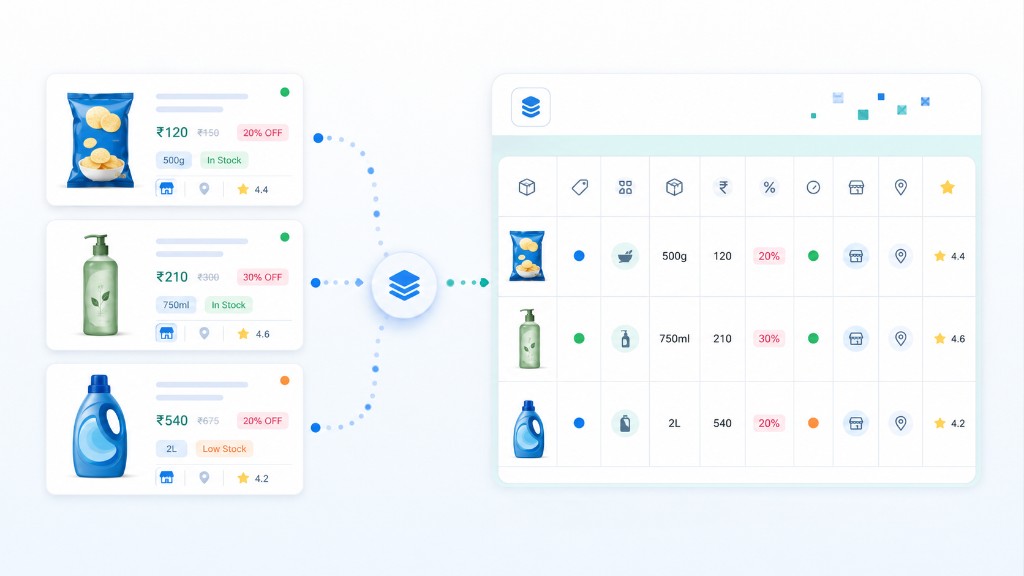
FMCG and CPG listings change by channel, location, retailer, promotion, pack size, stock status, and seller context. A value copied into a spreadsheet this morning may no longer represent the visible offer when a pricing, category, or analytics team reviews it later.
Manual collection becomes difficult when teams need to monitor assortments across channels, compare locations, preserve historical snapshots, or repeat the process across categories. Basic scripts create a different problem: page layouts change, fields become inconsistent, and maintenance consumes engineering time.
FMCG teams need stable field definitions, agreed collection schedules, and output that can move directly into pricing, assortment, analytics, and monitoring workflows without rebuilding the dataset each week.
For grocery-specific collection, see grocery delivery app scraping. For broader retail workflows, explore ecommerce data extraction and price intelligence solution.
What Nenodata Provides
Nenodata provides an FMCG Data Extraction Service for collecting product, pricing, stock, promotion, assortment, and review signals from approved public or authorized retail sources. You define the channels, locations, fields, refresh expectations, and delivery destination. Nenodata scopes the workflow, structures the output, and delivers it on the agreed schedule.
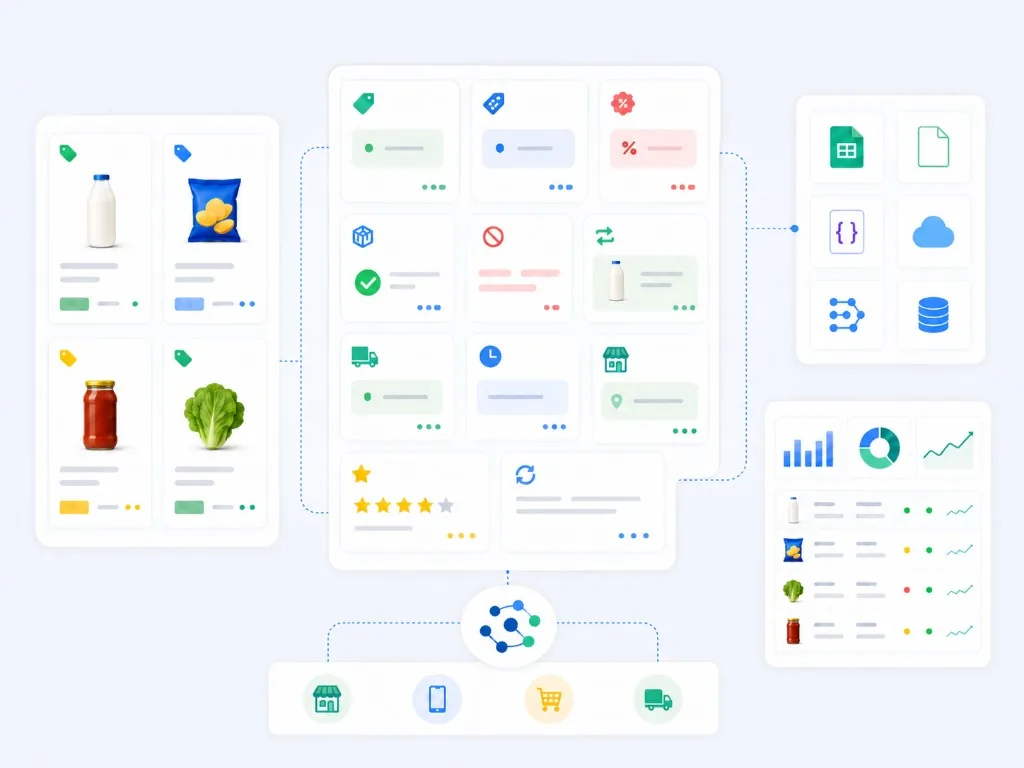
Depending on project scope, outputs can include product names, brands, categories, SKUs, pack sizes, listed prices, discount and promotion text, stock signals, location context, ratings, review counts, seller or retailer identifiers, and assortment signals where those elements are available and included in the approved scope.
Supported sources, countries, platforms, and delivery formats are confirmed during scoping rather than assumed in advance.
Sample output structure
Use an illustrative sample to confirm field names, channel coverage, and output format before configuring a larger recurring workflow.
| Product | Price | Discount | Stock | Location | Timestamp |
|---|---|---|---|---|---|
| Example product | Example value | Example discount | Example status | Example market | YYYY-MM-DDTHH:MM:SSZ |
{
  "collection_timestamp": "YYYY-MM-DDTHH:MM:SSZ",
  "source_channel": "Example retail channel",
  "location_input": "Example market or service area",
  "retailer_or_seller": "Example retailer",
  "product_name": "Example product",
  "brand": "Example brand",
  "category": "Example category",
  "sku_or_id": "Example identifier",
  "pack_size": "Example size",
  "listed_price": "Example value",
  "discount_text": "Example discount",
  "promotion_text": "Example promotion",
  "stock_status": "Example status",
  "average_rating": "Example value",
  "review_count": "Example value",
  "product_url": "Example public URL"
}
Full illustrative field list
collection_timestamp,
source_channel,
location_input,
retailer_or_seller,
product_name,
brand,
category,
sku_or_id,
pack_size,
listed_price,
discount_text,
promotion_text,
stock_status,
average_rating,
review_count,
product_url
Field availability can vary by source, market, platform, and project scope.
Data Fields and Outputs
Actual availability should be confirmed against target sources during scoping.
Product information
- • Product name
- • Brand
- • Category path
- • SKU or product identifier
- • Pack size or unit size
- • Product description
- • Product page URL
Pricing and promotions
- • Listed price
- • Discount text
- • Promotion text
- • Previous or comparison price
- • Unit-price information where available
- • Observation timestamp
Inventory and availability
- • Stock status
- • Out-of-stock indicators
- • Substitution signals where publicly displayed
- • Inventory update context where available
- • Channel or storefront identifier
Delivery and location
- • Location or market input
- • Delivery fee indicators where publicly displayed
- • Delivery window signals where publicly displayed
- • Store or service-area context
- • Retailer or seller context
Ratings and reviews
- • Average rating
- • Review count
- • Rating distribution where available
- • Review excerpts where publicly displayed and scoped
Assortment and seller/retailer
- • Seller or retailer name
- • Assortment or category listing signals
- • Brand page or reseller listing context
- • Search or category result context
- • Channel source identifier
Platform and Source Coverage
Potential source types are confirmed during scoping. The final source list should be approved before launch.
Grocery and quick commerce
Grocery delivery platforms and quick-commerce storefronts where publicly accessible and included in approved scope.
Ecommerce marketplaces
Marketplace product pages, category results, and seller listings relevant to FMCG monitoring workflows.
Retailer and supermarket sites
Online supermarket pages, retailer websites, and public product listings scoped to the target market.
Brand and reseller pages
Brand pages, reseller listings, and public product pages used for assortment and availability review.
Use cases
Competitor price monitoring
Bring current prices, discounts, and promotion context from relevant FMCG listings into one dataset so pricing teams can compare channels and decide where a response is warranted.
Assortment intelligence
Organize category or keyword-based results into structured records that support assortment review, gap analysis, and category performance reporting.
Promotion tracking
Capture promotion and discount signals so commercial teams can study campaign patterns across channels and respond with better context.
Stock and availability monitoring
Record stock signals across monitored products and locations to support replenishment review and retailer reporting.
Category benchmarking
Compare price bands, pack sizes, and listing signals within a category to support category management and planning workflows.
Retail market research
Build research datasets from scoped retailers and channels to study brands, price ranges, and listing signals for analytics workflows.
Who This Is For
This service fits FMCG brands, CPG manufacturers, retail analytics teams, pricing teams, category managers, market research firms, and data teams that depend on regularly refreshed public retail data.
It also supports software platforms that need structured FMCG listing information without dedicating internal engineering capacity to maintaining a separate collection workflow.
How It Works
Share requirements
Define target channels, locations, product groups, required fields, preferred output format, refresh expectations, and delivery destination so Nenodata can scope the workflow and proposed schema.
Configure collection
Nenodata sets up the extraction workflow around the agreed input model. Targets may include product URLs, categories, keywords, retailers, or a recurring monitored product set.
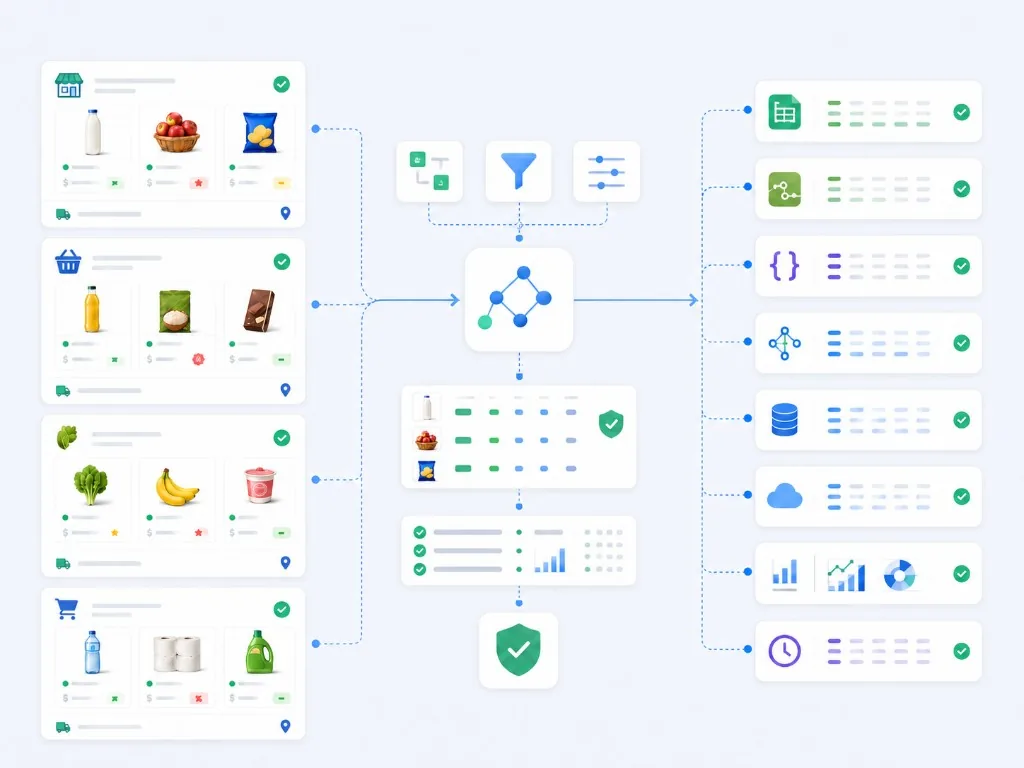
Clean and validate
Collected records are standardized, reviewed for completeness, and prepared in the agreed structure. Duplicate or inconsistent entries can be reduced before delivery.
Deliver and maintain
Receive output once or on a recurring schedule via agreed formats and destinations. Nenodata maintains the configured workflow as sources and requirements evolve.
Why Choose Nenodata
Scoped source review first
Projects begin with the channels, markets, and fields that matter to your team—not a promise to extract every FMCG source without scoping.
Schema-ready outputs
Records are organized for analysis and downstream workflows. Your team can define naming conventions, required identifiers, and the structure expected by its systems.
Normalization during delivery
Collected data can be cleaned, deduplicated where applicable, and validated against agreed rules defined during scoping.
FMCG and CPG context
Workflows can account for pack sizes, channel variation, location-sensitive listings, and other retail factors defined during the project.
Sample-first buying path
Request a free data sample with the sources, fields, locations, categories, and preferred format needed before committing to a larger workflow.
Approved source scope
Collection is limited to public or authorized sources relevant to the agreed business purpose. Private, account-protected, restricted, or personal information should not be included in the project scope.
Explore quick commerce FMCG data extraction, Instacart data scraping, Blinkit data scraping, Carrefour data scraping, web scraping services, custom data pipelines, and all Nenodata services.
Integrations and Delivery
Delivery formats and destinations are confirmed during scoping. Projects may support CSV, Excel, JSON, and API integration where agreed. Database, warehouse, and BI-ready delivery should be confirmed for each engagement.
Teams often combine FMCG data workflows with grocery delivery collection, ecommerce extraction, and custom pipeline work depending on the use case.
Frequently asked questions
Request a scoped FMCG data sample
Share target platforms, locations, required fields, preferred format, and refresh expectations when you contact Nenodata so the team can scope the workflow accurately.
- Target platforms or channels
- Locations or markets
- Required fields
- Preferred output format
- Refresh expectations