Restaurant Data Scraping for Location, Hours and Ratings
Nenodata helps teams collect, clean, validate, and deliver public or permissioned restaurant location, hours, ratings, cuisine, and marketplace presence data for market intelligence and product workflows. For menu-item and modifier extraction, see Restaurant Menu Data Scraping.
Why manual restaurant data monitoring breaks down
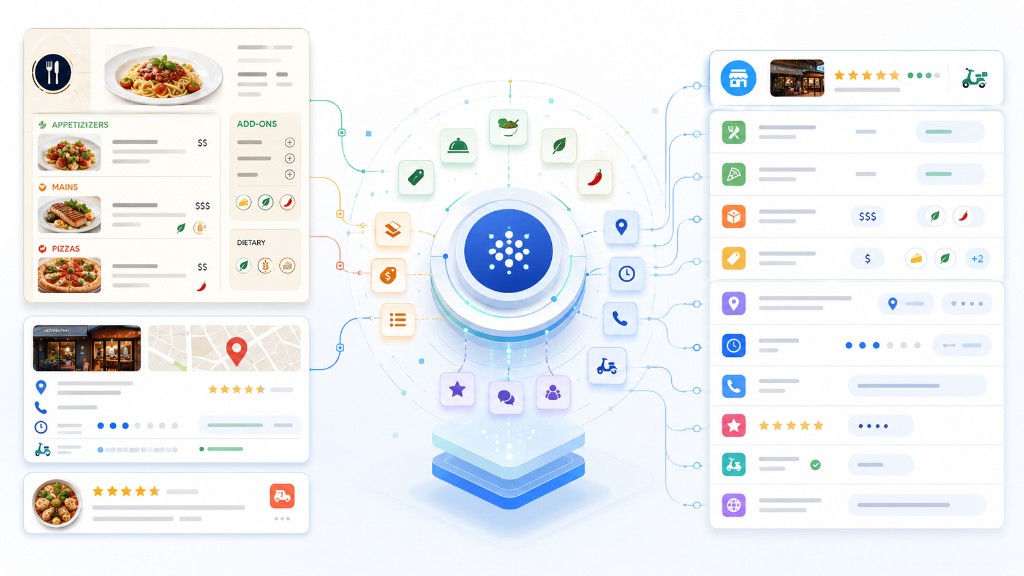
Restaurant menus, prices, hours, locations, and review signals change frequently across brand sites, listing directories, delivery marketplaces, and review platforms. A menu price copied manually into a spreadsheet may no longer match the visible listing when a pricing or market intelligence team reviews it later.
Manual monitoring becomes difficult when teams need to track items across locations, compare channels, preserve historical snapshots, or repeat collection across markets. Basic scripts struggle when page layouts change, menu depth varies by location, fields are labeled inconsistently, and maintenance consumes engineering time.
Restaurant Data Scraping Services Built Around Your Sources
Nenodata builds managed restaurant data workflows around the sources, markets, locations, menu fields, and delivery requirements your team defines. That includes target websites, public listings, review sources, delivery marketplaces, or customer-provided source lists evaluated during scoping.
Depending on approved scope, outputs can include restaurant profile fields, addresses, hours, menu categories, item names, descriptions, prices, modifiers, promotions, ratings, review counts, delivery signals, and source metadata where those elements are publicly visible or permissioned and included in the agreed schema.
Source feasibility, field availability, refresh cadence, and delivery formats are confirmed during scoping and sample review rather than assumed in advance.
Learn more about enterprise web scraping for broader extraction workflows where appropriate. Need menu-only workflows? See restaurant menu data scraping.
Restaurant profile vs menu and food-delivery hubs
Use this page for restaurant profile, address, hours, cuisine, and ratings across listing sources. Use restaurant menu scraping for item and modifier lines, or the food-delivery hub for multi-app menu economics.
| Source | Best for | Learn more |
|---|---|---|
| Restaurant data services | Location, hours, cuisine, ratings, marketplace presence | This service |
| Restaurant menu scraping | Menu categories, item names, prices, and modifiers | Restaurant menu scraping |
| Food-delivery hub | Multi-app menus, fees, and ETA — not profile directories | Food delivery scraping |
Sample output / proof
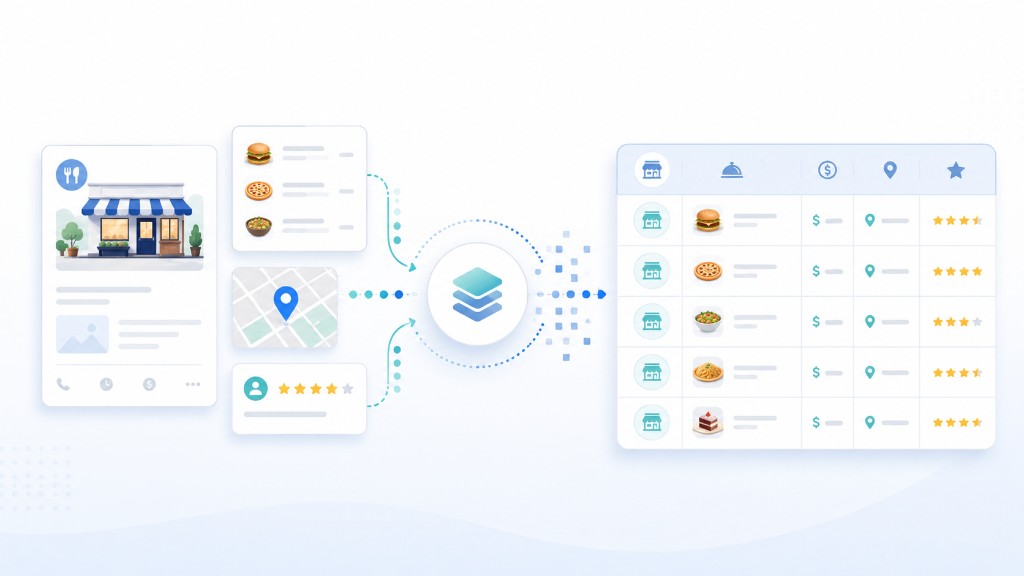
Use an illustrative sample to confirm field names, source coverage, location and hours depth, and output format before configuring a larger recurring workflow.
| Restaurant | City | Cuisine | Hours | Rating | Reviews | Timestamp |
|---|---|---|---|---|---|---|
| Joe's Pizza | New York | Pizza | 11:00–23:00 | 4.5 | 2140 | 2026-08-17T14:00:00Z |
{
  "collection_timestamp": "2026-08-17T14:00:00Z",
  "source_name": "Public restaurant listing",
  "restaurant_name": "Joe's Pizza",
  "restaurant_id": "joes-pizza-broadway",
  "cuisine": "Pizza",
  "address": "7 Carmine St",
  "city": "New York",
  "state_or_region": "NY",
  "postal_code": "10014",
  "phone": null,
  "hours_text": "11:00–23:00",
  "average_rating": "4.5",
  "review_count": "2140",
  "marketplace_presence": "Delivery apps listed",
  "source_url": "https://www.yelp.com/biz/joes-pizza-new-york-4"
}
Illustrative CSV-style field list
collection_timestamp,
source_name,
restaurant_name,
restaurant_id,
cuisine,
address,
city,
state_or_region,
postal_code,
phone,
hours_text,
average_rating,
review_count,
marketplace_presence,
source_url
Field availability can vary by source, location, menu depth, and project scope.
Data fields and outputs
Actual availability should be confirmed against target sources during scoping.
Restaurant profile
- • Restaurant name and identifier
- • Brand or chain where displayed
- • Cuisine or category tags
- • Phone and website where shown
- • Source URL
- • Collection timestamp
Location data
- • Street address
- • City, state or region, postal code
- • Country where displayed
- • Coordinates where publicly shown
- • Delivery zone or service area text
- • Branch or location identifier where available
Menu data
- • Menu category or section
- • Item name and description
- • Modifiers or size options where displayed
- • Dietary flags where shown
- • Item availability signals
- • Menu depth context by location
Pricing data
- • Item price
- • Currency
- • Promotion or discount text
- • Combo or bundle pricing where displayed
- • Tax or fee text where shown
- • Price change context via timestamps
Reviews and ratings
- • Average rating
- • Review count
- • Rating distribution where available
- • Review excerpts where publicly displayed and scoped
- • Sentiment or tag signals where shown
Delivery and marketplace signals
- • Delivery fee text where displayed
- • Estimated delivery time where shown
- • Marketplace or channel name
- • Pickup vs delivery indicators
- • Promotion text on marketplace listings
Source and quality metadata
- • Source platform or channel name
- • Search or market input context
- • Record identifier where available
- • Validation or completeness flags where scoped
- • Last-seen timestamp
Delivery formats
- • CSV or Excel for analyst workflows
- • JSON for engineering pipelines
- • API-ready structured records
- • Scheduled feeds where scoped and confirmed
- • Database or warehouse-ready files where confirmed
Use cases
Menu price monitoring
Track item prices and promotions across scoped restaurant sources and locations to support pricing intelligence and competitive response workflows.
See price intelligence for broader pricing workflows, or restaurant menu data scraping for menu-focused delivery.
Location intelligence
Build structured location datasets with addresses, hours, and branch context for market coverage and expansion analysis.
Review and rating tracking
Include ratings and review counts where permitted so brand and customer insight teams can monitor listing sentiment alongside menu and location context.
Explore review and social data extraction.
Food delivery marketplace intelligence
Organize marketplace listing results into structured records that support channel comparison and delivery-fee analysis where publicly displayed.
See grocery delivery app scraping for related marketplace patterns where scoped.
Restaurant database enrichment
Enrich internal restaurant records with scoped public fields such as menus, locations, hours, and ratings for product and analytics workflows.
Competitive benchmarking
Compare menu breadth, price ranges, and location signals across agreed competitor sets using cleaned, field-consistent records.
Who this is for
This service fits food and beverage brands, restaurant chains, delivery marketplace teams, market intelligence firms, location analytics groups, and product teams that need structured restaurant, menu, price, location, and review data from scoped public or permissioned sources.
It also supports organizations that want monitored restaurant feeds without dedicating internal engineering capacity to maintaining brittle collection scripts across changing sites and listing platforms.
How it works
Share requirements
Define target sources, markets, locations, required fields, menu depth expectations, refresh needs, and delivery destination so Nenodata can scope the workflow.
Review sources
Nenodata evaluates source feasibility, access rules, page behavior, and field availability before confirming the proposed schema and collection approach.
Extract and structure
Collected records are parsed, standardized, and organized in the agreed structure. Menu, location, and pricing fields are prepared for downstream use.
Validate and deliver
Output is reviewed for completeness and delivered via agreed formats and schedules. Nenodata maintains the configured workflow as sources and requirements evolve.
Why choose Nenodata
Source review before scale-up
Projects begin with a review of target websites, listings, and fields—not a promise to collect every restaurant source without scoping.
Structured for downstream workflows
Records are organized for pricing, location analysis, enrichment, and reporting. Field naming and structure can align with your destination systems once confirmed.
Less maintenance burden
Restaurant and menu pages can change layouts and behavior. A managed workflow can include monitoring and maintenance planning beyond a one-off script.
Validation before delivery
Collected data can be cleaned, deduplicated where applicable, and reviewed against agreed rules defined during scoping and sample review.
Delivery built around your stack
Output formats and destinations are agreed before production delivery. CSV, JSON, API-ready records, and scheduled feeds can be discussed during scoping.
Careful public-data framing
Collection is scoped around public or permissioned sources. Private, restricted, login-gated, or protected data should remain outside the project scope.
Integrations and delivery
Depending on approved scope, structured restaurant data may flow from agreed sources through Nenodata extraction and validation into the delivery formats your team uses for analytics, enrichment, or product workflows.
Teams often combine restaurant data workflows with price intelligence, review extraction, ecommerce data collection, and market intelligence depending on the use case.
- • CSV or Excel for analyst workflows
- • JSON for engineering and product pipelines
- • API-ready structured records where scoped
- • Scheduled feeds and webhook workflows where confirmed
- • Database or warehouse-ready files where confirmed
Explore ecommerce data extraction, market intelligence, and contact Nenodata to discuss formats confirmed during scoping.
FAQ
Ready to turn restaurant, menu, price, location, and review data into a structured workflow?
Share target sources, required fields, markets, locations, refresh needs, and preferred delivery format when you contact Nenodata so the team can scope the workflow accurately.