Real Estate Data Scraping Services for Structured Property Data
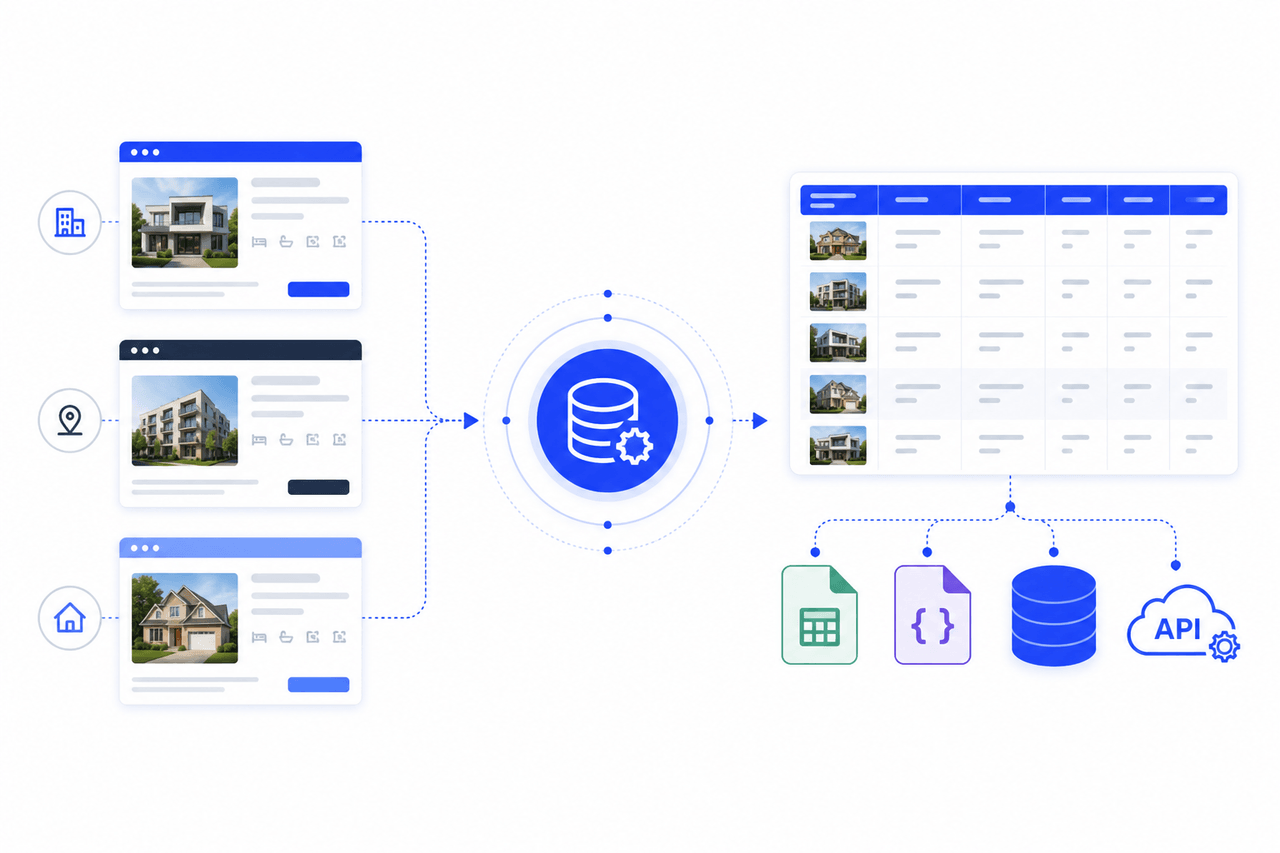
Property information is spread across listing portals, brokerage websites, regional marketplaces, directories, and customer-authorized feeds. A real estate data scraping service collects the required records, converts inconsistent fields into an agreed schema, and delivers data that product, analytics, investment, or operations teams can use.
Nenodata scopes custom property-data workflows around the required sources, markets, fields, update schedule, and delivery destination. Source support and field availability are confirmed before implementation rather than assumed.
What a real estate data scraping service should provide
A scraping service should deliver more than copied text or a collection of page URLs. The output should be structured, traceable, and suitable for the customer's intended workflow.
A typical managed project includes:
- Reviewing the target sources and access conditions
- Defining the required fields and output schema
- Collecting agreed listing or search pages
- Parsing property information into separate fields
- Standardizing values and formats
- Applying agreed validation rules
- Identifying duplicate or repeated records where included in scope
- Comparing records across collection runs when monitoring is required
- Delivering the output in the agreed format
- Maintaining the workflow as supported source layouts change
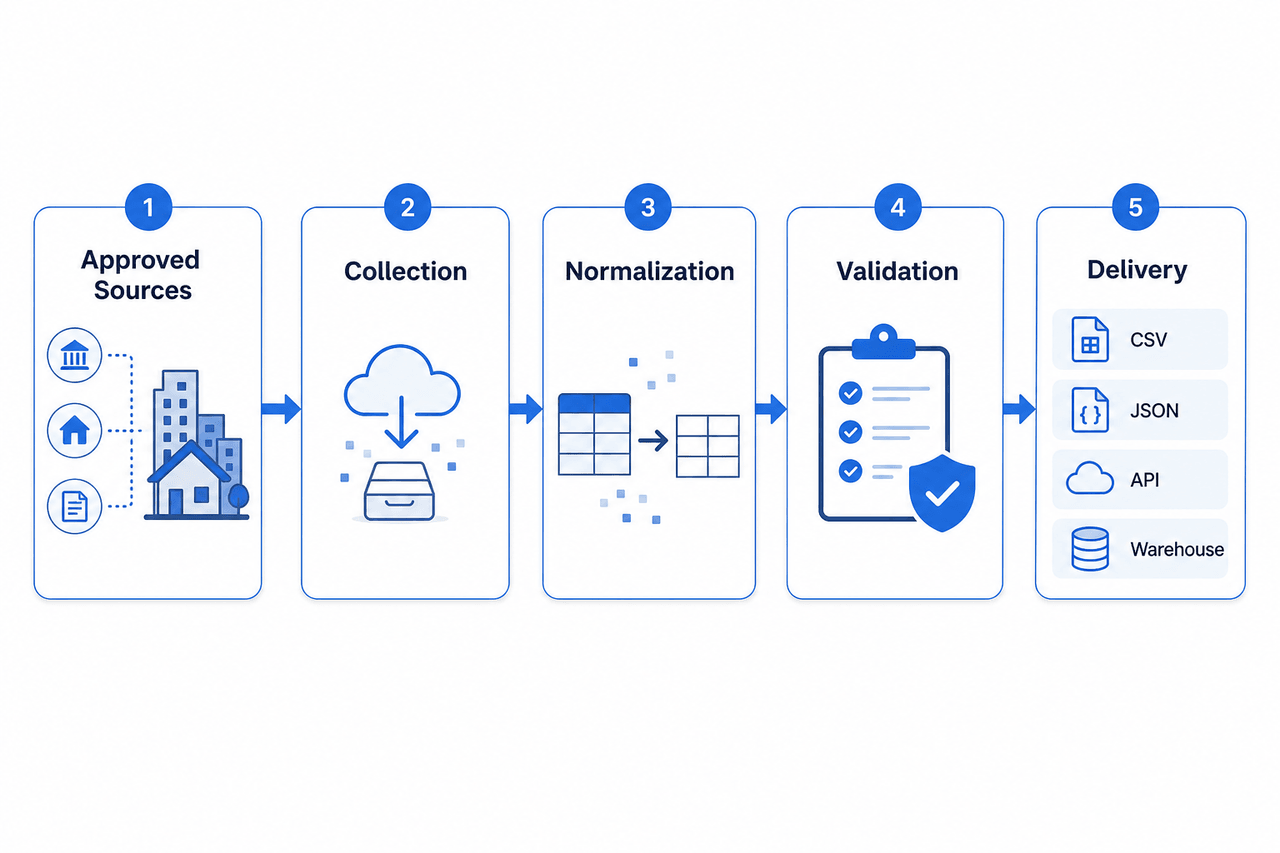
Nenodata's current real-estate pages describe custom extraction from approved public or permissioned sources, with structured delivery through options such as CSV, JSON, API-oriented feeds, scheduled feeds, and custom pipelines. Final formats and refresh requirements are confirmed during project scoping. See enterprise web scraping for the underlying extraction capability.
Property data that may be collected
The available fields depend on the source, market, property type, and access conditions. A practical schema may include the following categories.
Listing details
- • Source listing ID
- • Listing URL
- • Listing title
- • Description
- • Listing status
- • Date published or updated
- • First-seen timestamp
- • Last-seen timestamp
Pricing information
- • Asking price
- • Rental price
- • Currency
- • Previous observed price
- • Price-change value
- • Price per unit of area
- • Displayed fees or deposits
Property characteristics
- • Property type
- • Bedrooms
- • Bathrooms
- • Living area
- • Lot area
- • Year built
- • Parking
- • Amenities
- • Furnishing status
- • Commercial asset category
Location fields
- • Street address
- • Neighborhood
- • City
- • County
- • State
- • Postal code
- • Country
- • Latitude and longitude where displayed or otherwise approved
Agent and brokerage context
- • Agent name
- • Brokerage name
- • Office name
- • Profile URL
- • Source-provided business contact details
- • Listing attribution
Where displayed and permitted. Field availability must be assessed source by source.
Nenodata's Trulia-focused service page states that pricing, listing status, property attributes, agent or brokerage context, and source metadata may be structured when those fields are available on approved sources. See Trulia data extraction for source-specific context.
Why raw property data needs normalization
Real-estate sources often represent equivalent information differently. Without normalization, those variations make filtering, comparison, reporting, and product integration unreliable.
| Raw source variation | Normalized approach |
|---|---|
| $625,000, $625K, and 625000 | Numeric price with currency code |
| 3 Beds, 3 bd, and Bedrooms: 3 | Standardized bedroom count |
| For Sale, Active, and Available | Mapped listing status taxonomy |
| 1,850 sq ft and 1850 sqft | Standardized area with unit |
| Full state names and postal abbreviations | Consistent location codes |
Nenodata's broader services page describes custom transformations, validation, structured delivery, and custom data pipelines, but any exact quality or performance claims require separate human approval.
Data-quality rules to define before collection
"Accurate data" is too vague to use as a project requirement. Buyers should agree on measurable validation rules.
- •Price must be numeric when present.
- •Currency must use an agreed code.
- •Required URLs must be retained.
- •Timestamps must follow one standard.
- •Known listing statuses must map to an approved taxonomy.
- •Unexpected values must be flagged rather than silently changed.
- •Required fields must meet an agreed completeness rule.
- •Duplicate source listing IDs must be identified.
- •Source values must remain traceable when normalization is applied.
The provider should also explain how it handles missing values. A reliable workflow should return a null or an exception state rather than inventing unavailable property information.
What to inspect in a sample
Before approving a recurring project, review a representative output for:
A real sample is more useful than a broad accuracy promise.
Listing monitoring and change history
A recurring property-data workflow can compare each accepted record with the previous collection run.
Useful change types
- • New listing
- • Price increase
- • Price decrease
- • Listing-status change
- • Agent or brokerage change
- • Property-detail change
- • Listing no longer observed
- • Listing reappeared
Monitoring requirements to define
- • Collection frequency
- • Record identity
- • Which fields are compared
- • How changes are classified
- • How removals are handled
- • How long history is retained
- • How alerts or updates are delivered
A "not observed" state should not automatically be interpreted as a sale. A record may disappear because it was withdrawn, expired, relocated, temporarily unavailable, or affected by a collection failure. Nenodata publicly positions its real-estate workflows for listing, price, and status monitoring, but the exact cadence and history available for a project must be confirmed during scoping.
Real estate data scraping use cases
Property marketplaces and PropTech products
Structured listing feeds can support:
- • Property search
- • Filtering
- • Map-based discovery
- • Listing comparison
- • New-listing alerts
- • Market expansion
- • Source-coverage analysis
The output schema must be stable enough for the receiving product, and source attribution should be preserved.
Property investment research
Investment teams may use listing data to compare:
- • Asking prices
- • Property characteristics
- • Geographic coverage
- • Price changes
- • Listing statuses
- • Days observed
- • Rental signals
Listing data should not be presented as authoritative ownership, transaction, deed, tax, mortgage, valuation, or parcel data unless it comes from an appropriate licensed, government, partner, or customer-authorized source.
Rental market monitoring
A rental-data workflow may track:
- • Advertised rent
- • Property or unit characteristics
- • Availability
- • Listing additions
- • Listing removals
- • Price changes
- • Neighborhood coverage
Teams should distinguish advertised rent from contracted rent and account for duplicates, relisted properties, stale pages, and incomplete availability.
Brokerage operations
Brokerages and related service providers may use scoped property data for:
- • Listing audits
- • Market coverage analysis
- • CRM enrichment
- • Internal reporting
- • Public agent or office directories
- • Listing-status checks
Private brokerage, account, or MLS data must not be treated as publicly accessible merely because related listings appear online.
Commercial real estate research
Depending on the source, commercial property records may include:
- • Property or asset type
- • Building size
- • Lot size
- • Asking price
- • Displayed lease rate
- • Building class
- • Broker details
- • Location
- • Availability status
Commercial sources often use different taxonomies and field structures. They usually require a source-specific schema rather than a single universal template.
For app and marketplace requirements, see real estate app data scraping.
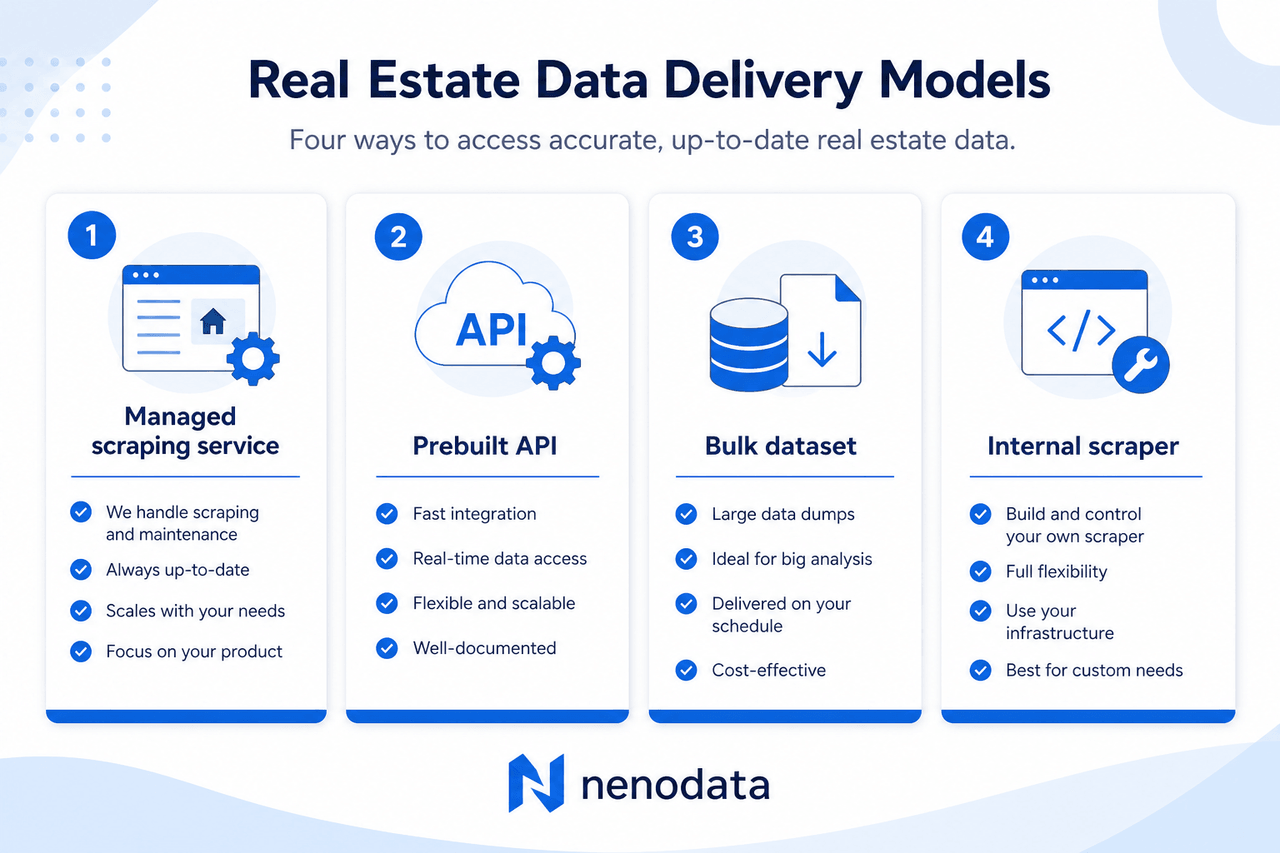
Managed service, API, dataset, or internal scraper?
The correct delivery model depends on the source and how much work the customer wants to manage.
| Option | Best suited to | Main advantage | Main limitation |
|---|---|---|---|
| Managed scraping service | Teams needing specific sources, fields, and recurring maintenance | The provider manages extraction and supported maintenance | Requires project scoping |
| Prebuilt real estate API | Products whose needs match the API's existing coverage and schema | Faster integration | Coverage, fields, licensing, and limits may be fixed |
| Bulk dataset | Historical analysis or periodic research | Large volume delivered together | May become outdated |
| Commercial data platform | Users who need a ready-made research interface | Built-in search and analysis | Export, licensing, and customization may be limited |
| Internal scraper | Engineering teams requiring direct implementation control | Full control over architecture | Ongoing engineering and maintenance burden |
A managed service is generally a better fit when:
- •The sources are specific or regional.
- •The required fields do not match a standard API.
- •Several sources require one normalized schema.
- •Price or status changes must be monitored.
- •Data must be delivered into an existing product or warehouse.
- •The customer does not want to maintain scraping infrastructure.
Delivery options
The appropriate format depends on how the customer will consume the data.
CSV or Excel
Useful for:
- • Sample review
- • Analyst workflows
- • One-time exports
- • Small recurring deliveries
JSON
Useful for:
- • Development workflows
- • Nested property records
- • Prototypes
- • API-oriented integration
API-oriented delivery
Potentially useful for property applications, search products, internal tools, and CRM enrichment. Before approving API delivery, confirm:
- • Authentication
- • Pagination
- • Schema versioning
- • Error handling
- • Usage limits
- • Update behavior
- • Historical access
- • Availability commitments
Scheduled pipeline delivery
Recurring records may be scoped for delivery into:
- • Cloud storage
- • Databases
- • Data warehouses
- • Internal dashboards
- • Business intelligence workflows
- • Customer systems
See custom data pipelines and web scraping API for recurring database, warehouse, and API-oriented delivery paths.
Common project mistakes
Requesting "all available data"
This creates an undefined scope and makes quality difficult to assess. Instead, classify fields as required, optional, derived, or unavailable without separate enrichment.
Assuming every source contains the same fields
One site may expose coordinates, lot area, or agent details while another does not. Require source-level field coverage rather than one blended completeness figure.
Treating listing data as verified public-record data
A portal listing may contain marketing information and an asking price. It may not confirm ownership, a completed transaction, a deed, a mortgage, or an official valuation. Use the appropriate licensed or government source when authoritative records are required.
Omitting collection timestamps
Without collected_at, first_seen_at, or last_seen_at, the receiving team may not know whether a record is current. Make timestamp rules part of the schema.
Assuming an absent listing has sold
Use neutral change states until the outcome can be confirmed through an approved source.
Using "real time" without defining a cadence
Specify the operational requirement in hours, days, or another measurable interval. Feasibility depends on the source, volume, access conditions, and delivery architecture.
Source access, privacy, and permitted use
A property-data project should be reviewed according to source access method, applicable source terms, public or permissioned status, authentication requirements, data type, personal-information exposure, intended use, storage and retention, republishing or redistribution, relevant jurisdictions, and contractual restrictions.
Public accessibility does not by itself establish that every collection method or commercial use is permitted. For authorized MLS-related workflows, see MLS listing data extraction.
This section provides project-planning information, not legal advice. Obtain qualified legal guidance for the specific sources and intended use.
What determines the project scope?
Fixed pricing, refresh frequency, completeness, or delivery commitments should not be published before these variables are reviewed:
- •Number and type of sources
- •Countries, cities, ZIP codes, or other markets
- •Required search combinations
- •Property categories
- •Number of fields
- •Page and record volume
- •Collection schedule
- •Historical backfill
- •Change-history requirements
- •Normalization rules
- •Duplicate handling
- •Validation requirements
- •Delivery format
- •Monitoring and maintenance needs
What to send when requesting a sample
- Target URLs or source categories
- Countries, states, cities, ZIP codes, or neighborhoods
- Residential, rental, commercial, land, or other property types
- Must-have and optional fields
- Search filters
- Estimated page or record volume
- Required collection frequency
- Snapshot, history, or monitoring requirements
- Preferred delivery format
- Intended business use
- Relevant source permission or authorization details
- Criteria for accepting the sample
How Nenodata supports custom property-data workflows
Nenodata is best suited to requirements that need source-specific extraction rather than a fixed, prepackaged property database.
- Custom listing-data extraction
- Source and field scoping
- Property price and status signals
- Data cleaning and normalization
- Structured CSV or JSON delivery
- API-oriented feeds
- Scheduled delivery
- Custom data pipelines
Explore real estate data intelligence services, real estate app data scraping, MLS listing data extraction, and Trulia data extraction. Nenodata should not be presented as a universal substitute for licensed MLS feeds, government property records, or commercial real-estate intelligence platforms.
Frequently asked questions
Request a property data sample
Send Nenodata your target sources, geography, required fields, expected volume, collection schedule, delivery format, and intended use. The team can review the requirement, assess source feasibility, and determine whether a representative property-data sample can be prepared.