Custom Data Pipelines for Structured Delivery
Nenodata designs, builds, and maintains Custom Data Pipelines that turn approved public or permissioned sources into validated records for your warehouses, databases, APIs, and BI tools. For hosted scraper operations, see cloud hosted web scraping. For post-deployment health checks, see pipeline observability.
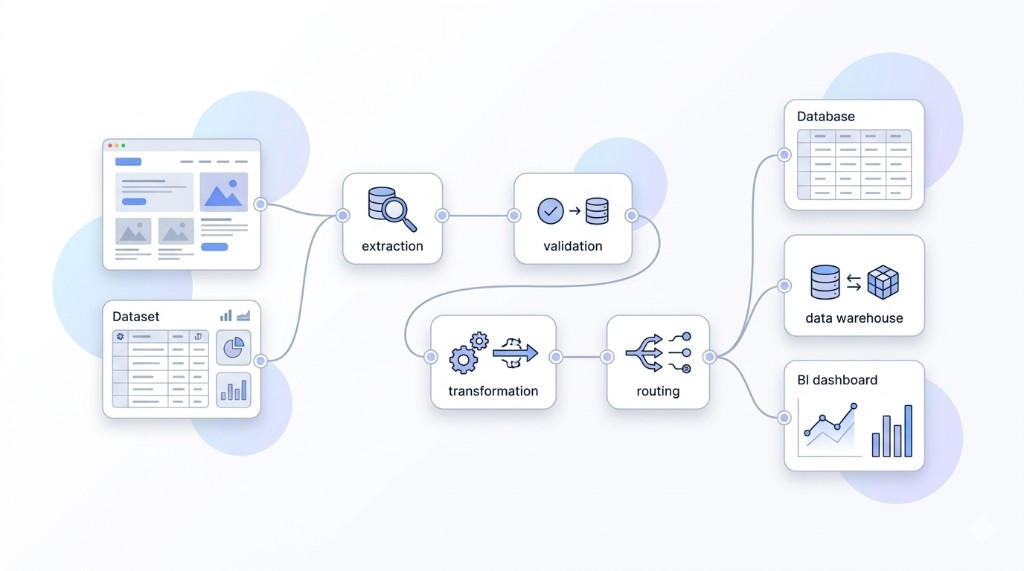
One-off scripts do not scale into reliable production feeds
Teams often start with a scraper script that works for a demo, then discover that production needs retries, schema contracts, destination loading, monitoring, and ownership when layouts change.
Without a defined pipeline, extraction, cleaning, and delivery stay fragmented across engineers and spreadsheets—creating silent gaps when fields drift or destinations reject payloads.
A managed custom pipeline scopes sources, fields, cadence, and destinations first, then ships a repeatable workflow your analytics and product systems can trust.
What Custom Data Pipelines include
Nenodata scopes approved sources, required fields, transformation rules, validation checks, refresh cadence, and delivery destinations before production deployment.
Pipelines can combine collection, normalization, enrichment hooks, and destination loading so downstream teams receive records in an agreed schema—not raw page dumps.
Maintenance and monitoring can be included when layout changes or destination requirements evolve. Observability can be layered on through a separate scoped engagement.
For extraction-first work, see enterprise web scraping. For hosted collection operations, see cloud hosted web scraping. For recurring curated feeds, see Data-as-a-Service solutions.
Illustrative pipeline record
Use a representative sample to confirm field names, validation status, and destination fit before scaling volume.
{
  "pipeline_id": "example-pipeline",
  "source_url": "https://example.com/listing/illustrative",
  "entity_id": "SKU-EXAMPLE",
  "fields": {
    "title": "Example Product",
    "price": "49.99",
    "currency": "USD",
    "availability": "in_stock"
  },
  "validation_status": "passed",
  "destination": "warehouse_table_example",
  "collected_at": "YYYY-MM-DDTHH:mm:ssZ"
}
Capabilities
Collection and mapping
- • Approved source scoping
- • Field mapping to your schema
- • Incremental or full refresh modes
Validation and transforms
- • Required-field and type checks
- • Dedup and null handling rules
- • Exception flags for review
Delivery destinations
- • CSV, JSON, Excel files
- • API-ready payloads and webhooks
- • Database and warehouse loads
Use cases
Warehouse and BI feeds
Deliver cleaned records on a schedule into Snowflake, BigQuery, Redshift, or similar destinations for reporting and analytics.
Operational product systems
Push validated catalog, pricing, or listing updates into internal apps, PIM, or CRM workflows with agreed field contracts.
Multi-source consolidation
Combine approved sources into one pipeline schema when teams need a single downstream table rather than separate exports.
Change-aware refreshes
Support incremental updates and change detection where scoped, so destinations receive deltas instead of full reloads every run.
How a custom pipeline engagement works
Requirements and sample
Define sources, fields, cadence, destinations, and success criteria. Review a representative sample before build.
Design and implement
Map extraction, transforms, validation, and delivery paths into a maintainable workflow.
Validate and hand off
Confirm schema fit, destination loading, and exception handling with your team.
Operate and improve
Maintain the pipeline when sources or destinations change, with optional observability monitoring.
Why teams use Nenodata for custom pipelines
- Pipeline design focused on destinations, not only page extraction
- Sample-first scoping before production volume
- Clear handoff to observability when monitoring is required
- Flexible delivery into files, APIs, databases, and warehouses
- Managed maintenance options when layouts or schemas change
Related: data pipeline observability, enterprise web scraping, media and OTT data scraping, Data-as-a-Service, multi-source data aggregation, product taxonomy mapping, search engine data scraping, and cloud hosted web scraping.
FAQ
Scope a custom data pipeline
Share target sources, required fields, refresh cadence, destination systems, and volume expectations so Nenodata can review feasibility and propose a sample-first build plan.