Zillow Data Scraping

Zillow Data Scraping for Structured Real Estate Data

Property teams can obtain structured Zillow data by building an internal collector, using scraping infrastructure, running a self-service tool, or working with a managed data provider. The right option depends on the required locations, fields, collection frequency, output quality, and amount of maintenance the team can support.

A one-time export may only require addresses, prices, and property URLs. A recurring product or analytics feed also needs stable field definitions, timestamps, duplicate handling, change detection, and rules for incomplete records.

Nenodata provides scoped Zillow data-extraction workflows for organizations that need structured property records rather than manually copied listing information. Supported sources, fields, frequency, and formats must be confirmed during project scoping.

Custom field and market scopingNormalization and duplicate handlingCSV, JSON, Excel, or API-ready delivery
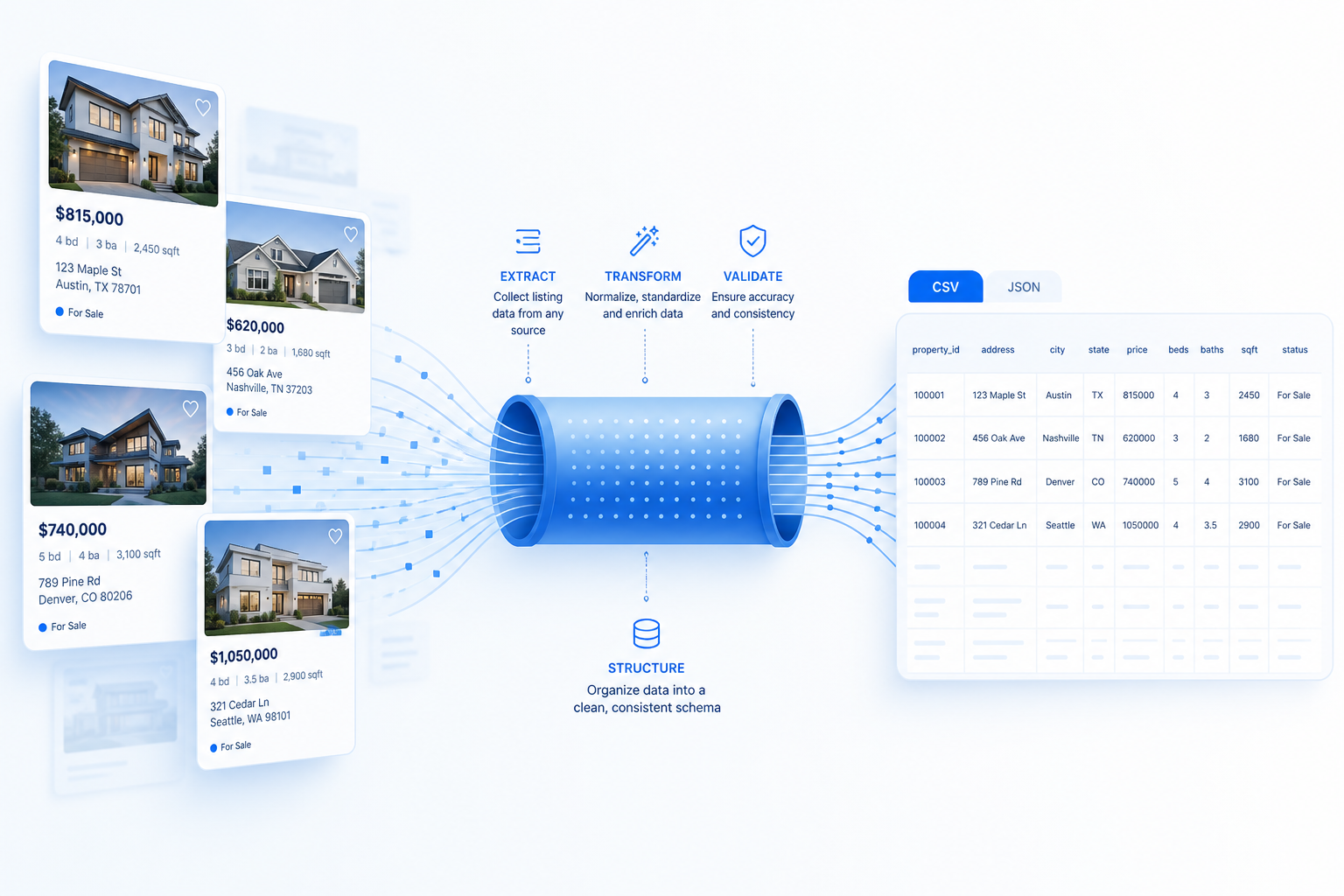
Zillow property data transformed into structured real estate records for analysis and delivery

What is Zillow data scraping?

Zillow data scraping is the process of converting information displayed on Zillow pages into structured records that can be reviewed, analyzed, or delivered to another system.

Depending on the approved source pages and project scope, a record may include:

  • Property address
  • City, state, and ZIP code
  • Source URL
  • Property identifier where available
  • Listing type and status
  • Listing price
  • Bedrooms and bathrooms
  • Living area
  • Lot size
  • Property type
  • Year built
  • Geographic coordinates
  • Displayed valuation fields
  • Broker or agency context
  • Collection timestamp

Nenodata's existing Zillow Scraper page lists search-result and property-page extraction, custom field selection, data cleaning, duplicate reduction, and delivery in formats such as CSV, JSON, Excel, or API-ready structures. The page also offers one-time and recurring collection. Field availability should be confirmed against the current target pages before the project is approved. Define the required fields before choosing a collection approach.

Define the required fields before choosing a tool

A common project mistake is starting with a scraper before defining the dataset.

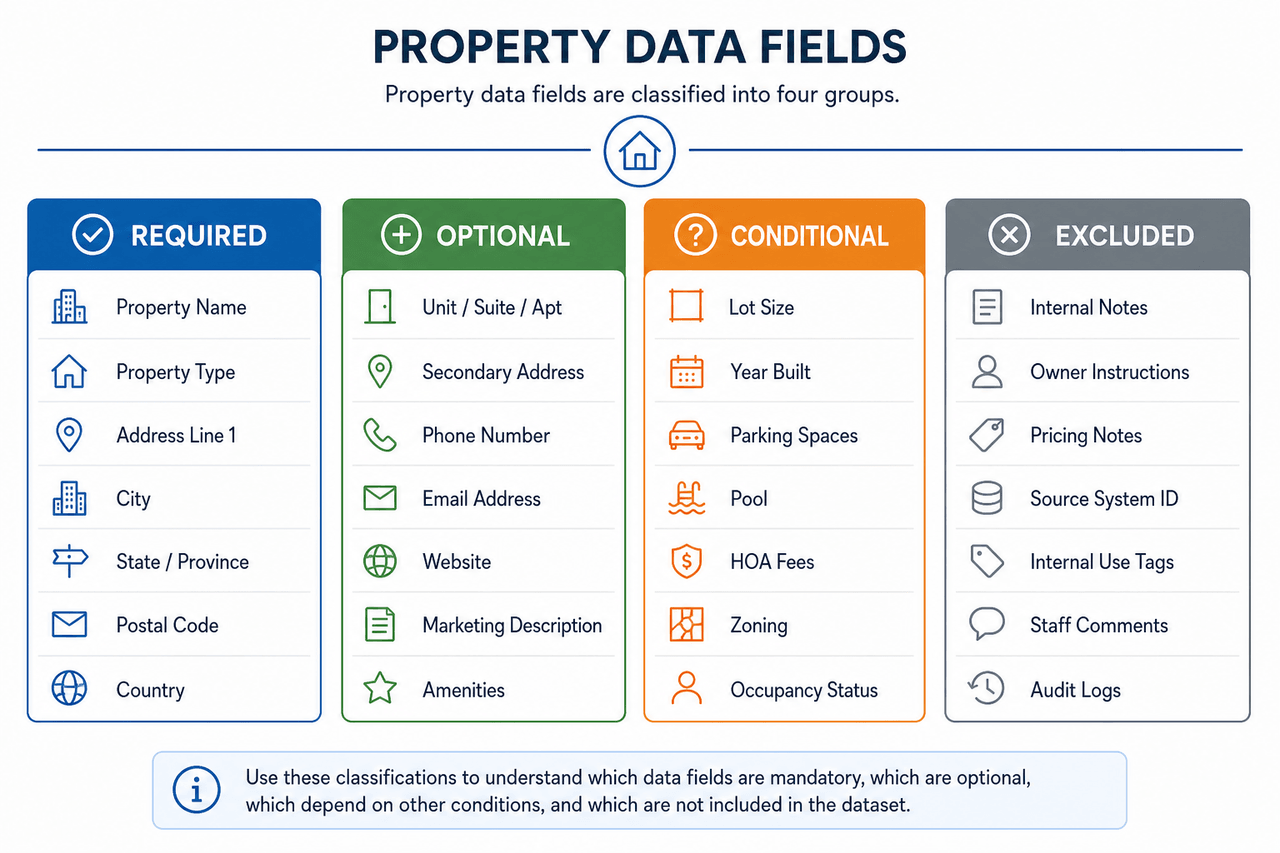
The field specification should identify:

  • Mandatory fields
  • Optional fields
  • Fields that may require additional page collection
  • Fields that may be unavailable for some records
  • Fields excluded because of source, privacy, or usage restrictions
Suggested property data field categories
Data categorySuggested fieldsWhy they matter
Record identitySource URL, property ID, listing URLSupports traceability and duplicate handling
LocationAddress, city, state, ZIP code, latitude, longitudeSupports geographic analysis and matching
ListingProperty type, listing status, listing priceDefines the current market record
Property detailsBedrooms, bathrooms, living area, lot size, year builtSupports filtering and comparison
MonitoringPrevious price, change type, first seen, last seenSupports recurring market analysis
DeliveryCollection timestamp, batch ID, validation statusSupports auditing and downstream processing
Property data fields classified as required, optional, conditional, and excluded

Nenodata's Real Estate Data Intelligence page states that identifiers, addresses, prices, status labels, property attributes, change indicators, timestamps, and source metadata may be included when they are publicly visible or permissioned and part of the agreed schema. It also states that availability varies by source, market, listing type, and scope.

Search results and property pages may require different collection plans

A market-level project may begin with a search URL, city, ZIP code, or another approved search input. A richer project may also require collection from individual property pages.

These approaches should be scoped separately because they can differ in:

  • Number of pages collected
  • Fields available
  • Processing requirements
  • Frequency
  • Failure points
  • Data completeness
  • Maintenance effort

Do not assume that every requested field is available in the initial search results or on every property page.

Instead, test a representative sample and classify each field as:

  • Confirmed
  • Conditionally available
  • Not displayed
  • Failed to parse
  • Outside the approved scope

This prevents an unavailable field from being mistaken for a technical failure.

Treat Zillow valuation fields as separate data points

A Zestimate is Zillow's estimate of a home's market value. Zillow states that it is not an appraisal and cannot be used in place of one.

A property-data schema should therefore keep these concepts separate:

  • Listing price
  • Previous listing price
  • Recorded sale price
  • Zestimate
  • Rent Zestimate
  • Tax-assessed value
  • Professional appraisal
  • Internal valuation model

Combining them into one field such as property_value removes the meaning of each value and can produce misleading analysis.

A clearer field structure is:

{
  "list_price": 625000,
  "previous_list_price": 649000,
  "displayed_zestimate": 618500,
  "displayed_rent_zestimate": 3250,
  "currency": "USD",
  "collection_timestamp": "2026-07-29T08:00:00Z"
}

This is an illustrative schema, not a real Nenodata customer record or proof that every field is available for every property.

Four ways to obtain structured Zillow data

Build an internal collector

An internal collector gives the engineering team control over inputs, extraction logic, validation, storage, and delivery.

It may be suitable when:

  • The scope is small
  • The work is experimental
  • The team has relevant engineering experience
  • The required fields are limited
  • The team accepts ongoing maintenance

The first working script is not the complete system. A production collector also needs:

  • Logging
  • Retry rules
  • Failed-record reporting
  • Schema tests
  • Duplicate handling
  • Collection timestamps
  • Monitoring for page changes
  • A process for reviewing incomplete records

Without these controls, a job may continue running while returning partial or inconsistent data.
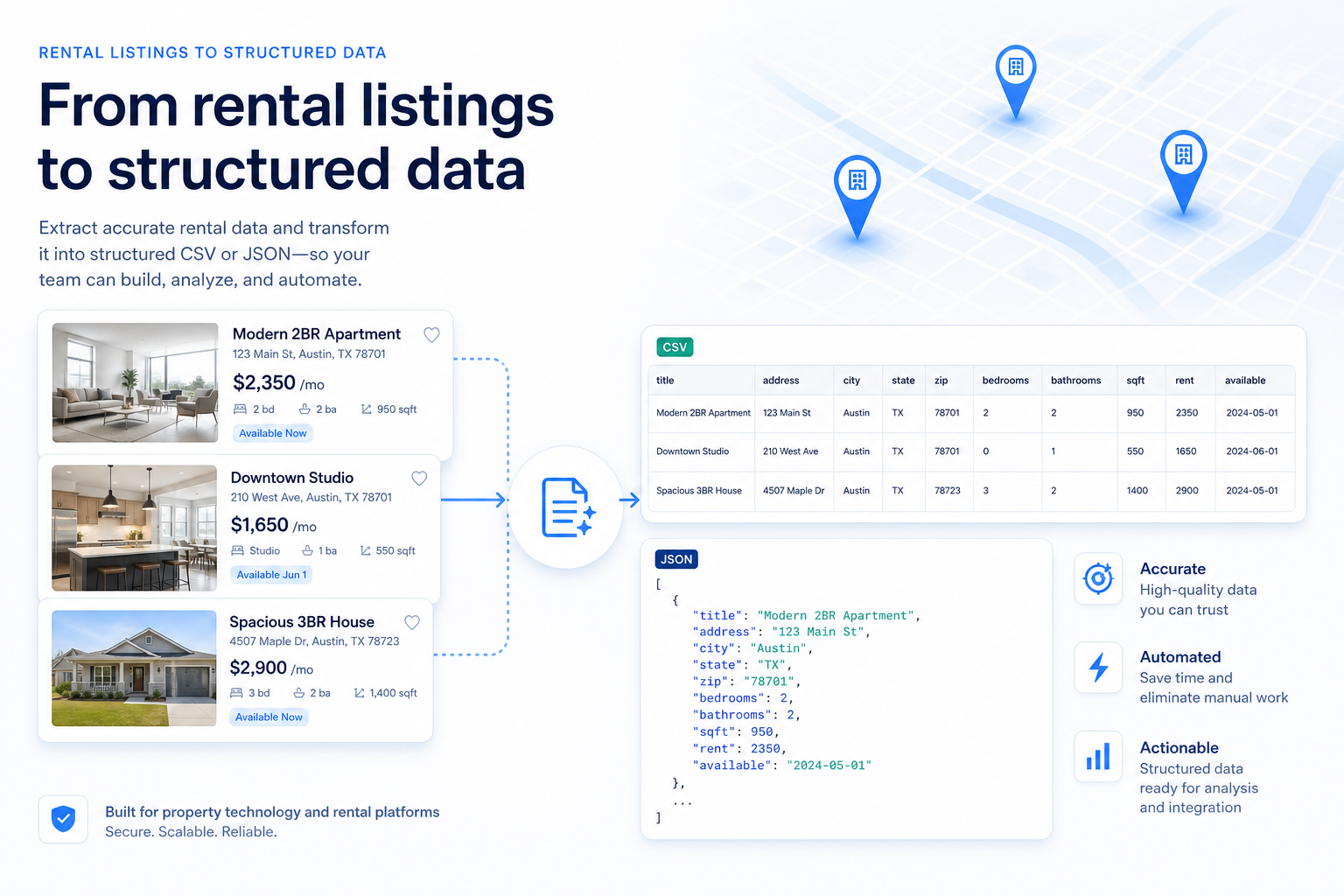
Use scraping infrastructure

A scraping API or similar infrastructure can reduce work at the page-access layer. The customer may still need to manage URL generation, parsing, field mapping, data cleaning, duplicate resolution, scheduling, storage, quality checks, and downstream integrations.

The deciding question is not simply whether the service returns a successful response. The team should determine whether it receives:

  1. 1. Raw page content
  2. 2. Partially structured output
  3. 3. A stable property-data schema
  4. 4. A fully managed dataset

These are different products with different internal workloads.

Use a self-service extraction tool

A hosted actor or no-code tool may suit one-time research, small exports, or a proof of concept. Before adopting one for repeated use, test:

  • Whether unavailable fields are returned as null or omitted
  • Whether the schema remains stable across property types
  • How duplicate properties are handled
  • How failed pages are reported
  • Whether search and detail collection are priced separately
  • Whether previous versions of a listing are retained
  • Whether output can be sent directly to the required destination

A low-cost export may still require significant internal work before it can be loaded into a production database.

Use a managed property-data service

A managed service begins with the required business output rather than a generic scraping interface. The buyer defines target source, markets, property types, fields, frequency, validation, format, destination, and intended use. The provider then reviews feasibility, configures the workflow, cleans the records, and delivers the agreed output.

Nenodata describes its Real Estate Data Intelligence service as a managed process for agreed public or permissioned sources. Real Estate Data Intelligence Services describe the managed process for agreed public or permissioned sources. For app and listing portal extraction, see real estate app data scraping. Source coverage, field availability, refresh cadence, and delivery formats are confirmed during scoping and sample review. Custom delivery may also use custom data pipelines.

Which approach fits the project?

Comparison of Zillow data collection approaches
ApproachSuitable forInternal workloadCustomizationMaintenance
Internal collectorExperiments and controlled technical projectsHighHighInternal team
Scraping infrastructureEngineering teams that want to own the data logicMedium to highHighMostly internal
Self-service toolSmall exports and standard requirementsLow to mediumLimited to mediumShared
Managed serviceRecurring, custom, or integration-ready datasetsLower for the buyerDefined during scopingProvider under agreed scope

A managed service is not necessary for every project. A self-service tool may be sufficient for a small, temporary request with a standard schema.

Managed delivery becomes more relevant when the project requires several markets, recurring refreshes, custom transformations, change history, stable delivery, or limited internal maintenance. See compare real estate data providers for broader provider-selection context.

Raw property data must be normalized

Extracted values are not automatically ready for analytics or product use.

A raw address may appear as one string:

1450 Market Street, Denver, CO 80202

A normalized record separates it into consistent components:

{
  "street_address": "1450 Market Street",
  "city": "Denver",
  "state": "CO",
  "postal_code": "80202",
  "country": "US"
}

The example is fictional and used only to show the transformation.

The same principle applies to numeric values. A source may display:

$625,000
2,145 sq ft
0.34 acres

An analysis-ready record should preserve numbers and units separately:

{
  "list_price": 625000,
  "currency": "USD",
  "living_area": 2145,
  "living_area_unit": "sq_ft",
  "lot_size": 0.34,
  "lot_size_unit": "acre"
}

Keeping the raw display value alongside the normalized value can help with auditing.

Use a stable approach to missing fields

Property pages do not always contain identical information.

A stable schema should distinguish among:

  • A field that was not displayed
  • A field that failed to parse
  • A page that failed to load
  • A field excluded from the project
  • A listing that is no longer available

Those cases should not all become an unexplained blank cell.

For expected but unavailable fields, a consistent null value is usually easier to validate than removing the field from individual records:

{
  "year_built": null,
  "lot_size": null,
  "brokerage_name": null,
  "record_status": "collected_with_missing_fields"
}

The final status labels should follow Nenodata's approved internal methodology. They must not be published as a claimed Nenodata standard until verified.

Define how duplicates will be resolved

The same property may appear in overlapping searches, different map areas, or multiple collection runs.

Potential matching inputs include:

  • Property identifier where available
  • Canonical property URL
  • Normalized address
  • Unit number
  • Project-specific record hash

No single key is sufficient in every case.

Address-only matching can merge separate units in the same building. URL-only matching can fail when a URL changes. The deduplication rule should therefore be tested against the property types included in the project.

Nenodata's real-estate service page states that record hashes or deduplication keys can be included where scoped, and that field mapping and duplicate-handling rules can be defined during project setup.

Recurring collection needs change detection

Repeated downloads do not automatically create useful listing history.

A monitoring workflow should compare the latest accepted record with the previous accepted version.

Useful monitoring fields include:

  • First seen
  • Last seen
  • Previous price
  • Current price
  • Previous status
  • Current status
  • Change type
  • Collection batch
  • Collection result
  • Source URL

An illustrative event might look like this:

{
  "listing_id": "example-property-id",
  "change_type": "price_decrease",
  "previous_price": 625000,
  "current_price": 599000,
  "change_amount": -26000,
  "first_seen_at": "2026-07-15T08:00:00Z",
  "last_seen_at": "2026-07-29T08:00:00Z",
  "collection_status": "success"
}

This is a fictional example. It must not be described as Nenodata output until replaced with a verified internal record.

A listing absent from one run should not automatically be marked as removed. It may have:

  • Fallen outside a search filter
  • Failed to load
  • Moved to another page
  • Changed status
  • Become temporarily unavailable
  • Been removed from the source

The workflow should use an approved confirmation rule before creating a removal event. See how Nenodata works for the broader project workflow.

Review source access and intended use separately

Visible information is not automatically unrestricted information.

Before collecting or reusing property data, review:

  • The applicable source terms
  • The access method
  • The requested fields
  • Collection volume and frequency
  • Personal-information implications
  • Intellectual-property restrictions
  • Data-retention requirements
  • Intended display or distribution
  • Resale or enrichment plans
  • Relevant jurisdictional requirements

Zillow's official API terms apply to its approved API licensees and include restrictions relating to bulk access, retention, redistribution, direct marketing, and certain uses of Zillow data. They also state that licensees must not imply a broader partnership with Zillow without written approval.

These API terms do not by themselves determine the rules for every independent collection method. They do demonstrate why an independent service should not be described as an official Zillow API and why access and downstream use require appropriate review.

Zillow also publishes downloadable real-estate metrics for certain research and analytical uses, and its Bridge Public Records API is described as invite-only for commercial use cases. Teams should assess whether an official dataset or licensed interface already meets the requirement before commissioning another workflow.

This is operational guidance, not legal advice. High-volume, commercial, public-display, or redistribution projects should receive qualified legal review.

What Nenodata needs to scope a Zillow dataset

A useful request should include the following areas.

Target market

Provide the relevant:

  • Country
  • State
  • City
  • ZIP codes
  • Neighborhoods
  • Search URLs, where appropriate

Listing criteria

Define the required:

  • For-sale, for-rent, or other listing category
  • Property type
  • Price range
  • Bedroom or bathroom filters
  • Additional search conditions

Field specification

Separate fields into mandatory, preferred, and optional. A basic request may include:

property_url
listing_id
address
city
state
postal_code
list_price
listing_status
bedrooms
bathrooms
living_area
collection_timestamp

Delivery requirements

Specify:

  • One-time or recurring collection
  • Desired frequency
  • CSV, Excel, JSON, or another approved format
  • API, database, cloud, or file delivery requirement
  • Approximate record volume
  • Intended business use

Nenodata's Zillow page describes daily, weekly, or custom collection and CSV, JSON, Excel, XML-ready, API-ready, cloud, or database-oriented delivery. These options are website-supported but must be technically confirmed for the requested volume and scope before being promised. API-oriented delivery may also be reviewed against the Real Estate API options where relevant.

Request a scoped Zillow data sample

Send Nenodata your target locations or approved search inputs, listing category, required fields, approximate volume, one-time or recurring requirement, preferred format, delivery destination, and intended use. Nenodata can then review source feasibility and confirm which fields and delivery options can be included in the proposed scope.

Request a Zillow Data Sample

Ready to automate your data?

Tell us what you need. We'll build a custom scraping solution and deliver a free proof-of-concept within 48 hours.