Instacart Data Scraping for ZIP & Store-Level Grocery Feeds
Nenodata builds managed Instacart Data Scraping Services for ZIP- and store-level product, pricing, promotion, and availability feeds—scoped to your retailer storefronts, locations, and schema. For multi-app grocery coverage, see grocery delivery app scraping.
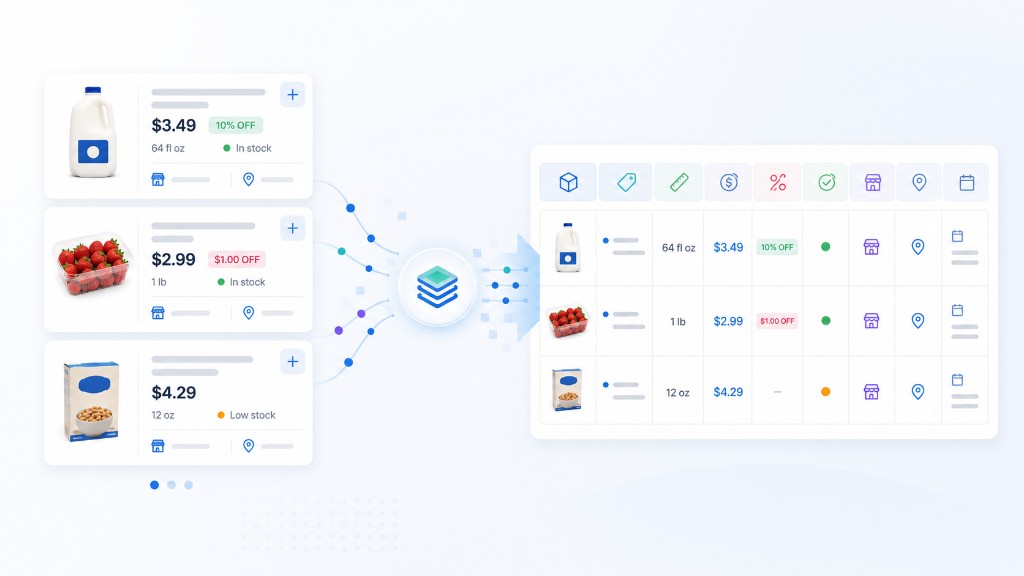
The Challenge of Collecting Usable Instacart Data
A single product can appear with different prices, promotions and availability depending on the retailer storefront and delivery location. That makes store-level grocery pricing difficult to compare through manual checks.
Teams must repeatedly set a location, find matching products, distinguish regular prices from promotions and capture enough context to make records comparable. Spreadsheet-based collection is slow, while one-off scripts can fail when page structures, product variants or access conditions change.
The result is missing observations, inconsistent naming and analyst time spent repairing data rather than using it. A managed workflow gives pricing, category and research teams a repeatable way to define their requirements, collect publicly accessible marketplace information and receive structured records for review—without treating every source change as a new internal engineering project.
What Instacart Data Scraping Services Include
Nenodata scopes each project around the locations, retailer storefronts, product groups, fields and collection schedule relevant to the buyer's decision. The Instacart data extraction workflow can cover publicly accessible product information, pricing, promotions, availability and location context where those elements are accessible and included in the approved project scope.
Collected Instacart product data is organized into consistent records, then cleaned, normalized and checked before delivery.
Nenodata's broader grocery delivery app scraping service covers multi-platform grocery workflows. Related marketplace pages include Blinkit data scraping, BigBasket data scraping, Zepto data scraping, and FMCG data extraction. Structured delivery can use CSV, Excel, JSON, API integration or approved cloud and database destinations.
Actual fields, locations and collection frequency are confirmed during scoping. Nenodata does not claim an official Instacart partnership, guaranteed access to every page or access to private, restricted or account-protected information.
Instacart vs other grocery sources
Use this page for Instacart retailer storefronts and ZIP/store inputs. Use grocery-delivery scraping for multi-app grocery programmes, or US restaurant-chain scraping for delivery menus — not Instacart SKUs.
| Source | Best for | Learn more |
|---|---|---|
| Instacart | ZIP/store product, pack size, listed price, and availability | This service |
| Grocery delivery hub | Multi-app grocery price and stock programmes | Grocery delivery scraping |
| US restaurant chains | Chain menu and delivery fields — not grocery SKUs | US chain delivery data |
See How the Output Could Be Organized
The structure below demonstrates how a scoped dataset could organize product, price, promotion and location observations. It does not represent a confirmed Nenodata deliverable or a live customer dataset.
| Product | Price | Promotion | Availability | Location |
|---|---|---|---|---|
| Kirkland Signature Organic Eggs | 8.49 | none | In stock | 10001 |
{
  "observation_timestamp": "2026-08-12T16:22:08Z",
  "retailer_name": "Costco",
  "location_input": "10001",
  "product_name": "Kirkland Signature Organic Eggs",
  "brand": "Kirkland Signature",
  "package_size": "24 ct",
  "listed_price": "8.49",
  "promotion_text": null,
  "availability_status": "In stock",
  "product_url": "https://www.instacart.com/store/costco/products/kirkland-signature-organic-eggs"
}
Data Fields and Delivery Outputs
Available fields depend on the public page, retailer storefront, selected location and agreed project scope.
Product Identity
- • Product name
- • Brand
- • Package or unit size
- • Product category
- • Product page URL
- • Image URL
Pricing and Promotions
- • Listed price
- • Previous or comparison price
- • Promotion text
- • Discount indicator
- • Unit-price information
- • Observation timestamp
Availability and Location
- • Availability status
- • Selected ZIP code or location input
- • Retailer or storefront name
- • Store context
- • Delivery information where publicly displayed
- • Collection timestamp
Product and Retailer Context
- • Product description
- • Variant information
- • Category path
- • Rating or review information where publicly displayed
- • Retailer identifier
- • Source URL
Verified Delivery Options
Nenodata's existing site describes the following delivery methods for grocery and broader data workflows:
- CSV
- Excel
- JSON
- API integration
- Cloud or database delivery
- Delivery to an approved CRM or data warehouse
The final method depends on the required schema, volume, collection schedule and destination system.
Use Cases
Instacart Price Monitoring
Pricing teams can struggle to compare products when observations come from different locations, package sizes or retailer storefronts. A scoped recurring dataset creates a more consistent basis for reviewing price movements, identifying changes and preparing information for pricing analysis without relying on repeated manual checks. See Nenodata's price intelligence capabilities for related monitoring use cases.
Promotion Tracking
Promotional messages can vary by retailer, location and collection time. Nenodata can structure publicly displayed promotion information alongside the relevant product, price and observation context, helping commercial teams compare campaign visibility and evaluate how promotional activity changes across selected markets.
Instacart Availability Tracking
Category and supply teams need to understand where selected products appear available or unavailable. A location-aware feed can organize public availability observations by product, retailer and market, helping teams identify patterns that merit further investigation without presenting availability as guaranteed inventory information.
Assortment and Digital-Shelf Analysis
Brands may not have a consistent view of which products, variants and pack sizes are visible across selected retailer storefronts. Structured collection supports assortment comparisons, digital-shelf reviews and gap analysis by organizing product observations into a common schema for downstream analysis. See ecommerce data extraction for related catalog and marketplace workflows.
Instacart Product Monitoring
Product titles, descriptions, images, sizes and category placement can change over time. A managed monitoring workflow helps teams identify observed changes in selected product records, giving digital commerce and catalog teams a structured input for quality reviews and marketplace reporting.
Market and Location Analysis
Researchers often need comparable observations across cities, ZIP codes or retailer storefronts. Location-based grocery data can support market studies by connecting each observation to its collection context, helping analysts distinguish real geographic variation from records gathered under inconsistent settings.
Who This Service Is For
Nenodata supports CPG and FMCG brands, grocery retailers, pricing teams, category managers, digital-shelf teams, market-research firms and retail-analytics providers that need structured grocery marketplace data.
The service is suited to organizations with defined products, locations or monitoring questions but without the internal time or engineering capacity to maintain a source-specific collection workflow. Projects can be scoped for one-time research, recurring monitoring or delivery into an existing analytical process, subject to source accessibility and agreed requirements.
How It Works
- 1
Share Your Requirements
Define the retailer storefronts, locations, products, categories, fields, collection schedule and intended destination. Nenodata reviews the request and identifies any scope elements requiring technical or human verification.
- 2
Configure the Collection
Nenodata prepares a workflow for the approved public data sources and collection context. The configuration is based on the agreed locations and fields rather than an assumed universal Instacart dataset.
- 3
Clean and Validate
Collected records are structured, normalized and checked for issues such as missing values, inconsistent formats or duplicate observations before delivery.
- 4
Deliver the Dataset
Receive the approved output through CSV, Excel, JSON, API integration or another verified destination agreed during scoping.
Why Choose Nenodata
Scope Built Around Your Decision
The project starts with the products, locations, fields and business questions that matter to your team, helping prevent an oversized dataset that still lacks the context required for analysis.
Managed Source Maintenance
Nenodata manages the extraction workflow and responds to identified source-structure changes. This reduces internal maintenance work without implying uninterrupted access or guaranteed collection from every page. Explore enterprise web scraping for broader extraction workflows.
Structured for Your Systems
Schema and delivery requirements are discussed before implementation, so the output can be planned around your spreadsheet, database, warehouse, API or approved analytical workflow.
Quality Checks Before Delivery
Records can be cleaned, normalized and reviewed for structural issues before handoff. Project-specific validation rules must be confirmed during scoping.
Clear Collection Expectations
Locations, fields, schedule, delivery method and known constraints are defined before collection begins. This gives buyers a documented scope rather than an open-ended promise of complete platform coverage.
Delivery and Integration Options
Nenodata can provide grocery data through CSV, Excel, JSON, API integration and approved cloud or database destinations. Its broader workflow also describes delivery to a CRM, data warehouse or API.
The recommended delivery method depends on how the data will be used.
CSV or Excel
Analyst review, reporting and spreadsheet workflows.
JSON
Structured ingestion and development workflows.
API integration
Programmatic access within an approved system.
Database or warehouse delivery
Recurring analytical pipelines.
CRM delivery
Approved commercial or account workflows where relevant.
Each integration, destination and update process must be confirmed before implementation. Related: grocery delivery app scraping, price intelligence, FMCG data extraction, and custom data pipelines.
Frequently Asked Questions
Turn Your Requirements Into a Scoped Dataset
Share the products, retailer storefronts, locations, fields and delivery method your team needs. Nenodata will review the request and define the next step without assuming universal coverage or a fixed collection schedule.
After submission, the team reviews your scope and follows up about feasibility, sample requirements and delivery options.
You can also discuss your data requirements with the team directly.