Travel & Hospitality Data Scraping for Hotel, OTA & Flight Listings
Nenodata Travel & Hospitality Data Scraping collects listing-level hotel, OTA, and flight records from public or permissioned sources—property, room, rate, and check-in context—for pricing, availability, and analytics workflows. For KPI fare-change feeds, see travel data intelligence. For hotel amenities extraction, see hotel data scraping.
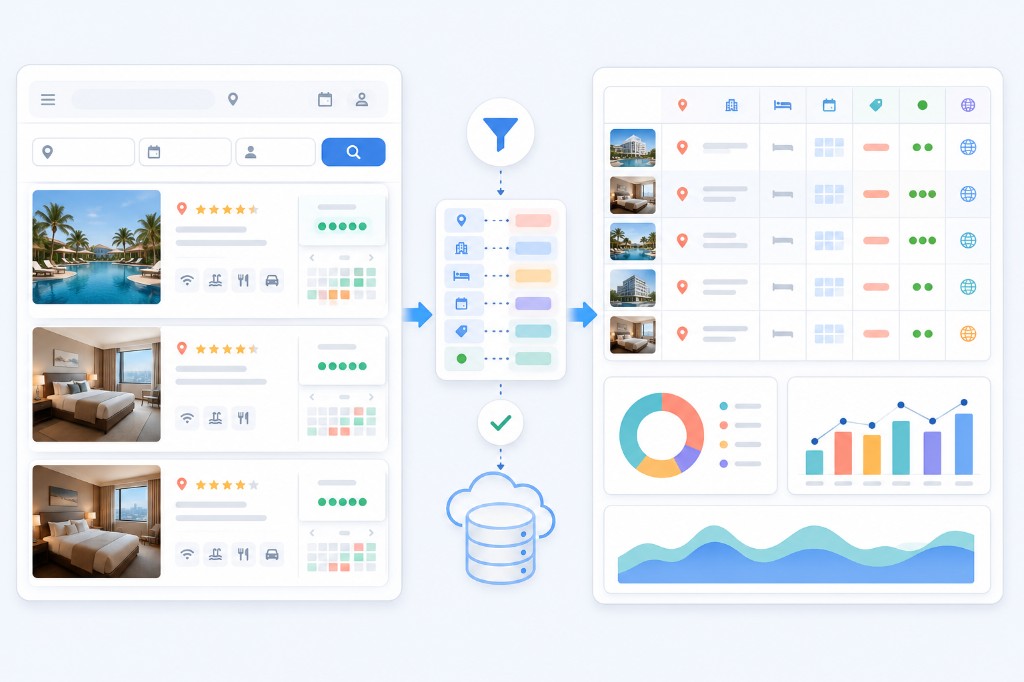
The problem: travel data changes faster than manual workflows can track
Hotel rates, flight fares, OTA availability, and review signals can change frequently across channels, making manual tracking slow and inconsistent. A rate copied from one listing page may already be stale when a revenue or analytics team reviews it later.
Travel pages vary by source structure, geography, and channel behavior, which makes brittle scripts difficult to maintain at scale. Room-type labels, check-in inputs, and currency displays differ across OTAs, hotel sites, and airline pages.
Without managed extraction and validation, teams spend more effort fixing collection issues than using travel data for pricing and market decisions. Listing-level hospitality records need a stable schema so property, room, rate, and stay-date fields can be compared without rebuilding the dataset each cycle.
What Nenodata provides for Travel & Hospitality Data Scraping Services
Nenodata provides Travel & Hospitality Data Scraping Services for approved public or permissioned sources with source-specific scoping before delivery. This page is the hospitality extraction hub: one listing record with property or route identity, room or cabin, rate or fare, availability, and check-in or travel date.
It is not the travel intelligence KPI layer (channel fare-change or parity delta) and not hotel-only amenities extraction. Workflows can include collection, cleaning, normalization, and structured output mapped to pricing, catalog, and product requirements. Related hotel comp-set monitoring lives on hotel pricing monitoring; multi-OTA programmes live on OTA data scraping.
Nenodata does not promise universal access to every site or real-time collection everywhere. Coverage, cadence, and delivery formats are confirmed during scoped implementation. Sample listings are reviewed before production volume is committed.
Related services: Traveloka data scraping, vacation rental data scraping, travel data scraping, travel data intelligence services, enterprise web scraping, live crawler services, car rental data scraping, car rental price scraping, flight data scraping, custom data pipelines, and web scraper maintenance and monitoring, and web scraping API.
Hospitality scraping vs travel scrape and hotel data
Use this page for listing-level hotel, OTA, and flight records. Use travel-data-scraping for a broader travel programme, hotel data scraping for property/amenities extraction, or travel intelligence for channel fare-change KPIs.
| Source | Best for | Learn more |
|---|---|---|
| Hospitality scraping | Hotel/OTA/flight listing: property, room, rate, check-in | This service |
| Travel data scraping | Broader travel extraction beyond hospitality listings | Travel data scraping |
| Hotel data scraping | Hotel listing, amenities, and property-level extraction | Hotel data scraping |
Travel & Hospitality Data Scraping Services sample output
Illustrative example
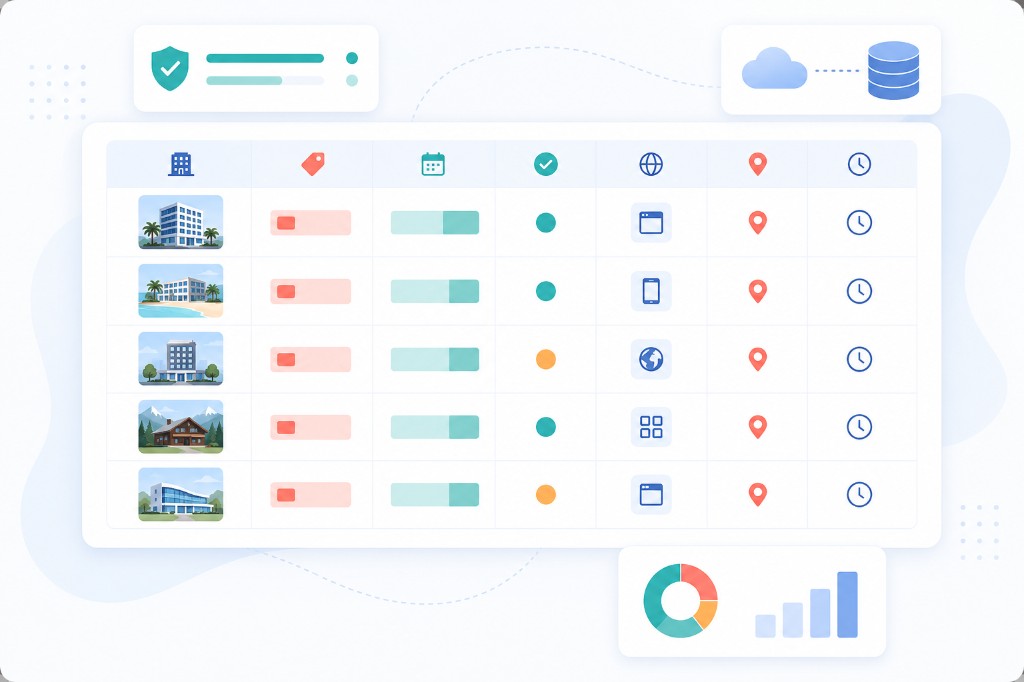
| Property | Room Type | Rate | Availability | Source | Captured At |
|---|---|---|---|---|---|
| Palmer House a Hilton Hotel | King Guest Room | 189.00 | available | Booking.com | 2026-08-13T14:00:00Z |
{
  "property_name": "Palmer House a Hilton Hotel",
  "source_name": "Booking.com",
  "room_type": "King Guest Room",
  "rate": "189.00",
  "currency": "USD",
  "availability_status": "available",
  "check_in_date": "2026-09-18",
  "check_out_date": "2026-09-19",
  "source_url": "https://www.booking.com/hotel/us/palmer-house-a-hilton-hotel.html",
  "captured_at": "2026-08-13T14:00:00Z"
}
Illustrative CSV-style field list
property_name,
source_name,
room_type,
rate,
currency,
availability_status,
check_in_date,
check_out_date,
source_url,
captured_at
Data fields and outputs
Property and rate data
- • Property name
- • Room type
- • Rate
- • Currency
- • Rate timestamp
Flight and route data
- • Route
- • Fare
- • Airline
- • Schedule where visible
- • Fare timestamp
OTA and channel data
- • OTA/source name
- • Channel listing URL
- • Channel-specific rate
- • Promotion text where visible
Review and reputation data
- • Rating value
- • Review count
- • Review text snippets where visible
- • Reputation signals
Availability and change data
- • Availability status
- • Inventory indicators where visible
- • Change timestamps
- • Status history where scoped
Delivery metadata
- • Capture timestamp
- • Source type
- • Validation status
- • Batch ID
- • Delivery format
Use cases
Competitor rate monitoring
Track competitor hotel and channel rates to support pricing and revenue decisions.
OTA parity and channel checks
Monitor rate and availability differences across OTA and direct channels.
Market intelligence for travel platforms
Build recurring datasets for destination, property, and channel market analysis.
Flight fare observation
Collect fare and route signals for pricing and route-level monitoring workflows.
Vacation rental and alternative stay analysis
Track listing, pricing, and availability signals across alternative stay sources.
Review and reputation analysis
Capture rating and review signals to support quality and reputation monitoring.
Travel data products and APIs
Deliver structured travel datasets for product, analytics, and integration workflows.
Related workflows: price intelligence and review and social data extraction.
Who this is for
This service is for revenue managers, pricing analysts, market intelligence teams, product managers, data teams, engineering teams, OTAs, hotel groups, airline and travel aggregators, vacation rental platforms, hospitality analytics firms, tourism research teams, and travel-data products.
It supports organizations that need managed travel data extraction and delivery without maintaining fragile internal scrapers.
How it works
Share requirements
Define target sources, fields, geography, cadence, and delivery destination.
Configure collection
Nenodata scopes source feasibility and configures collection around approved requirements.
Clean and validate
Records are normalized, deduplicated, and validated against the agreed schema.
Deliver and maintain
Structured feeds are delivered on schedule and maintained as sources evolve.
Why choose Nenodata
Source-specific scoping
Coverage and field feasibility are reviewed before implementation commitments.
Freshness matched to the workflow
Refresh cadence is scoped to source behavior and business requirements.
Structured output for analytics teams
Outputs are prepared for BI, reporting, and operational analysis workflows.
Maintenance beyond the first crawl
Nenodata manages extraction and maintenance as travel sources change over time.
Responsible collection boundaries
Projects are scoped around approved public or permissioned source access.
Integrations and delivery options
Travel data delivery workflow from approved sources through Nenodata processing into CSV, JSON, XML, API-ready files, databases, warehouses, and webhooks.
CSV and spreadsheet formats
Tabular delivery for analyst and reporting workflows.
JSON and XML
Structured payloads for engineering and integration workflows.
API and webhook delivery
Programmatic delivery where API or webhook workflows are scoped.
Warehouse and database-ready files
Batch outputs prepared for storage and analytics destinations depending on the confirmed scope.
Learn how Nenodata works or contact Nenodata to scope delivery options.
FAQ
Ready to scope a travel data workflow?
Share your target travel and hospitality sources, required fields, sample URLs, delivery format, refresh frequency, and intended use case with Nenodata.
After submission, Nenodata should ask for target sources, required fields, sample URLs, delivery format, refresh frequency, and intended use case.