Digital Shelf Analytics Services for Ecommerce Teams
Nenodata helps ecommerce, retail, marketplace, and CPG teams collect public digital shelf signals and deliver them as clean, recurring datasets for analysis.
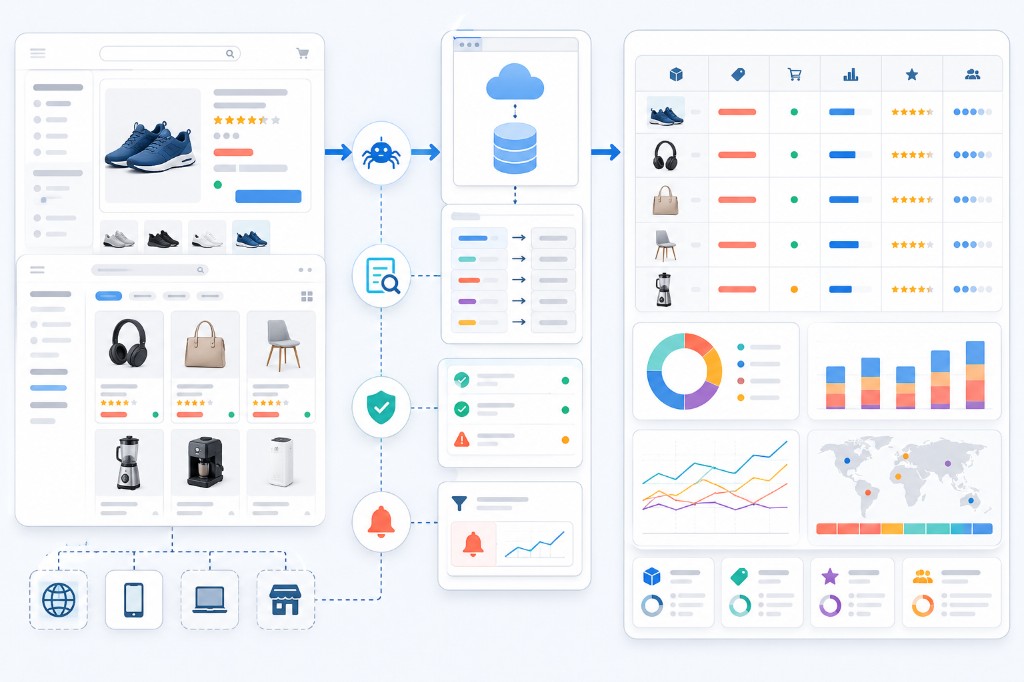
Why manual digital shelf monitoring breaks down
Manual checks across retailer and marketplace pages quickly become inconsistent when prices, availability, rankings, reviews, and seller context change throughout the day.
Teams that rely on spreadsheets or brittle scripts often lose historical context, miss updates, and spend more effort fixing extraction issues than using the data.
Digital shelf monitoring needs scoped source coverage, consistent field definitions, and recurring structured delivery to support reporting and operational workflows.
Digital Shelf Analytics Services Built Around Structured Ecommerce Data
Nenodata provides managed extraction workflows built around public ecommerce product, category, and marketplace signals required by your reporting teams.
Projects are scoped to your target sources, product URLs or SKUs, required fields, and delivery expectations before recurring collection is activated.
Supported sources, field coverage, and update frequencies are confirmed during scoped discovery before production delivery.
Digital Shelf Analytics Services sample output
Illustrative example
| Product | Price | Availability | Seller | Rank | Collected At |
|---|---|---|---|---|---|
| Example product | Example value | in_stock | Example seller | Example value | YYYY-MM-DDTHH:mm:ssZ |
{
  "collection_timestamp": "YYYY-MM-DDTHH:mm:ssZ",
  "source_name": "Example retailer or marketplace",
  "product_title": "Example product",
  "brand": "Example brand",
  "product_url": "https://example.com/product",
  "category": "Example category",
  "price": "Example value",
  "promotion_text": "Example promotion",
  "availability_status": "in_stock",
  "seller_name": "Example seller",
  "rating_value": "Example value",
  "review_count": "Example value",
  "search_rank": "Example value"
}
Illustrative CSV-style field list
collection_timestamp,
source_name,
product_title,
brand,
product_url,
category,
price,
promotion_text,
availability_status,
seller_name,
rating_value,
review_count,
search_rank
Data fields and outputs
Product content signals
- • Product title
- • Brand
- • Product URL
- • SKU/identifier where visible
- • Category path
Pricing and promotion signals
- • Current price
- • Previous/original price where shown
- • Promotion text
- • Currency
- • Price timestamp
Availability signals
- • Availability status
- • Stock indicators where shown
- • Out-of-stock markers
- • Availability timestamp
Seller and retailer signals
- • Seller name
- • Retailer/marketplace source
- • Fulfillment context
- • Offer-level context where visible
Search and category visibility signals
- • Search rank where visible
- • Category position
- • Listing presence
- • Share-of-shelf context
Ratings and reviews signals
- • Rating value
- • Review count
- • Review trend snapshots where visible
- • Badge/label signals
Delivery formats
- • CSV
- • Excel
- • JSON
- • API-ready output where scoped
- • Scheduled or destination-based delivery where scoped
Use cases
Ecommerce product monitoring
Track recurring product-level changes across monitored retailer and marketplace pages.
Assortment tracking
Monitor assortment presence and listing changes across target stores, categories, and brands.
Content compliance monitoring
Check whether key listing content attributes remain aligned across tracked product pages.
Competitor pricing context
Collect price and promotion context to support competitive benchmarking workflows.
Availability monitoring
Track in-stock and out-of-stock signals to detect commercial changes quickly.
Review and rating monitoring
Capture rating and review signals over time for quality and category analysis.
Category and search visibility
Measure relative visibility across category and search contexts where signals are available.
Who this is for
This service supports ecommerce teams, brand analytics teams, category managers, market intelligence teams, pricing teams, and data operations teams that need recurring digital shelf datasets.
It is also suited for organizations that want managed extraction and delivery without maintaining internal crawler infrastructure.
How it works
Connect
Share target sources, product URLs/SKUs, required fields, and business objectives.
Extract
Nenodata configures scoped extraction across approved public ecommerce source pages.
Transform
Records are cleaned, normalized, validated, and prepared for reporting workflows.
Deliver
Structured outputs are delivered to your preferred format and destination workflows.
Why choose Nenodata
Built around the signals your team needs
Field and source coverage are scoped around your reporting priorities before collection starts.
Managed pipelines, not fragile one-off scripts
Nenodata handles extraction operations and maintenance as sources evolve.
Clean data for reporting workflows
Data is prepared for analytics and operational usage in structured formats.
Flexible delivery formats
Delivery can align to agreed formats and downstream tools where scoped.
Honest scope definition before buildout
Feasibility and limitations are confirmed before implementation commitments are finalized.
Delivery and integrations
Related solutions: ecommerce data extraction, price intelligence solutions, Amazon data scraping, API solutions, and contact Nenodata.
FAQ
Ready to monitor your ecommerce shelf with structured data instead of manual checks?
Ready to replace manual shelf checks with structured recurring data? Share your target sources, product URLs or SKUs, required fields, preferred delivery format, and update frequency expectations with Nenodata.
After submission, Nenodata can review feasibility and confirm the best sample or demo path.