AI Scraping Services for Complex Web Extraction
Nenodata's AI Scraping Services combine LLM-assisted extraction, validation rules, and managed maintenance for complex, dynamic, and unstructured pages where brittle selectors fail. For traditional selector-led pipelines, see enterprise web scraping. For definitions and hybrid patterns, read what is AI scraping.
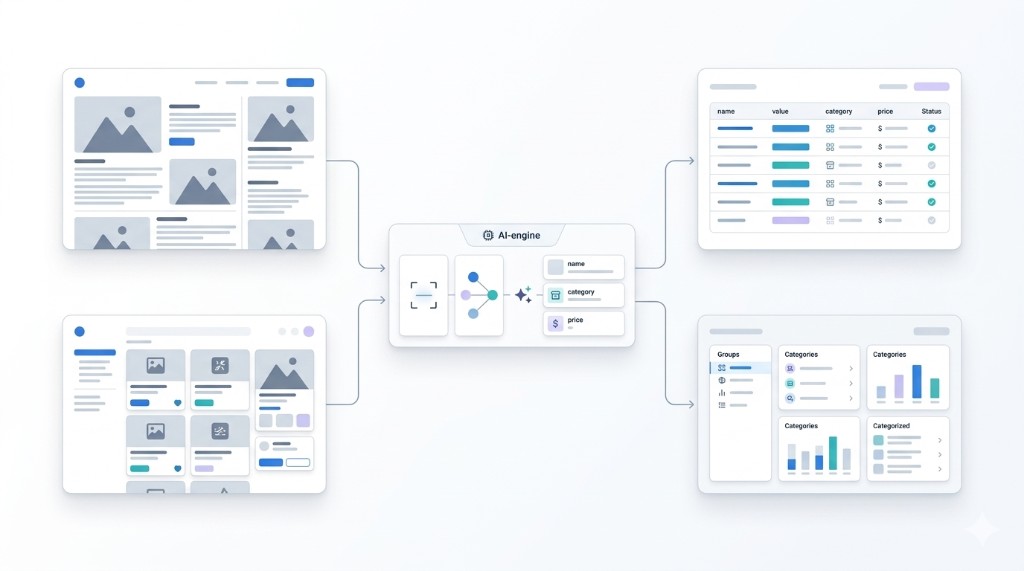
Complex layouts and frequent page changes break brittle scrapers
Many high-value pages mix dynamic HTML, inconsistent field labels, nested modules, and unstructured text. Selector-only collectors fail when templates drift or when the same attribute appears in different DOM locations by locale or A/B variant.
Teams then spend engineering time repairing parsers instead of analyzing structured records. Manual review does not scale when volume, refresh cadence, or multi-source coverage increases.
AI-assisted extraction helps when context and semantic understanding matter—but production use still needs scoped sources, field contracts, validation, and exception handling rather than unchecked model output.
What Nenodata AI Scraping Services include
Nenodata scopes approved public or permissioned sources, required fields, confidence thresholds, refresh cadence, and delivery destinations before production collection begins.
Workflows may combine traditional parsing with LLM-assisted extraction for unstructured blocks, then apply cleaning, normalization, and validation so outputs match an agreed schema.
AI is reserved for fields that selectors cannot hold stably: inconsistent labels, nested modules, locale variants, and long-form text that must map into a contract. Stable price, SKU, and URL fields stay deterministic wherever the DOM is predictable.
When not to use AI: high-volume templates with fixed markup, pages that already expose JSON in the response, and fields that must be bit-for-bit identical to a visible label. Those jobs stay on enterprise web scraping or dynamic JS scraping.
Every AI-assisted field can carry a confidence score and a review flag. Records below the agreed threshold are held or routed for human review instead of silently filling downstream systems.
Nenodata does not claim unrestricted access to every site or zero-maintenance forever. Maintenance, monitoring, and exception review are part of the managed service when included in scope.
Compare approaches in our best AI web scraping tools guide, or start with managed enterprise web scraping when pages are stable and selector-led.
AI scraping vs dynamic JS and traditional extraction
Use this page when layouts are inconsistent and fields need semantic mapping with confidence scores. Use dynamic scraping for JS/AJAX page state, or enterprise web scraping for stable selector-led pages.
| Source | Best for | Learn more |
|---|---|---|
| AI scraping | LLM-assisted fields, confidence, and review flags on messy pages | This service |
| Dynamic website scraping | JavaScript, AJAX, and SPA page state after render | Dynamic scraping |
| Enterprise web scraping | Selector-led extraction on stable, high-volume templates | Web scraping services |
Illustrative AI scraping output
Use a representative sample to confirm field names, confidence handling, and validation status before scaling a recurring workflow.
{
  "source_url": "https://www.bestbuy.com/site/anker-soundcore-life-q30-wireless-headphones/6461323.p",
  "entity_name": "Anker Soundcore Life Q30 Headphones",
  "category": "Audio > Headphones",
  "price": "79.99",
  "currency": "USD",
  "attributes": {
    "material": "protein leather earcups",
    "size": "over-ear"
  },
  "extraction_method": "hybrid_llm_assisted",
  "validation_status": "passed",
  "confidence": 0.92,
  "review_required": false,
  "collected_at": "2026-08-12T13:28:05Z"
}
Capabilities
LLM-assisted field extraction
- • Context-aware parsing of unstructured blocks
- • Flexible mapping into agreed schema fields
- • Confidence and review flags where configured
Hybrid collection
- • Selector or DOM parsing where stable
- • Model-assisted fallbacks for layout drift
- • Source URL and collection timestamps
Validation and delivery
- • Schema checks and null/exception handling
- • CSV, JSON, Excel, or API-ready payloads
- • Scheduled files or pipeline destinations
Use cases
Complex or inconsistent page templates
Extract structured fields from pages where layouts vary by category, locale, or experiment without rewriting selectors for every change.
Unstructured content to records
Turn articles, listings, or long-form page text into normalized entities, attributes, and metadata for analytics and enrichment workflows.
Adaptive monitoring programs
Support recurring collection on sites that change often, with monitoring and maintenance included when scoped—not silent failure.
Visual or multi-modal cues (when scoped)
Where approved, incorporate text recovered from images or screenshots into the same validated schema used for HTML extraction.
Who this is for
Product, pricing, research, and data teams that need structured outputs from complex public pages where traditional scrapers require constant repair.
Engineering leaders who want managed AI-assisted extraction with explicit schema contracts, samples, and validation—not ad-hoc chatbot exports.
How an AI scraping workflow is scoped
Requirements and sample
Define sources, fields, confidence rules, refresh needs, and delivery destination. Review a representative sample before scale.
Hybrid extraction design
Map stable selectors where possible and LLM-assisted paths for unstructured or volatile sections.
Validate and normalize
Apply schema checks, exception flags, and cleaning so records are usable downstream.
Deliver and maintain
Ship agreed formats on the contracted cadence, with monitoring and maintenance when included in scope.
Why teams use Nenodata for AI scraping
- Sample-first scoping before production volume
- Clear differentiation from unmanaged chatbot extraction
- Validation and exception visibility in the output
- Managed maintenance options when layouts change
- Delivery into files, APIs, or downstream pipelines
Related resources: enterprise web scraping, AI entity resolution, what is AI scraping, and best AI web scraping tools.
FAQ
Request an AI scraping sample
Share target URLs, required fields, expected volume, refresh cadence, and delivery destination so Nenodata can scope feasibility and prepare a representative sample.