Food Delivery App Scraping for Menus, Prices & Restaurant Signals
Extract structured menu, pricing, fee, rating, and restaurant data from food delivery apps such as DoorDash, Uber Eats, Grubhub, Deliveroo, and Swiggy. Use Nenodata feeds for competitive intelligence, product enrichment, and multi-market analytics.
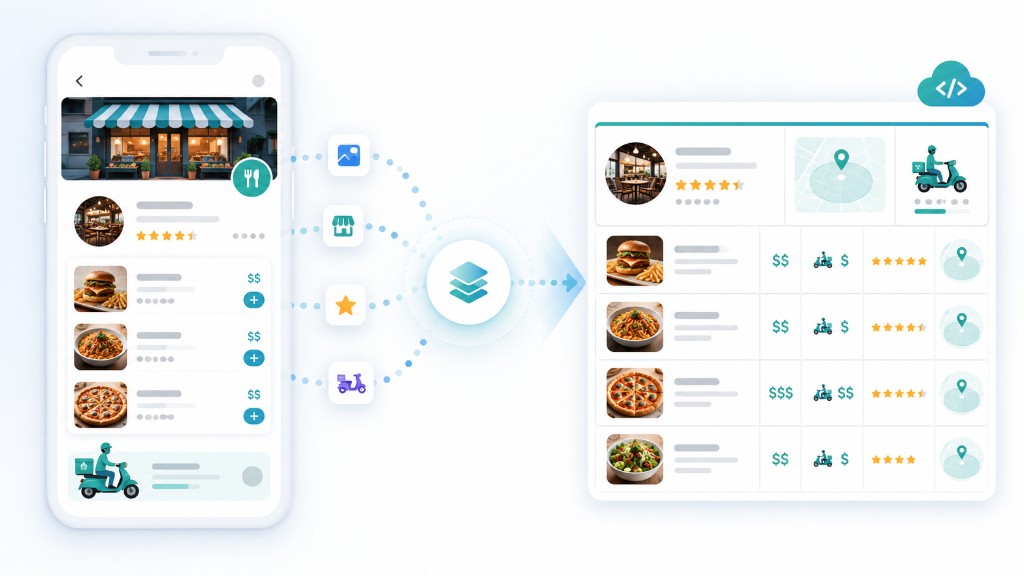
What this service covers
This page is for multi-app food delivery extraction and comparison. For US restaurant and chain-focused monitoring, see food delivery data scraping for US restaurants and chains.
Menu and item extraction
Collect item names, descriptions, categories, modifiers, allergens, and availability signals across delivery apps.
Price and fee monitoring
Track menu prices, delivery fees, service fees, promotions, and minimum order thresholds by market and time window.
Delivery coverage signals
Capture delivery zones, ETA ranges, and fulfillment status where publicly available for competitive analysis.
Ratings and reputation
Extract ratings, review volume, and cuisine metadata to support restaurant and marketplace benchmarking.
Location context
Normalize restaurant location, city, and market identifiers so multi-app datasets remain comparable.
Platforms commonly scoped
Final coverage depends on source access, geography, and project requirements.
- DoorDash
- Uber Eats
- Grubhub
- Deliveroo
- Swiggy
- Other agreed public delivery marketplaces
Related platform pages: DoorDash USA scraping, Deliveroo data scraping, and restaurant menu data scraping.
Delivery Hero ecosystem data scraping across consumer brands
Delivery Hero data scraping is best understood as a multi-market collection requirement, not extraction from a single global consumer application.
Delivery Hero's consumer marketplaces operate through regional brands, with different interfaces, geographic footprints, restaurant catalogs and commercial information.
For multinational restaurant chains, pricing teams and delivery intelligence providers, this creates a practical challenge: how do you compare restaurant and menu observations across several brands without losing the context that makes each record meaningful?
A scoped multi-platform dataset should identify the source marketplace, country, city, restaurant branch, item, currency and collection timestamp.
NenoData's existing food-delivery extraction service provides a general framework for collecting agreed marketplace records, normalizing common fields, validating outputs and delivering structured data. Individual Delivery Hero brands and markets require separate source-access and feasibility review.
Which Delivery Hero consumer brands are relevant?
The Delivery Hero ecosystem includes regional consumer brands such as foodpanda, Glovo, talabat, PedidosYa, foodora, HungerStation and Yemeksepeti.
These names represent different consumer platforms and market footprints. They should not be treated as interchangeable interfaces or assumed to share one accessible data source.
The official Delivery Hero brands and countries directory provides a starting point for market research.
For a proposed project, the buyer should specify the actual marketplace brands and target countries rather than request unrestricted coverage of the corporate group.
| Consumer brand | Collection consideration |
|---|---|
| foodpanda | Confirm target market, marketplace interface and permitted source access |
| Glovo | Define delivery location and restaurant/menu visibility |
| talabat | Preserve market, currency and merchant context |
| PedidosYa | Validate country-specific fields and language |
| foodora | Confirm applicable market and restaurant coverage |
| HungerStation | Review market-specific source feasibility |
| Yemeksepeti | Establish source access and local menu structure |
This table identifies brands for scoping, not confirmed NenoData production coverage.
Corporate ownership and market availability can change. Announced transactions should be checked against their actual completion status before publication or project approval.
Selected consumer brands, each a separate collection source:
- foodpanda
- Glovo
- talabat
- PedidosYa
- foodora
- HungerStation
- Yemeksepeti
Each consumer brand is a separate source with its own interface, markets and feasibility review.
| Marketplace | Country | City | Delivery-location input | Source feasibility |
|---|---|---|---|---|
| foodpanda | To be confirmed | To be confirmed | To be confirmed | To be confirmed |
| Glovo | To be confirmed | To be confirmed | To be confirmed | To be confirmed |
| talabat | To be confirmed | To be confirmed | To be confirmed | To be confirmed |
| PedidosYa | To be confirmed | To be confirmed | To be confirmed | To be confirmed |
| foodora | To be confirmed | To be confirmed | To be confirmed | To be confirmed |
| HungerStation | To be confirmed | To be confirmed | To be confirmed | To be confirmed |
| Yemeksepeti | To be confirmed | To be confirmed | To be confirmed | To be confirmed |
Restaurant and menu fields across platforms
A cross-brand restaurant dataset should preserve the relationship between the consumer platform, restaurant, branch, menu category, item and optional modifiers.
Depending on approved source access and field visibility, candidate records may include:
| Data group | Candidate fields |
|---|---|
| Source identity | Consumer brand, source domain, source URL |
| Restaurant | Displayed name, venue identifier, brand or chain |
| Geography | Country, city, delivery-location context |
| Menu | Category, item name, description |
| Configuration | Variant, modifier group, modifier option |
| Commercial information | Listed price, promotional price, currency |
| Delivery | Displayed delivery fee, ETA, availability |
| Reputation | Rating and review count where publicly visible |
| Observation | Collection timestamp, source status |
The source platform should remain an explicit field in every record.
A restaurant listed on two consumer marketplaces may have different displayed prices, menu structures or delivery conditions. Matching those listings requires agreed branch and item-matching rules rather than relying on restaurant names alone.
For more detailed menu hierarchy requirements, see Restaurant Menu Data Scraping.
Pricing, promotions and delivery observations
Cross-market price monitoring requires more than converting every amount into one currency.
The original displayed price and currency should be preserved alongside the source marketplace, restaurant branch, item configuration, delivery location and observation timestamp.
Where visible and authorized, the dataset may also distinguish listed menu-item prices, promotional prices, modifier charges, delivery fees, service fees, minimum-order information, ETAs and availability.
Fee labels and promotional rules can differ between consumer marketplaces. A value should not be mapped to a shared field unless its meaning is sufficiently comparable.
Currency conversion, if required, should be a separate analytical transformation with a documented exchange-rate source and date. It should not replace the original marketplace price.
A collection timestamp records when a value was observed, not necessarily when the restaurant or platform changed it.
How cross-brand normalization works
The purpose of normalization is to make agreed fields usable across sources without erasing differences between them.
A practical approach is to retain both common analytical fields and source-specific attributes.
- Shared fields
- Source brand, country, city, restaurant, item, price, currency, delivery location and collection timestamp.
- Source-specific fields
- Platform-specific modifier structures, promotion labels, fee types, availability indicators and other fields that do not have a reliable cross-brand equivalent.
| Normalization issue | Recommended treatment |
|---|---|
| Different restaurant identifiers | Preserve source ID; use a separately validated matched entity ID |
| Different menu categories | Retain original category and optional normalized category |
| Different currencies | Preserve original value and currency |
| Different modifier structures | Maintain nested source-specific records where necessary |
| Different fee labels | Map only genuinely comparable fee types |
| Missing fields | Distinguish unavailable, not visible and failed collection |
| Repeated observations | Preserve collection timestamp and source context |
A normalized record should remain traceable to its original marketplace observation.
- Source brand
- Geography
- Restaurant / branch
- Item
- Original price / currency
- Delivery location
- Timestamp
Source-specific extensions
- Modifier structure
- Promotion labels
- Fee types
- Availability indicators
Identifiers stay separate
- source_id
- as displayed by the marketplace
- matched_entity_id
- assigned only after separate validation
API-ready and structured data delivery
A request for a Delivery Hero scraping API can mean several different things.
It may refer to a third-party extraction API, an authorized marketplace integration or a managed data feed prepared for a buyer's downstream systems. These are separate arrangements.
NenoData's existing Web Scraping API Services and food-delivery hub describe general structured and API-oriented delivery options. They do not establish unrestricted access to Delivery Hero's private systems or a universal endpoint covering every consumer brand.
Depending on the approved project, delivery options may include CSV, JSON, API-ready records or recurring feeds.
The final specification should confirm required consumer brands and markets, the field-level schema, source-specific exceptions, delivery format, destination, collection schedule and maintenance responsibilities.
API-ready delivery means preparing records for an agreed integration workflow; it should not be confused with access to an official Delivery Hero corporate API.
- Approved source / market
- Extract
- Normalize
- Validate
- CSV / JSON / API-ready delivery
How NenoData scopes a multi-brand project
- 1
Define brands and markets.
Confirm consumer marketplaces, countries, cities, delivery locations, restaurant examples, required fields and permitted collection methods.
- 2
Review source feasibility.
Validate the requested platforms individually and obtain representative samples for the approved scope.
- 3
Extract and normalize.
Map restaurant, menu, price and observation fields into an agreed schema while preserving original source identity.
- 4
Validate and deliver.
Review critical fields, missing records, geographic context and matching rules before delivering the agreed dataset.
Recurring collection can be assessed after the source-specific samples and refresh expectations have been approved.
Business uses for Delivery Hero ecosystem data
Cross-market restaurant research
Compare selected restaurant listings and market presence across agreed consumer brands.
Menu benchmarking
Analyze comparable categories, items and configurations while preserving source-specific menu structures.
Competitive pricing
Review displayed prices across selected platforms, restaurant branches and observation periods.
Promotion monitoring
Track visible offers where the promotional conditions can be recorded and interpreted.
Delivery-fee analysis
Compare displayed fee observations without assuming identical calculation rules across brands.
Restaurant intelligence
Enrich internal merchant records using agreed matching and validation criteria.
Multi-platform dataset enrichment
Prepare consistent source-aware records for BI, research and downstream analytical workflows.
These are potential applications of a scoped dataset, not evidence of an existing Delivery Hero-wide production feed or completed client engagement.
Coverage, access and data-quality boundaries
- Delivery Hero ecosystem collection must be evaluated at the consumer-brand and market level.
- A project's approved scope should establish which countries, cities, delivery locations and restaurant records are technically accessible and permitted.
- Field availability may vary between brands. Modifier trees, ratings, promotional labels, delivery fees and ETAs should only be included where visible through approved sources.
- A missing restaurant or menu item does not necessarily mean it has been removed from the marketplace. It may be unavailable for the selected delivery location, temporarily hidden or absent because collection was incomplete.
- Historical comparisons require repeated observations, documented matching rules and agreed retention. Universal real-time collection and complete historical coverage are not implied.
- Private customer information, unauthorized account data and restricted operational resources are outside the proposed market-intelligence scope.
Request a source-validated multi-platform sample
Share the Delivery Hero consumer brands, countries, cities and restaurant categories relevant to your project.
Include the menu, pricing, delivery and reputation fields you need, along with your preferred output format and refresh expectations.
NenoData can review the requirements against its managed extraction workflow and establish the next steps for source-specific feasibility and sample validation.
Delivery Hero FAQs
It refers to collecting permitted data from selected consumer marketplaces associated with the Delivery Hero ecosystem and organizing it for business analysis. Delivery Hero is a corporate group, so the relevant extraction sources are its individual consumer brands, not one universal application.
Brands relevant to scoping include foodpanda, Glovo, talabat, PedidosYa, foodora, HungerStation and Yemeksepeti. Actual inclusion depends on current market status, approved source access, field availability and technical feasibility.
A cross-brand dataset can be proposed using an agreed common schema while preserving the original source platform and source-specific fields. Production feasibility must be validated for each requested brand and market.
Common fields such as restaurant name, country, city, menu category, item, displayed price, currency and timestamp can be mapped to an agreed structure. Platform-specific modifiers, promotions and fee labels should remain distinguishable when they do not have reliable equivalents.
NenoData's general services support API-oriented and structured delivery where scoped. A Delivery Hero-specific feed or endpoint requires separate approval. This does not imply access to a universal official Delivery Hero API or private partner resources.
Coverage should be checked by consumer brand, country, city and delivery-location input. A brand's presence in one market does not establish coverage of every restaurant or delivery area.
Historical analysis can be developed from repeated, approved observations. It requires source-specific collection schedules, matching rules, timestamps and retention arrangements. Pre-existing historical coverage should not be assumed.
NenoData's existing food-delivery service describes CSV, JSON, API and scheduled feeds. The formats applicable to the requested consumer brands and integration destination must be confirmed during scoping.
No approved Delivery Hero-specific customer case study was supplied for this page. Buyers can request a representative sample or relevant authorized project evidence where available. No fictional customer story or performance result should be published.
Send NenoData the target consumer brands, countries, cities, restaurant examples, required fields and preferred delivery format through its contact page. The team can review feasibility and the appropriate sample scope.
Compare selected delivery marketplaces with source-aware data
Bring together restaurant, menu, pricing and delivery observations without losing the marketplace, location, currency or timestamp behind each record.
Tell NenoData which Delivery Hero consumer brands and markets matter to your project. Start with an agreed schema and source-specific feasibility review before planning recurring collection.
Coverage, field availability, access methods and refresh schedules are confirmed during scoping.
Food-delivery hub vs other delivery pages
Use this hub for multi-app, multi-country marketplace programs. Use DoorDash USA for DoorDash-only US feeds, or the US-chains page for multi-app US restaurant menus.
| Source | Best for | Learn more |
|---|---|---|
| Food-delivery hub | Multi-app, multi-country menus, fees, ratings, and restaurant signals | This service |
| DoorDash USA | DoorDash-only US restaurant, menu, and fee feeds | DoorDash USA |
| US restaurants & chains | Multi-app US chain menus, USD prices, ZIP, and fees | US restaurants & chains |
Illustrative multi-app sample
Hub extracts keep country, currency, and marketplace in the row so a London Deliveroo item is not mixed with a Chicago DoorDash item. This sample is illustrative only.
{
  "source_name": "deliveroo.co.uk",
  "restaurant_name": "Dishoom - Shoreditch",
  "city": "London",
  "country": "GB",
  "menu_category": "Breakfast",
  "item_name": "Bacon Naan Roll",
  "item_price": "8.90",
  "currency": "GBP",
  "delivery_fee": "2.49",
  "estimated_delivery_time": "25-40 min",
  "availability_status": "available",
  "rating": "4.7",
  "source_url": "https://deliveroo.co.uk/menu/london/shoreditch/dishoom-shoreditch",
  "collected_at": "2026-08-12T18:22:11Z"
}
When to use this hub instead of a single-app page
Choose this hub when the same schema must cover more than one aggregator and more than one country. A typical program tracks menu price, delivery fee, service fee, ETA, and rating for the same cuisine or chain across DoorDash, Uber Eats, Grubhub, Deliveroo, or Swiggy, then writes one CSV or JSON feed.
Do not use this page for a DoorDash-only US job — that belongs on DoorDash USA scraping. Do not use it for US chain menus with ZIP and USD as the only market — that belongs on US restaurants and chains. Grocery SKUs, pack size, and stock belong on grocery delivery app scraping, not this restaurant-menu hub.
Fields that usually differ by app include modifier trees, promo badges, and fee labels. Scoping confirms which of those stay in the shared schema and which stay app-specific so downstream models do not treat a Deliveroo service fee as a DoorDash dashpass discount.
Use cases
Multi-app competitive pricing
Compare menu and fee structures across platforms in the same city to identify positioning gaps.
Menu trend research
Track emerging items, cuisine shifts, and promo patterns across aggregator ecosystems.
Marketplace and aggregator builds
Seed structured restaurant and menu catalogs for product, analytics, or enrichment workflows.
How it works
Scope apps and markets
Confirm platforms, geographies, fields, cadence, and compliance boundaries.
Extract and normalize
Collect approved public listing data and map it into a stable schema.
Validate and deliver
QA critical fields, then deliver CSV, JSON, API, or scheduled feeds.
- Stable schema mapping across apps and markets
- Validation on pricing, availability, and location fields
- CSV, JSON, API, and scheduled feed delivery
Related services
US restaurants and chains delivery data · DoorDash USA scraping · Deliveroo data scraping · Wolt restaurant data scraping · Glovo data scraping · Delivery.com dataset research · Postmates restaurant, menu & grocery data · restaurant data scraping services · grocery delivery app scraping · price intelligence · custom data pipelines
FAQ
This page focuses on multi-platform food delivery app coverage and cross-app comparison. The US restaurants and chains page is scoped to US market and chain-heavy monitoring workflows.
Coverage is scoped per project. Common requests include DoorDash, Uber Eats, Grubhub, Deliveroo, Swiggy, and other agreed public marketplaces.
Typical delivery formats include CSV, Excel, JSON, API endpoints, and scheduled feeds into warehouses or internal systems.
Share target apps, cities, and required fields. Nenodata can provide a scoped sample before full production delivery.
Ready to scope food delivery app data?
Share target apps, cities, and fields. Nenodata will propose a scoped sample and delivery plan.
Contact NenodataReady to automate your data?
Tell us what you need. We'll build a custom scraping solution and deliver a free proof-of-concept within 48 hours.