Shipping and Delivery Fee Monitoring by ZIP and Threshold
Nenodata collects publicly displayed charges across agreed ecommerce and delivery sources, then structures each observation with location, basket, threshold, promotion, and timestamp context.
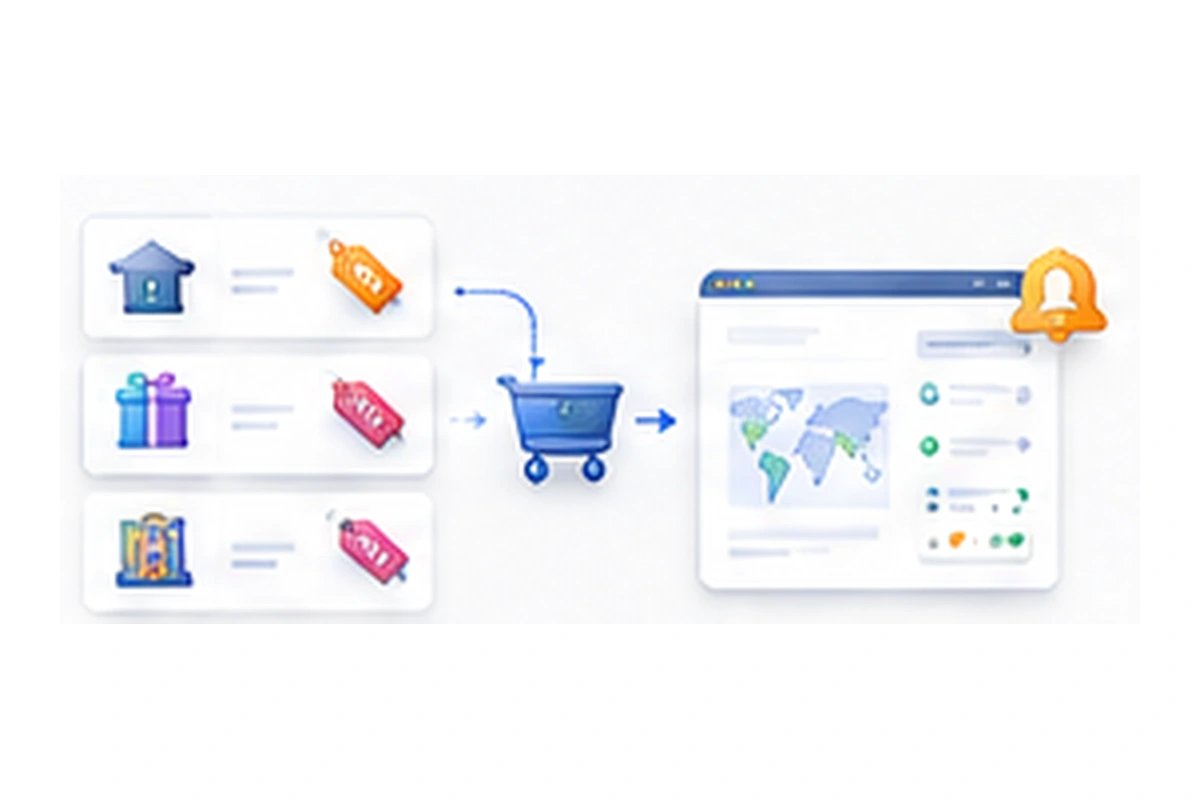
Customer-visible fees change with the transaction context
Shipping, delivery, service, and handling charges often change with location, basket value, free-delivery thresholds, promotions, and checkout timing.
Teams that capture a single fee amount without that context cannot compare competitors reliably or explain why the same retailer shows different charges across scenarios.
A managed monitoring workflow records the customer-visible fee components together with the location, basket, threshold, and observation context needed for analysis.
For item-price and assortment monitoring, see price intelligence solutions.
Shipping and Delivery Fee Monitoring Services
Nenodata scopes approved ecommerce, grocery, restaurant, and delivery sources, the fee components to observe, location and basket scenarios, refresh needs, and delivery format before collection begins.
Each observation preserves the customer-visible labels shown at checkout or delivery selection, then maps comparable charges into normalized categories for downstream analysis.
Related retail and catalog work can sit alongside broader retail and ecommerce data when product, assortment, or seller fields are also required.
What this service does not cover
This service does not provide carrier shipment tracking, warehouse operations data, private account balances, or fees that are only available after login unless separately authorized and reviewed.
It also does not replace pricing intelligence for product prices. Use fee monitoring when the commercial question is about customer-visible shipping and delivery charges rather than item prices alone.
Fee monitoring vs item price and grocery feeds
Use this page for customer-visible checkout fees by ZIP, basket, and free-delivery threshold. Use price intelligence for item prices, or Instacart scraping for ZIP/store grocery SKUs — not checkout fees.
| Source | Best for | Learn more |
|---|---|---|
| Fee monitoring | Displayed delivery/service fee, ZIP, basket, threshold | This service |
| Price intelligence | Competitor item prices and assortment — not checkout fees | Price intelligence |
| Instacart | ZIP/store grocery product price and availability | Instacart scraping |
Illustrative fee-monitoring output
Illustrative example
This record is illustrative and is not an approved Nenodata deliverable or customer result. Final fields depend on project scope and what approved public sources display.
{
  "source": "Best Buy",
  "source_url": "https://www.bestbuy.com",
  "location": "10001",
  "basket_value": 48.5,
  "currency": "USD",
  "displayed_label": "Delivery fee",
  "normalized_category": "delivery_fee",
  "amount": 5.99,
  "free_delivery_threshold": 35.0,
  "promotion_message": "none",
  "observed_at": "2026-08-13T14:00:00Z"
}| Displayed label | Normalized category | Amount | Location | Basket value | Observed at |
|---|---|---|---|---|---|
| Delivery fee | delivery_fee | 5.99 | 10001 | 48.50 | 2026-08-13T14:00:00Z |
| Service fee | service_fee | 2.49 | 10001 | 48.50 | 2026-08-13T14:00:00Z |
Data fields and outputs
Final fields and formats are confirmed during scoping based on approved sources and destination requirements. Related delivery design may also use custom data pipelines.
Source and observation context
- • Source or retailer label
- • Source URL where available
- • Observation timestamp
- • Collection reference
Fee components
- • Displayed fee label
- • Normalized fee category
- • Amount
- • Currency
Delivery and threshold context
- • Delivery option or method where shown
- • Estimated delivery information where shown
- • Free-delivery threshold where shown
- • Distance or zone context where shown
Product, retailer, restaurant, and basket context
- • Item or basket subtotal
- • Basket composition notes where scoped
- • Retailer or restaurant identifier
- • Category or cuisine context where shown
Promotions and free-delivery conditions
- • Promotion message where shown
- • Membership or loyalty message where shown
- • Threshold condition text where shown
- • Qualification note where applicable
Metadata and validation fields
- • Validation status
- • Change flag where scoped
- • Null-handling note
- • Schema version
Confirmed delivery formats
- • CSV
- • Excel
- • JSON
- • Database-ready files
- • Structured import files
Use cases
Competitor shipping fee monitoring
Compare publicly displayed shipping and delivery charges across agreed competitor sources under matched location and basket scenarios.
Free-shipping threshold monitoring
Track free-delivery or free-shipping thresholds as they appear to customers so merchandising and pricing teams can compare qualification conditions.
Location-based delivery fee tracking
Capture fee differences across ZIP codes, postcodes, cities, or delivery zones when those inputs are supported by the approved sources.
Checkout fee monitoring
Record customer-visible checkout charges such as delivery, service, and handling fees together with the labels shown at the point of decision.
Restaurant and grocery zone benchmarking
Benchmark delivery and service charges across restaurant and grocery sources where zone or location inputs change the customer-facing total. Related work may include grocery data extraction.
Market-entry and service-area research
Support market-entry reviews by collecting publicly displayed delivery fees and thresholds across target service areas.
Ecommerce shipping cost monitoring
Monitor shipping-cost presentations on ecommerce checkout or shipping calculators for agreed products, baskets, and destinations.
Historical fee-change analysis
Retain timestamped observations so teams can review how displayed fees and thresholds changed across agreed collection windows.
Who this service is for
This service is for ecommerce, grocery, restaurant, marketplace, pricing, and operations teams that need structured records of customer-visible shipping and delivery charges.
It also fits analytics and competitive-intelligence teams comparing fee components, thresholds, and location scenarios across agreed digital sources.
It is not intended for carrier shipment tracking, private account data, or teams seeking product-price intelligence alone.
How the managed workflow works
Share requirements
Define sources, locations, basket scenarios, fee components, refresh needs, preferred format, and the system that will consume the records.
Configure and collect
Nenodata assesses source feasibility and configures collection around the approved customer-facing fee contexts. Related extraction work may use enterprise web scraping where broader field extraction is also required.
Clean and validate
Displayed labels, amounts, thresholds, and context fields are structured, validated, and normalized according to the agreed schema without inventing missing values.
Deliver and maintain
Records are delivered in the confirmed format. Maintenance continues where included in the agreed support scope as supported page structures change.
Why choose Nenodata
See also case studies for related delivery and extraction engagements, Shopify data scraping services, Shopee data scraping services, Shein USA data scraping, and enterprise web scraping.
Start with a scoped sample
Required fields are reviewed against approved sources before broader production collection begins.
Define the customer context
Location, basket, threshold, and timing context are scoped so observations remain comparable across scenarios.
Normalize without losing source meaning
Original customer-facing labels stay available alongside normalized fee categories for audit and analysis.
Design the output for downstream use
Schema and delivery method are confirmed so records can fit analytics, pricing, or application workflows.
Use a managed collection workflow
Nenodata maintains the approved collection process where support is included, reducing reliance on fragile one-off scripts.
Work within defined source boundaries
Collection stays within approved public or permissioned boundaries. Private or restricted access is not assumed.
Delivery and downstream integration
Depending on the approved requirements, records can be prepared for spreadsheet analysis, structured-file import, or downstream systems where scoped during project planning.
Formats and destinations are confirmed during project scoping rather than treated as universally available for every engagement.
- CSV
- Excel
- JSON
- Database-ready files
- Structured import files
Frequently asked questions
Request a scoped fee-data sample
Share the sources, locations, basket scenarios, and fee components you need monitored. Nenodata will review feasibility and recommend the next sample or demo step.
Include representative source URLs, locations or zones, basket assumptions, required fee fields, preferred format, and whether the need is one-time or recurring.
Or contact Nenodata.