Travel Data Intelligence
Reviewed by: Pending technical review
Flight Price Data Intelligence: How to Build Comparable Airfare Data
Flight price data intelligence is the structured collection, normalization, and analysis of airfare observations across defined routes, travel dates, airlines, sellers, and booking conditions.
It answers a harder question than "What price appeared?": was this the same itinerary and fare product as the one observed earlier?
Data-use note: Public visibility does not automatically establish permission for every form of automated collection, storage, reuse, or redistribution. Review each source, access method, data category, jurisdiction, and intended use. This article is operational guidance, not legal advice.
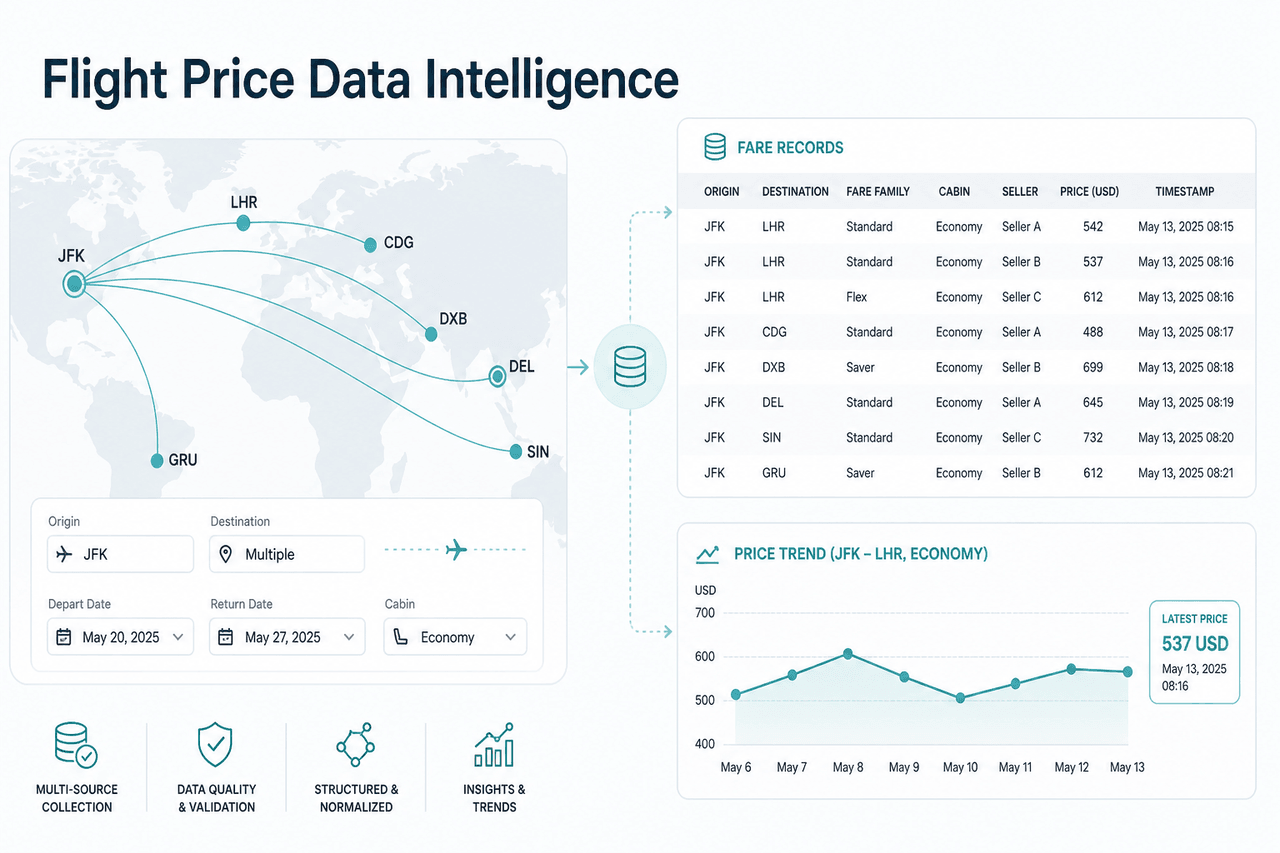
What flight price data intelligence includes
- Define routes, dates, passenger details, cabins, and markets to search
- Record publicly displayed fares and itinerary information from approved sources
- Convert source-specific results into a consistent data structure
- Determine which offers are genuinely comparable
- Store timestamped observations so changes can be measured
- Deliver records to analytics systems, databases, dashboards, or applications
A price tracker can show a move from $315 to $279, but price intelligence preserves enough context to determine whether this is the same itinerary and fare product or a fundamentally different offer.
Who needs airfare intelligence?
- Airlines and revenue teams studying routes, departure windows, and competitor offers
- OTAs and metasearch platforms comparing displayed offers across channels
- Travel technology and analytics companies building route or fare analysis products
- Corporate travel and research teams retaining historical observations for booking-window analysis
What fields should a flight-price dataset contain?
| Data group | Recommended fields |
|---|---|
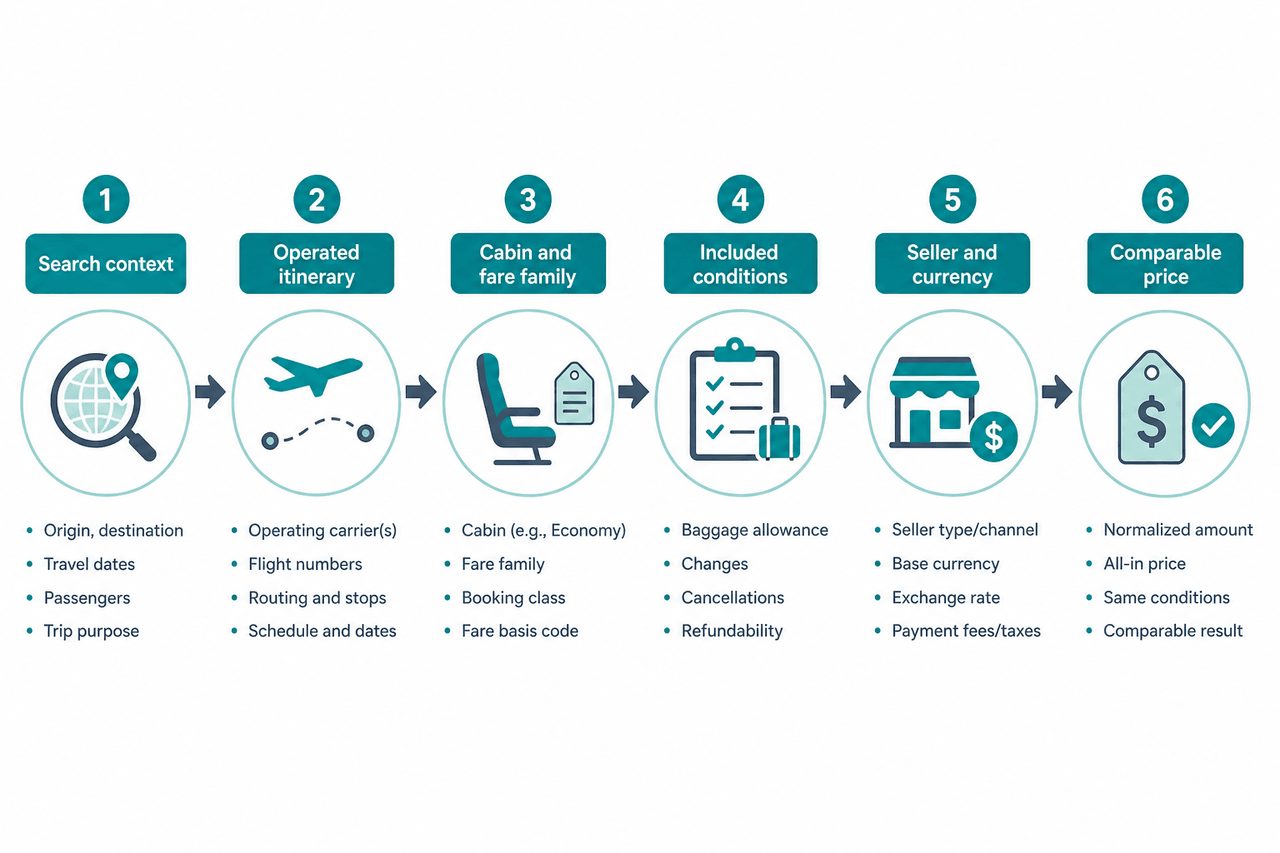
| Search context | Origin, destination, departure date, return date, passenger count, cabin requested, point of sale, locale, currency |
| Itinerary | Marketing carrier, operating carrier, flight number (where displayed), departure/arrival times, duration, stops, connection airports |
| Fare | Displayed total, base fare and taxes (if separated), currency, cabin, fare family, trip type |
| Conditions | Refundability, change restrictions, baggage allowances, seat conditions (where displayed) |
| Source context | Seller, source type, source URL/identifier, collection timestamp |
| Data quality | Availability state, extraction status, validation status, match status, exception code |
The collection timestamp is essential. A price without an observation time cannot support reliable historical analysis.
If you need a scoped workflow for publicly visible routes and fare conditions, see travel data scraping services.
A practical fare-matching model
Two offers with the same origin and destination can represent different products. A defensible matching order is: match search context, match operated itinerary, compare cabin/fare family, compare included conditions, confirm seller/currency, then compare the displayed price.
| Match state | Meaning | Illustrative example |
|---|---|---|
| Exact comparable | The core itinerary and relevant fare conditions align | Same operated flight, cabin, fare family, baggage, and seller context |
| Conditionally comparable | The itinerary aligns, but one commercial condition differs | Same flight and cabin, but different refund terms |
| Market alternative | The offer serves the same route but represents another travel product | Nonstop flight compared with a one-stop option |
| Not comparable | The search or itinerary differs materially | Different travel date, cabin, or destination airport |
| Review required | The source does not expose enough information | Fare family or operating carrier is unclear |
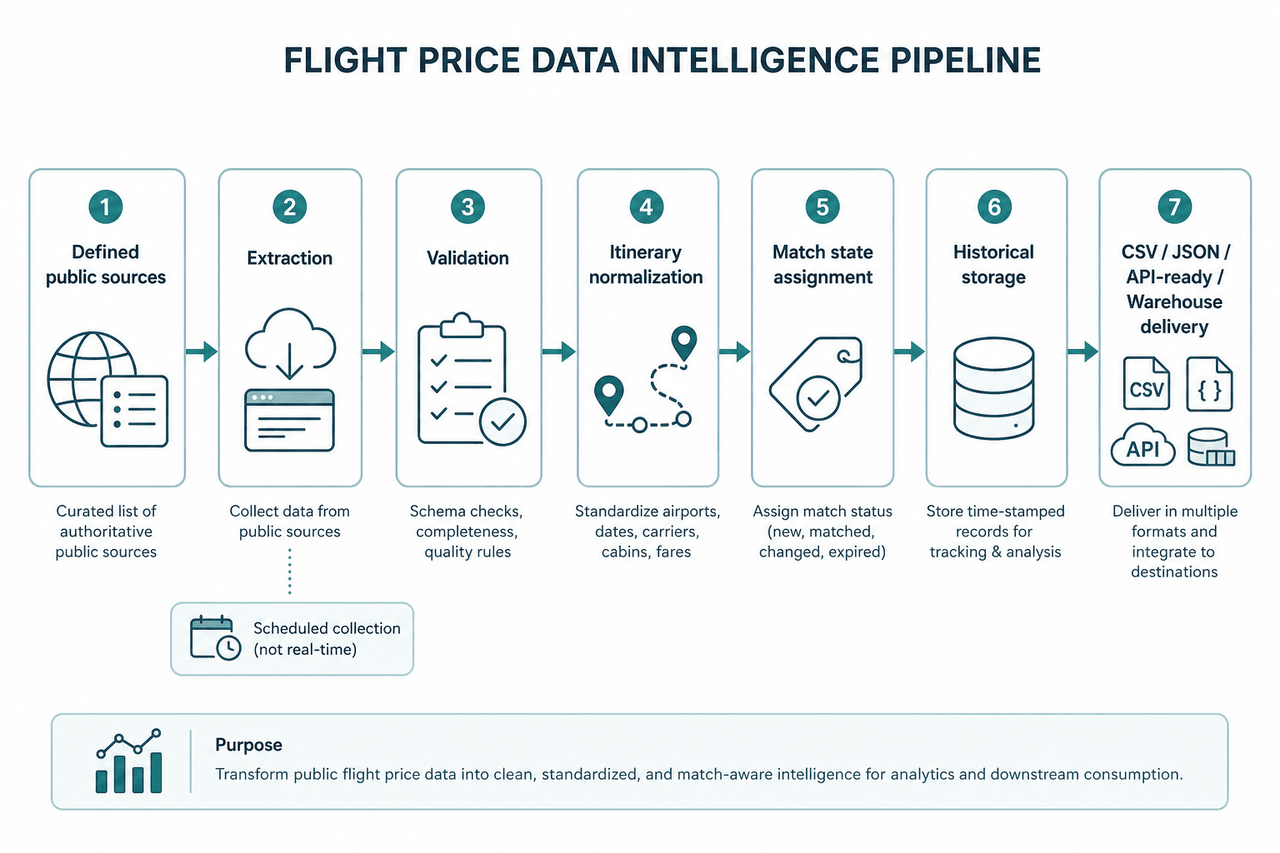
How a flight-price data pipeline works
- Define the search matrix: origins/destinations, dates, passenger details, cabin, point of sale, locale/currency, stop limits, sources, and refresh frequency.
- Review source feasibility: ensure required fields appear consistently, searches reproduce, and access method/terms are suitable.
- Extract without erasing context: retain original labels/values, identifiers, timestamps, and missing-field indicators.
- Normalize comparable records: standardize airport identifiers, preserve time zones, distinguish marketing vs operating carriers, and map fare families/cabins.
- Validate and classify failures: check required search fields, currency presence, time consistency, stop counts, and match status.
- Retain historical observations: do not overwrite prices; store what changed and when (including unavailability reasons).
- Deliver the data: CSV, JSON, API-ready records, databases/warehouses, and scheduled outputs.
If you also track adjacent pricing signals, you may find Price intelligence useful as complementary context.
For broader delivery and maintenance details, see How Nenodata works and Data extraction and web scraping services.
Data-quality problems to plan for
- Incomplete fare context (missing fare family, baggage, refund rules, or conditions)
- Currency differences (store original currency, conversion rate, and timestamp)
- Fare-family substitution (basic fare disappears but another fare appears)
- Codeshare duplication (preserve seller-facing listings while assigning operated-itinerary identity)
- Ambiguous unavailability (separate no itinerary returned vs extraction failure vs parsing issues)
- Stale records (expose last successful and last attempted collection)
How often should fares be collected?
There is no universal refresh cadence. The right schedule depends on business purpose, number of routes and sources, departure horizon, market volatility, required response time, and feasibility.
Ask vendors to define numeric collection intervals. Labels like "real time" are less informative than the actual collection/processing/delivery delay.
Choosing the right airfare-data option
| Option | Best fit | Main limitation |
|---|---|---|
| Airline rate-shopping platform | Revenue teams needing an established interface and pricing workflow | May not provide the required raw schema or custom source |
| Licensed airfare dataset | Organizations needing broad coverage and historical depth | May be excessive for a narrowly scoped requirement |
| Commercial API | Applications using documented endpoints | Many APIs focus on schedules/status rather than fares |
| Internal extraction system | Teams with ongoing maintenance capacity | Source changes and monitoring remain your responsibility |
| Managed custom pipeline | Teams needing selected public sources and structured delivery | Feasibility must be assessed source-by-source |
A managed custom workflow is usually most relevant when off-the-shelf data omits a required source/field and you need a customer-defined schema. If you also care about monitoring methodology, see Price intelligence guide.
How to scope a flight-fare data request
- Define the business question (for example: compare economy fare changes across channels)
- Supply the search dimensions (routes, point of sale, dates, return/one-way, passengers, cabin/fare requirements)
- Separate required vs optional fields
- Specify sources (mandatory and optional) and include example URLs where possible
- Define refresh cadence, delivery delay tolerance, and historical retention
- Specify output requirements (CSV, JSON, API-ready records, validation rules, match/duplicate policy)
Request a representative sample first
A useful sample uses the actual routes, search conditions, sources, and fields that matter to your proposed project.
- Two or three representative routes and departure horizons
- Cabin and fare-product requirements
- Passenger and point-of-sale context
- Target public sources and mandatory fields
- Refresh expectation and preferred delivery format
Use the sample to confirm field visibility, itinerary identification reliability, fare-condition clarity, and comparability.
Request a Flight-Fare Data Sample
Include the routes, required fare fields, and refresh/retention expectations so Nenodata can confirm feasibility and prepare an appropriate sample output.