What Is Price Scraping?
Instead of manually checking competitor websites, automated tools gather pricing data such as: product name, price, discounts or promotions, stock availability, product variations, and customer ratings or reviews.
- name
- price
- promotion
- availability
- variation
- rating
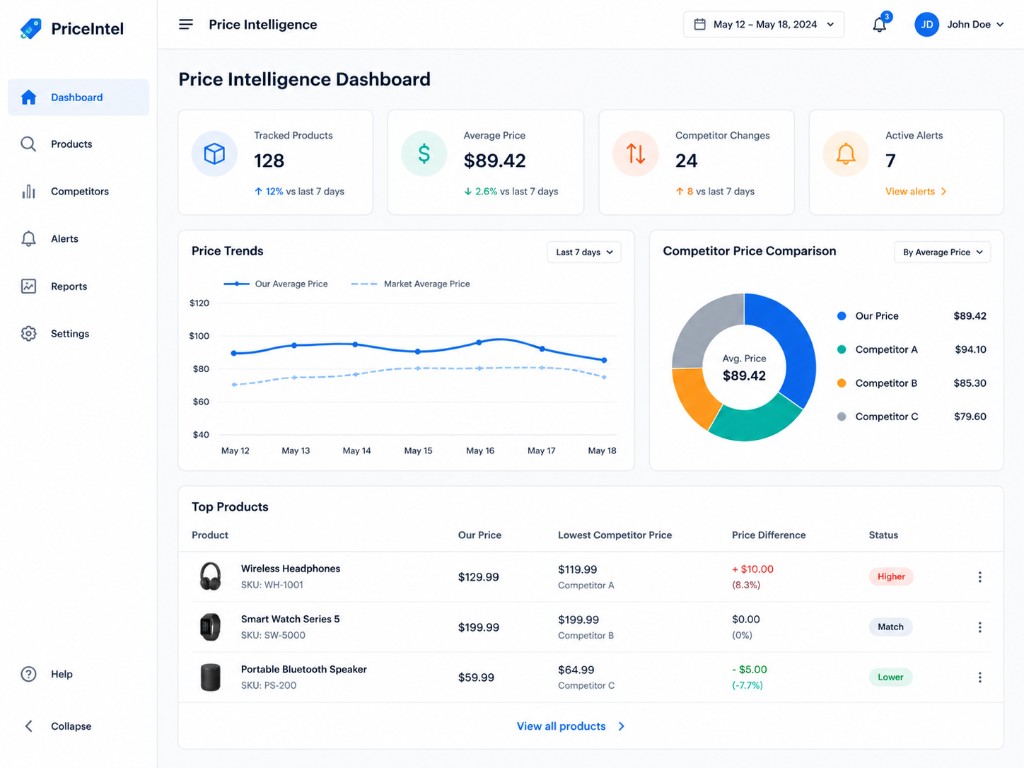
The collected data is then structured into datasets that businesses can analyze to support pricing strategies and market research.
Price scraping is widely used in industries like eCommerce, travel and hospitality, retail, consumer electronics, and market research.
How Price Scraping Works
Price scraping typically follows a structured workflow.
01 Target Websites
1. Identifying Target Websites
Businesses first identify competitor websites, marketplaces, or price comparison platforms they want to monitor—online stores, marketplaces, product catalogs, and comparison websites.
Online store → Marketplace → Product catalog → Comparison website
02 Extract
2. Data Extraction
A scraper or bot automatically visits product pages and extracts relevant pricing information from the website's HTML. This process can use web scraping scripts, APIs, or automated crawlers.
Website page → Scraper / API / crawler → Extracted fields
03 Clean & Structure
3. Data Cleaning and Structuring
Extracted data is often messy. The scraper organizes it into usable formats such as CSV, Excel, databases, or data dashboards.
Raw data → Clean/structure → CSV / Excel / Database / Dashboard
04 Analyze
4. Data Analysis
Businesses analyze scraped data to gain insights such as competitor pricing strategies, price fluctuations, promotional trends, and product demand patterns—supporting data-driven pricing decisions.
Structured pricing data → Analysis → Pricing decisions
Why Businesses Use Price Scraping
Price scraping has become a core part of modern competitive intelligence.
01
Competitive Price Monitoring
Companies constantly monitor competitors' prices to stay competitive in crowded markets.
02
Dynamic Pricing Strategies
Businesses use scraped data to automate pricing adjustments (lower when competitors reduce, raise when demand increases, match during promotions).
03
Market Research
Insights about product demand, market trends, and consumer preferences.
04
Inventory Optimization
Identify underpriced products, profitable pricing opportunities, and potential inventory gaps.
05
Time and Cost Efficiency
Automated scraping eliminates manual competitor monitoring.
Key Data Collected Through Price Scraping
Price scraping tools collect more than just product prices. Common data points include:
- Product titles, prices, discount percentages, shipping costs
- Product availability, SKU or product identifiers
- Customer ratings, seller information
Product Identity
- Product titles
- SKU or product identifiers
Pricing
- Prices
- Discount percentages
- Shipping costs
Availability
- Product availability
Marketplace Context
- Customer ratings
- Seller information
Example field structure
Price Scraping vs Web Scraping
Price scraping is a specialized type of web scraping focused on pricing data.
| Feature | Price Scraping | Web Scraping |
|---|---|---|
| Focus | Pricing data | Any web data |
| Use Case | Competitor pricing analysis | Market research, content extraction |
| Common Users | Retailers, ecommerce companies | Researchers, developers |
Industries That Use Price Scraping
eCommerce
Online stores adjust prices automatically and remain competitive.
Travel Industry
Airlines and hotel booking platforms track competitors' pricing.
Retail Chains
Retailers monitor competitor pricing across multiple locations.
Market Research Firms
Analysts collect pricing data for industry insights.
Popular Price Scraping Tools
Many tools help businesses automate competitor price monitoring.
1. Price Monitoring Platforms
Tools like Price2Spy, Prisync, and Competera specialize in competitor price tracking and analysis.
Price2Spy · Prisync · Competera
2. Web Scraping Frameworks
Developers build custom scrapers using Scrapy , BeautifulSoup , Puppeteer , and Selenium .
3. No-Code Scraping Tools
For non-technical users: Octoparse, ParseHub, and Apify .
For enterprise-scale solutions, explore our price intelligence and ecommerce data services.
Challenges of Price Scraping
While powerful, price scraping comes with challenges.
Anti-Bot Protection
Many websites use CAPTCHA, rate limiting, and bot detection.
CAPTCHA · Rate limit · Bot detection
Website Structure Changes
Layout updates can break scraping scripts.
Page structure v1 → Layout change → Scraper requires maintenance
Data Quality Issues
Product matching across competitors can be difficult.
Product A ↔ Product A variant → Matching challenge
Legal and Ethical Considerations
Best Practices for Effective Price Scraping
Consistent fields → Regular collection → Validation → Analytics
01
Use Structured Data Extraction
Ensure consistent fields like product name, SKU, and price.
02
Schedule Regular Scraping
Many businesses scrape multiple times daily.
03
Validate Data Quality
Use automated checks for missing or incorrect data.
04
Combine With Analytics
Integrate into dashboards or BI tools for deeper analysis.
FAQ: Price Scraping
What is price scraping?
Price scraping is the automated process of collecting product pricing data from websites using specialized tools or scripts.
Is price scraping legal?
Price scraping is generally legal when it collects publicly available information and follows website terms of service and data regulations.
Why do companies use price scraping?
Businesses use price scraping to monitor competitor prices, optimize pricing strategies, and analyze market trends.
What tools are used for price scraping?
Common tools include dedicated price monitoring platforms, web scraping frameworks like Scrapy and BeautifulSoup, and no-code scraping tools.
How often should competitor prices be scraped?
Many companies collect competitor price data multiple times per day to track changes and stay competitive.
Related Nenodata Services
- ServicePrice IntelligenceManaged competitor pricing datasets and monitoring workflows
- ServiceEcommerce Data SolutionsBroader product, catalog, and marketplace extraction
- ServiceLive CrawlerNear-real-time price and availability change detection
Continue Reading
- Ecommerce Price Scraping GuideEcommerce-specific monitoring patterns
- Competitive Price IntelligenceTurning scraped prices into pricing strategy
- What Is a Live Crawler?Low-latency monitoring vs batch scraping
External Resources
Conclusion
Price scraping has become an essential tool for modern businesses competing in digital markets. By automatically collecting competitor pricing data, companies gain valuable insights that help them optimize pricing, improve market positioning, and identify new opportunities.
When combined with analytics and automation, price scraping transforms raw pricing data into actionable intelligence.
Raw pricing data → actionable intelligence
For organizations in fast-moving industries like eCommerce and retail, leveraging price scraping effectively can provide a powerful competitive advantage. Contact us to learn how our price intelligence solutions and data extraction services can help.