Hotel Pricing Monitoring for Comp-Set Rate Parity
Nenodata Hotel Pricing Monitoring focuses on competitor rate visibility across OTAs and booking channels—comp sets, stay dates, room and rate-plan signals, and refresh cadence—delivered as structured feeds for revenue and parity workflows. For broader hotel listing extraction, see hotel data scraping services. For multi-source travel pricing programs, see hotels and travel price data scraping.
Why Manual Hotel-Rate Checks Break Down
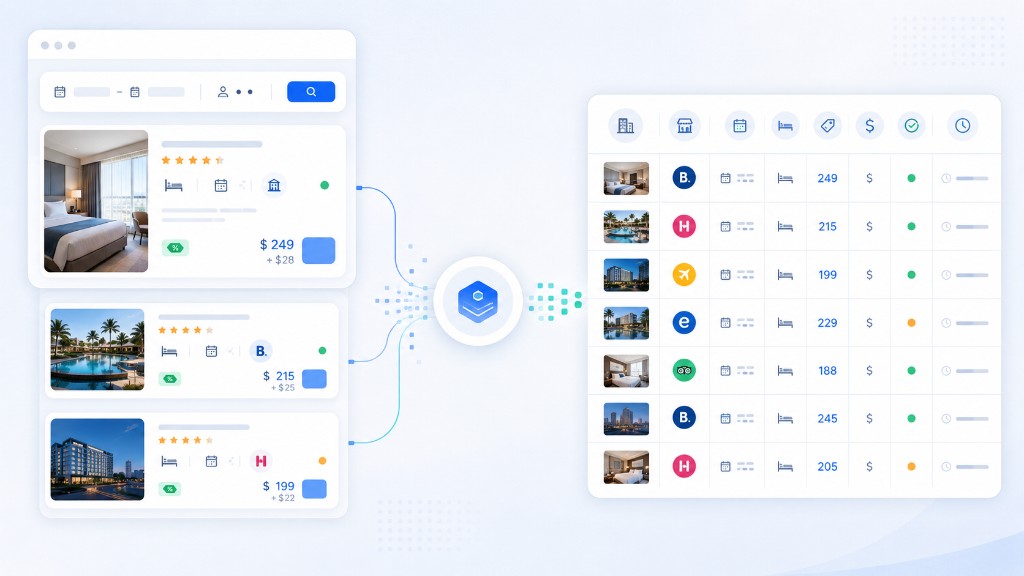
Revenue teams often rely on spot checks across OTAs, metasearch sites, and direct booking pages to understand competitor pricing. A rate copied manually into a spreadsheet may already be outdated by the time it is reviewed, and the comparison context—stay dates, room type, occupancy, or booking channel—can be lost in the process.
Manual checks become harder when comp sets span multiple markets, length-of-stay combinations, or promotional rate plans. Spreadsheet workflows do not scale cleanly, and basic scripts struggle when page layouts change, search inputs affect results, or fields are labeled inconsistently across channels.
Pricing teams need structured competitor rate data with stable field definitions, agreed refresh expectations, and output that can move into parity review, revenue reporting, and analytics workflows without rebuilding the dataset each cycle.
What Nenodata Provides for Hotel Pricing Monitoring
Nenodata configures scoped collection workflows around the hotel-rate monitoring requirements your team defines. That includes target booking sources, competitor properties, markets, stay-date logic, required fields, refresh expectations, and delivery destination.
Depending on approved scope, outputs can include property identifiers, stay context, room and rate-plan signals, nightly or total price fields, currency, availability status, booking channel, promotion text, and collection timestamps where those elements are publicly visible and included in the agreed schema.
Source coverage, field availability, refresh cadence, and delivery formats are confirmed during scoping rather than assumed in advance.
Hotel pricing vs hotel data and OTA hubs
Use this page for the same hotel across channels (comp-set / rate parity). Use hotel data scraping for listing-level hotel records, or the OTA hub for multi-OTA travel pricing.
| Source | Best for | Learn more |
|---|---|---|
| Hotel pricing | Same property, two channels, stay date, LOS, parity delta | This service |
| Hotel data scraping | Hotel listing, amenities, and property-level extraction | Hotel data scraping |
| OTA hub | Multi-OTA hotel/flight rates and availability feeds | OTA data scraping |
Sample output and proof
Use an illustrative sample to confirm field names, comp-set coverage, stay-date logic, and output format before configuring recurring monitoring.

| Property | Channel | Check-in | LOS | Room | Rate | Currency | Timestamp |
|---|---|---|---|---|---|---|---|
| The Langham, Chicago | Booking.com | 2026-09-18 | 2 | Deluxe King | 429.00 | USD | 2026-08-12T08:40:11Z |
| The Langham, Chicago | Expedia | 2026-09-18 | 2 | Deluxe King | 449.00 | USD | 2026-08-12T08:40:11Z |
| The Langham, Chicago | Direct | 2026-09-18 | 2 | Deluxe King | 419.00 | USD | 2026-08-12T08:40:11Z |
{
  "collection_timestamp": "2026-08-12T08:40:11Z",
  "property_name": "The Langham, Chicago",
  "property_id": "langham-chicago",
  "booking_channel": "Booking.com",
  "check_in_date": "2026-09-18",
  "check_out_date": "2026-09-20",
  "length_of_stay": 2,
  "occupancy": 2,
  "room_type": "Deluxe King",
  "rate_plan": "Flexible",
  "rate": "429.00",
  "currency": "USD",
  "taxes_and_fees_text": "Includes taxes and charges",
  "availability_status": "Available",
  "promotion_text": null,
  "parity_delta_vs_direct": "10.00",
  "property_url": "https://www.booking.com/hotel/us/the-langham-chicago.html"
}
Illustrative CSV-style field list
collection_timestamp,
property_name,
property_id,
booking_channel,
check_in_date,
check_out_date,
length_of_stay,
occupancy,
room_type,
rate_plan,
rate,
currency,
taxes_and_fees_text,
availability_status,
promotion_text,
property_url
Field availability can vary by source, market, stay context, and project scope.
Data Fields and Outputs
Grouped hotel-rate data fields for property context, stay context, pricing context, and delivery formats.
Property context
- • Property name and identifier
- • Brand or chain where displayed
- • City, market, or destination
- • Star category where available
- • Property URL
- • Source or channel name
Stay context
- • Check-in and check-out dates
- • Length of stay
- • Occupancy where required for comparison
- • Search or market input context
- • Collection timestamp
Pricing context
- • Room type and rate plan
- • Nightly or total price
- • Currency
- • Taxes and fees text where displayed
- • Promotion or package text
- • Availability status
Delivery formats
- • CSV or Excel for analyst workflows
- • JSON for engineering pipelines
- • API-ready structured records
- • Scheduled feeds where scoped and confirmed
- • Database or warehouse-ready files where confirmed
Use cases
Comp-set rate tracking
Monitor agreed competitor properties across booking channels so revenue teams can review current rate positions without manual OTA checks.
OTA vs direct rate comparison
Compare channel-level rate signals for the same stay context to support distribution and parity review workflows.
Length-of-stay pricing review
Collect rate signals across multiple stay lengths to study how competitors price short stays, weekends, or extended bookings.
Promotional rate detection
Track promotion text and package signals where publicly displayed so teams can spot discount campaigns affecting market positioning.
Market-rate benchmarking
Build structured datasets for destination or market-level benchmarking using scoped property and rate fields.
See market intelligence data for broader research workflows.
Revenue reporting feeds
Deliver cleaned competitor rate data into spreadsheets, BI tools, or internal reporting workflows on an agreed schedule.
Who This Is For
This service fits hotel revenue managers, distribution teams, hospitality analytics groups, travel-tech platforms, and market intelligence teams that need structured competitor hotel-rate data from agreed public booking sources.
It also supports organizations that want monitored rate feeds without dedicating internal engineering capacity to maintaining brittle collection scripts across changing OTA and direct-booking pages.
How It Works
Share brief
Define target sources, comp sets, markets, stay-date logic, required fields, refresh expectations, and delivery destination so Nenodata can scope the monitoring workflow.
Configure collection
Nenodata sets up the extraction workflow around the agreed input model, including property lists, booking paths, and comparison context needed for usable rate records.
Clean and validate
Collected records are standardized, reviewed for completeness, and prepared in the agreed schema. Inconsistent or incomplete entries can be reduced before delivery.
Deliver feed
Receive output once or on a recurring schedule via agreed formats and destinations. Nenodata maintains the configured workflow as sources and requirements evolve.

Why Choose Nenodata
Scoped sources before setup
Projects begin with a review of target OTAs, direct booking paths, markets, and fields—not a promise to monitor every channel without scoping.
Comparison-ready rate context
Outputs preserve stay dates, room context, channel, currency, and timestamps where available so teams can compare rates with fewer manual adjustments.
Fits revenue workflows
Structured feeds can be prepared for parity review, revenue reporting, spreadsheets, APIs, and analytics tools once formats are confirmed.
Sample-first schema review
A representative sample helps confirm field names, source coverage, and comparison logic before recurring delivery is configured.
Built for hospitality pricing teams
The workflow is scoped around hotel-rate monitoring use cases rather than generic page scraping without pricing context.
Delivery and Integrations
Depending on approved scope, structured hotel-rate data may flow from agreed booking sources through Nenodata collection and validation into CSV, Excel, JSON, API-ready records, or downstream reporting workflows.
Teams often combine hotel-rate monitoring with broader pricing intelligence, market research, and extraction services depending on the use case.
Explore hotel data scraping services, hotels and travel price data scraping, OTA data scraping, and price intelligence services for related delivery patterns confirmed during scoping.
Frequently asked questions
Scope your hotel-rate monitoring workflow
Share target sources, comp sets, stay-date logic, required fields, refresh frequency, and delivery format when you contact Nenodata so the team can scope the monitoring workflow accurately.
Contact Nenodata to discuss sources, comp sets, and delivery format.