Smiles UAE Food & Grocery Data

Smiles UAE Data Scraping API for Food, Grocery & Pricing Data

Collect structured Smiles UAE restaurant, menu, grocery, pricing, promotion, availability, and delivery-context data from agreed sources for competitive intelligence, analytics, pricing, and product workflows.

NenoData scopes the Smiles source surfaces, UAE location context, required fields, schema, refresh requirements, validation rules, and delivery method before production collection begins.

  • Smiles UAE Food and Grocery workflows
  • Location-aware, schema-mapped records
  • JSON, API, file, or database delivery where scoped
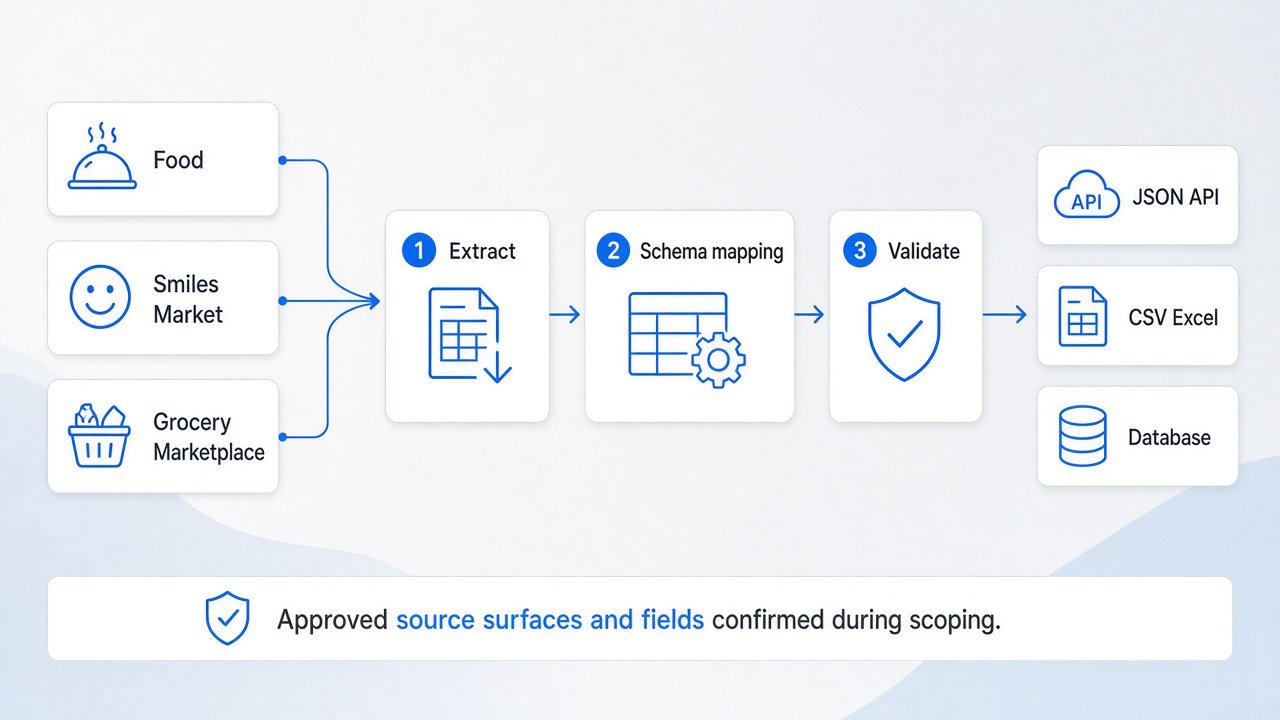
Smiles UAE Food and Grocery data moving through extraction, schema mapping, validation and structured delivery

What Smiles UAE data extraction means

Smiles UAE data scraping converts agreed information from relevant Smiles marketplace surfaces into structured records that teams can use in pricing analysis, competitive intelligence, research, BI, product systems, or other approved data workflows.

This page specifically refers to Smiles UAE, the UAE super app offering services that include food ordering and grocery shopping.

It does not refer to the unrelated airline-loyalty program also called Smiles.

For a NenoData project, Smiles extraction begins with a feasibility review. The source surfaces, locations, required fields, schema, refresh needs, validation rules, and destination are defined before production collection.

That distinction matters because a Smiles UAE data scraping API should not be interpreted as an unrestricted endpoint to everything inside the Smiles app. NenoData's broader Web Scraping API service is a managed, source-specific extraction and structured-delivery workflow rather than an unlimited open-web endpoint.

The objective is to turn agreed, collectable source values into records that downstream systems can actually use.

Which Smiles UAE surfaces can be scoped?

Smiles currently separates its consumer offering into multiple service categories. For this data-extraction page, the primary relevant surfaces are Food and Grocery.

Smiles Food Delivery and Pick Up

Smiles' current Food service includes delivery and pick-up and presents restaurant and offer information to users. Its official Food page also states that restaurant availability depends on the user's area.

A scoped Food workflow can therefore focus on restaurant, menu, pricing, promotion, availability, and delivery-related information that is visible on approved source surfaces.

Smiles Market

Smiles Market is Smiles' own grocery store experience for groceries, fresh produce, household products, and daily essentials.

A Smiles Market extraction scope can focus on visible product, category, pricing, promotion, and availability information where technically feasible and approved.

Grocery Marketplace / Grocery Retailers

Smiles also provides a Grocery Marketplace built around participating supermarkets and other retailers.

Smiles' own FAQ distinguishes this from Smiles Market: Smiles Market is its curated grocery store, while the broader Grocery Marketplace brings multiple retailers together.

This distinction should remain visible in the data model. A product observed in Smiles Market should not automatically be treated as equivalent to the same or similar product listed by an external grocery retailer.

Other Smiles categories

Smiles also operates other services, including pharmacies, home services, lifestyle offerings, telecom-related services, and rewards.

Those categories are not automatically included in this service page's extraction scope.

If a project requires another Smiles surface, NenoData should first verify the source, fields, permissions, technical feasibility, and appropriate data boundaries before representing it as supported.

Smiles Food restaurant and menu data

For restaurant and QSR teams, the useful unit is rarely just a restaurant name. Menu intelligence requires enough structure to understand the restaurant, menu hierarchy, item, price, offer, and location in which the observation was made.

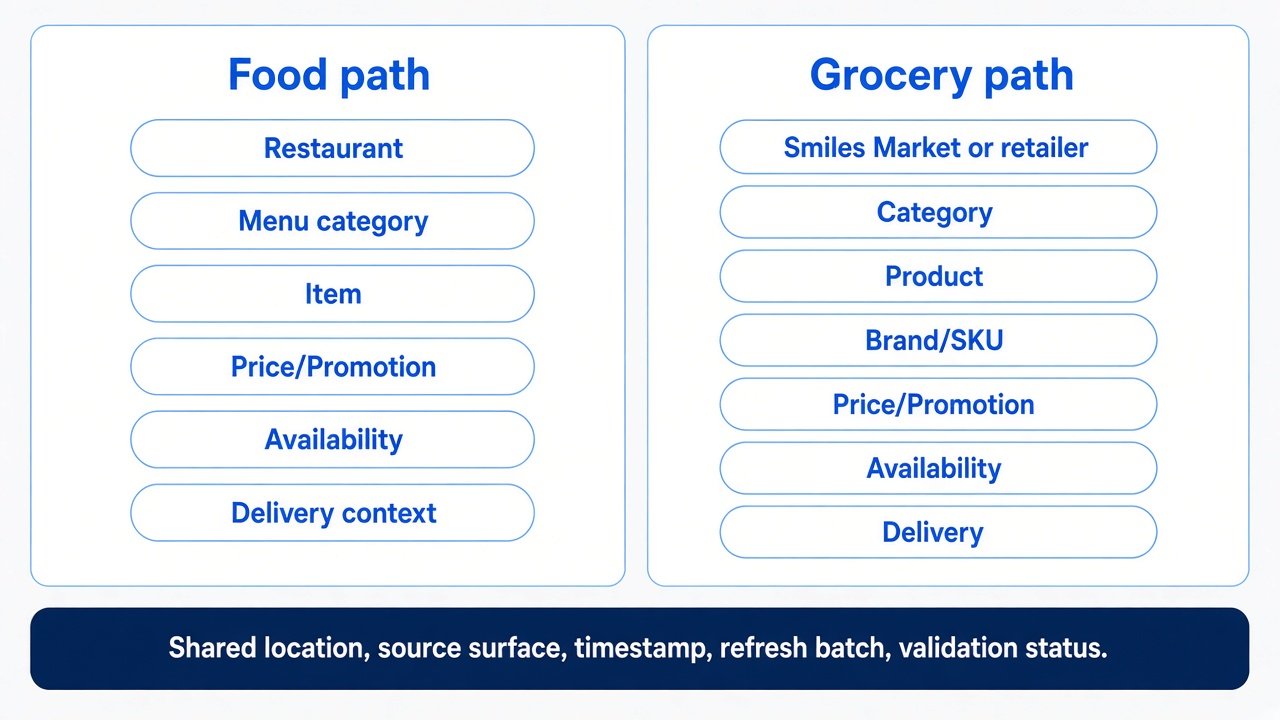
Subject to public visibility, source feasibility, and agreed scope, a Smiles Food dataset may include fields such as:

Candidate Smiles Food restaurant and menu fields
Field groupCandidate fields
RestaurantRestaurant name, source identifier where visible, cuisine/category, source URL
MenuMenu category, item name, item description
Item optionsModifier or add-on information where visible and scoped
PricingListed price, displayed discounted price, currency
PromotionsPromotion label, offer text, visible discount context
AvailabilityRestaurant or item availability signal where visible
DeliveryDelivery fee and estimated delivery time where visible
ReputationRating and review count only where publicly visible and scoped
LocationUAE location, city/area or other agreed serviceability context
MetadataSource surface, collection timestamp, refresh batch, validation status

These are candidate schema fields, not guaranteed fields for every restaurant or source surface.

Final availability should be established using representative Smiles sources during feasibility review.

Comparison of Smiles UAE Food and Grocery data schemas with shared location and validation context

Smiles Market and grocery product data

Grocery extraction needs a different schema from restaurant menus.

A scoped Smiles Market or Grocery Marketplace workflow may focus on visible product and retailer information such as:

Candidate Smiles Market and Grocery Marketplace product fields
Field groupCandidate fields
ProductProduct name, brand, category
Product identitySKU/product identifier where displayed
Retail contextSmiles Market, retailer/store name, source surface
PricingListed price, displayed discount price, AED currency
PromotionsOffer or promotion text where displayed
AvailabilityVisible product availability signal
DeliveryDelivery fee or delivery-time context where visible
LocationRelevant UAE location/serviceability context
MetadataSource URL, collected-at timestamp, refresh batch ID, validation status

Smiles' official material confirms that its grocery experience includes Smiles Market and a marketplace involving grocery retailers. It also states that users enter an address to determine which grocery retailers deliver to their area.

That makes retailer and location context important for a useful grocery dataset.

A price collected from one store or location should not automatically be treated as the universal Smiles UAE price for that product.

For multi-platform grocery monitoring, see NenoData Grocery Delivery App Scraping.

Pricing, promotions and delivery context

Smiles prominently uses discounts and offers across its Food and Grocery experiences. For monitoring projects, the important question is not simply “what is the price?” but what price or offer was visible, for which entity, in which context, and when?

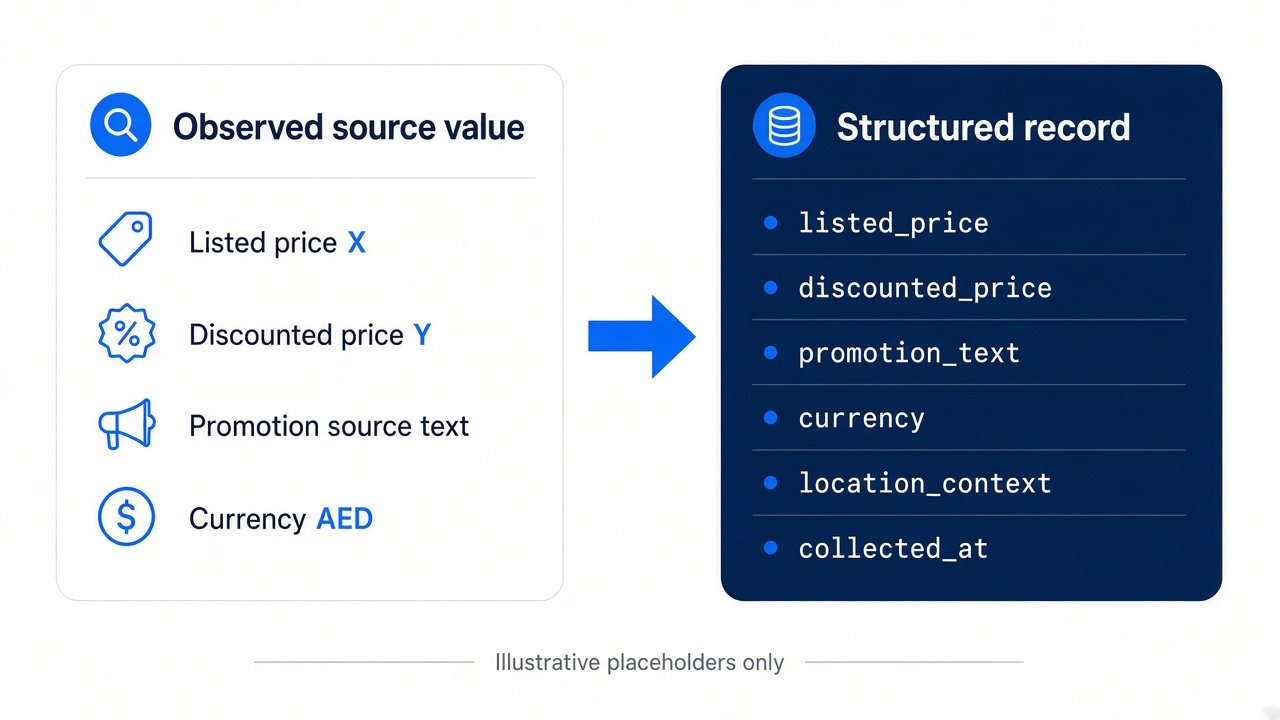
A structured observation can separate:

  • Listed price

    The displayed non-discounted price where available.

  • Discounted price

    A displayed reduced price where the source provides one.

  • Promotion or offer

    Visible promotional labels or offer text should remain separate from the base price rather than being converted into an inferred discount unless that calculation is explicitly part of the agreed transformation.

  • Currency

    For UAE-focused workflows, displayed monetary values should retain their currency context.

  • Delivery fee

    Smiles confirms that delivery fees can apply to Food and Grocery orders. A visible fee can be collected where the relevant source surface exposes it and it is included in scope.

  • Estimated delivery time

    Smiles' Food materials state that delivery timing can vary with distance and traffic, while its grocery pages indicate expected delivery timing during the ordering flow. ETA values should therefore be treated as contextual observations rather than permanent restaurant or store attributes.

  • Availability/serviceability

    A restaurant, retailer, product, or delivery option may depend on location. Visible availability should remain attached to the location and time in which it was observed.

Example mapping of displayed Smiles pricing and promotion values into structured data fields

UAE location and serviceability context

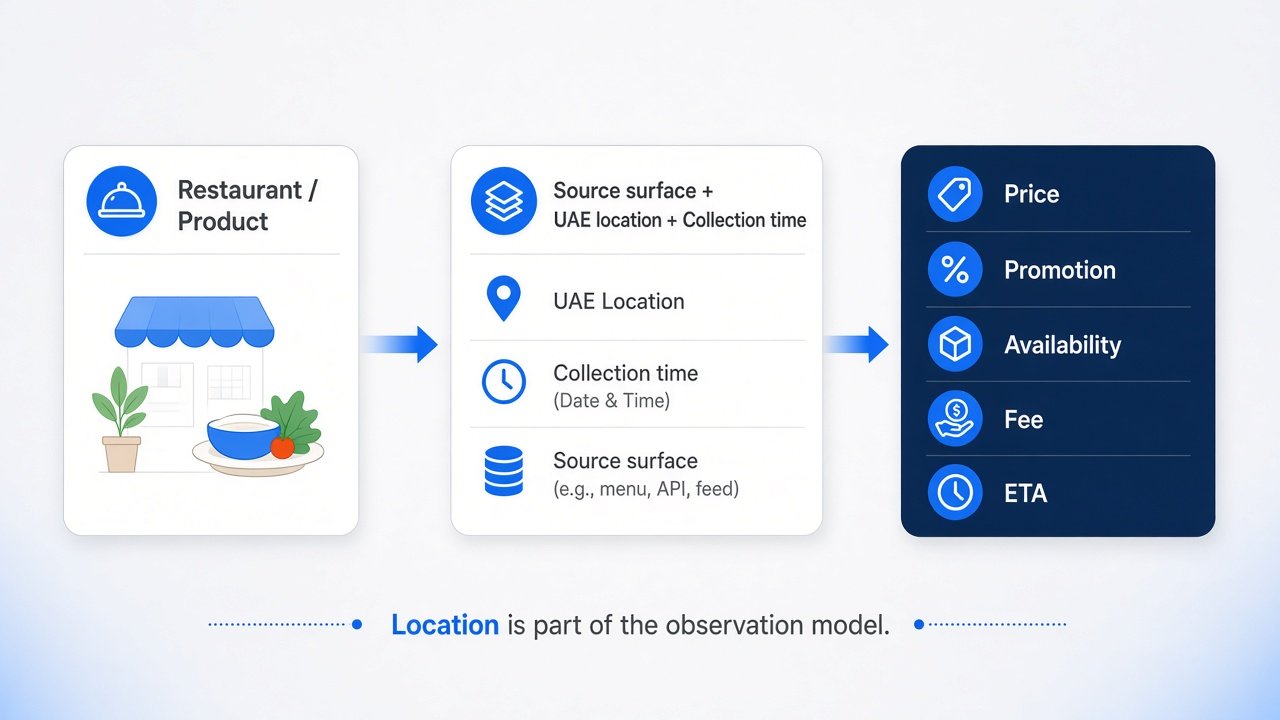
Location is part of the data model, not merely a collection setting.

Smiles tells users to enter an address to see restaurants and grocery retailers that deliver to their area. This means an observation without location context may be incomplete for competitive or market analysis.

Smiles UAE price, promotion, availability, fee and ETA observations tied to source, location and collection time

A location-aware record can preserve an agreed combination of:

  • Country or market
  • City where relevant
  • Area or other serviceability input where scoped
  • Restaurant, retailer, or store
  • Source surface
  • Collection timestamp
  • Delivery/serviceability state
  • Refresh batch

This enables downstream teams to distinguish, for example, a restaurant that is visible for one service area from a restaurant that was not observed under another collection context.

NenoData should not promise coverage for every UAE city, emirate, neighbourhood, restaurant, retailer, or delivery area. Requested locations must be checked during scoping.

For broader app-visible, location-sensitive workflows, see NenoData Mobile App Scraping Services.

What does a Smiles UAE data scraping API provide?

In this context, “API” refers to structured, programmatic delivery of the agreed extraction output.

NenoData's Web Scraping API service starts with approved sources, required fields, a schema, refresh requirements, validation rules, response format, and the downstream destination.

For a Smiles UAE project, that could mean mapping approved observations into JSON records or another structured delivery workflow for use by an application, analytics pipeline, warehouse, or other system.

It does not mean that this page represents an official Smiles developer API.

It also does not mean NenoData provides an unrestricted endpoint into Smiles' private systems or customer accounts.

Delivery options

Depending on feasibility and the agreed engagement, delivery may include:

JSON/API-oriented

For programmatic consumption

Scheduled feed

For recurring monitoring

CSV/Excel

For analyst workflows

Database/Warehouse

For downstream analytics infrastructure

Availability and cadence confirmed during scoping.

Smiles UAE structured data delivery options
Delivery modelUseful forScope consideration
JSON/API-oriented recordsApplications and internal data servicesAgree schema and integration behavior
Scheduled feedRecurring pricing or market monitoringAgree feasible cadence and batch structure
CSV/ExcelAnalyst workflows and straightforward importsAgree columns and file organization
Database/warehouse deliveryBI and analytics infrastructureConfirm destination and loading requirements
Other approved integrationsExisting data workflowsConfirm technical feasibility during scoping

NenoData's current services support JSON, CSV, Excel, API integration, and cloud/database or warehouse workflows where appropriate to the engagement.

Batch, scheduled, or on-demand behavior can be considered where source conditions and scope support it.

No Smiles-specific endpoint path, authentication mechanism, SDK, request parameter, rate limit, response-time guarantee, refresh interval, uptime figure, or SLA is implied here.

Illustrative structured Smiles UAE record

The following example shows how a Smiles Food observation could be represented after schema mapping.

It is an illustrative schema only. It is not a live API response, production endpoint contract, customer record, or guarantee that every field is collectable.

Illustrative schema — not a live API response or endpoint contract.

{
  "source": "smiles_uae",
  "source_surface": "food_delivery",
  "restaurant": {
    "name": "Example Restaurant",
    "source_id": "example-id"
  },
  "menu_item": {
    "category": "Mains",
    "name": "Example Item",
    "description": "Example description"
  },
  "pricing": {
    "listed_price": "42.00",
    "discounted_price": "35.00",
    "currency": "AED",
    "promotion_text": "Example visible offer"
  },
  "delivery_context": {
    "availability": "available",
    "delivery_fee": "8.00",
    "estimated_delivery_time": "example displayed ETA"
  },
  "location": {
    "market": "UAE",
    "city": "Example City",
    "area": "Example Area"
  },
  "source_url": "https://example.invalid/smiles-source",
  "collected_at": "YYYY-MM-DDTHH:mm:ssZ",
  "refresh_batch_id": "example-batch",
  "validation_status": "passed"
}

A grocery record would use product, brand, category, retailer/store, price, promotion, availability, and relevant location fields rather than forcing grocery data into a restaurant-menu schema.

The final names, types, nesting, required fields, and validation rules can be mapped to the customer's agreed schema.
Validation, normalization and schema handling

Extraction is only one part of a usable recurring data workflow.

  • Custom schema mapping

    Source values can be mapped into the field names, types, and nesting agreed for the downstream system. For example: displayed product price → unit_price or restaurant name → merchant_name when those mappings are defined during scoping.

  • Cleaning and normalization

    Records can be standardized according to project rules so that values such as currency, categories, price fields, timestamps, or source names are represented consistently.

  • Required-field validation

    Fields identified as required can be checked against agreed validation rules before delivery.

  • Missing values

    A missing field should not be replaced with an invented value. Where included in the project design, missing or unavailable values can be represented as nulls, exception states, or another agreed status.

  • Source and schema changes

    Smiles source structures can change. If an expected field moves, disappears, or changes representation, extraction and mapping logic may need review. NenoData's managed API and pipeline services support monitoring and maintenance where included in the agreed engagement; they do not imply that every future source change is automatically resolved without qualification.

  • Deduplication

    Where duplicate observations are possible, project-specific identifiers or matching rules can be used for deduplication when that transformation is included in scope.

  • Provenance

    Source URL or equivalent source metadata, collection timestamps, refresh-batch information, and validation state can be retained where required to help downstream teams understand where and when an observation originated.

Business use cases for Smiles UAE data

Restaurant menu benchmarking

Compare scoped restaurant menus, categories, item structures, and visible pricing across monitored restaurants.

Competitive menu-price monitoring

Track listed and discounted menu prices across successive collection periods while retaining restaurant, location, and timestamp context.

QSR pricing intelligence

Organize restaurant and item observations for chain-level or category-level pricing analysis.

Promotion monitoring

Track visible offer labels and promotional context across restaurants, products, retailers, or collection periods.

Smiles Market grocery price monitoring

Monitor scoped product pricing and visible promotions from Smiles Market for category or competitive analysis.

Grocery assortment analysis

Structure product, brand, category, retailer, and availability observations for FMCG/CPG and grocery teams.

Product availability monitoring

Track visible availability states where those signals can be collected within the approved scope.

Retailer and store comparison

Keep Grocery Marketplace retailer context attached to product observations so similar products from different retailers are not incorrectly treated as one source.

Delivery-fee comparison

Compare visible delivery-fee observations while retaining source, restaurant/store, location, and collection context.

ETA and serviceability research

Study visible delivery-time and serviceability signals as contextual observations rather than fixed merchant attributes.

UAE location-level market research

Organize Smiles marketplace observations by the agreed location inputs to support geographically meaningful analysis.

BI, warehouse and internal analytics feeds

Prepare structured records for downstream analytics or data systems using delivery methods confirmed during scoping.

Smiles alongside Careem, Talabat and Deliveroo

Smiles UAE can also form one source in a broader food-delivery or grocery intelligence workflow.

Careem, Talabat, Deliveroo, and Smiles may use different source structures, labels, restaurant identifiers, promotion formats, menu hierarchies, and delivery terminology.

Cross-platform normalization should therefore map genuinely comparable concepts rather than blindly combining raw fields.

An illustrative normalization model could look like this:

Illustrative cross-platform field normalization
Business conceptSmilesOther delivery sourceNormalized field
RestaurantSource restaurant valuePlatform restaurant valuerestaurant_name
Menu itemSource itemPlatform itemitem_name
Displayed priceSmiles pricePlatform pricelisted_price
PromotionSmiles offerPlatform offerpromotion_text
CurrencyAED/displayed currencyDisplayed currencycurrency
Delivery feeVisible Smiles feeVisible platform feedelivery_fee
ETAVisible Smiles ETAVisible platform ETAestimated_delivery_time
LocationSmiles service contextPlatform service contextlocation_context
SourceSmiles UAEPlatform namesource_platform
Observation timeCollection timestampCollection timestampcollected_at

Platform-specific fields should remain source-specific when their meanings are not sufficiently equivalent.

For broader workflows, see NenoData Food Delivery App Scraping, Grocery Delivery App Scraping, Careem Data Scraping, Deliveroo Data Scraping, and Talabat Data Scraping services. For extraction-to-destination workflows, see NenoData Custom Data Pipelines.

Responsible Smiles UAE source scope

This service is designed around approved public, permissioned, or otherwise authorized sources.

It should not be interpreted as unrestricted access to the Smiles app or private customer systems.

The page must not imply collection of:

  • Private customer accounts
  • Customer names or personal profiles
  • Individual order histories
  • Private order IDs tied to users
  • Payment or card information
  • Private Smiles Points balances
  • Personal rewards-redemption histories
  • Private loyalty behavior
  • Other restricted or personal information outside an approved scope

Field availability can vary by source surface, location, visibility, and technical conditions.

Accordingly:

  • Not every Smiles restaurant is assumed collectable.
  • Not every retailer or grocery product is assumed collectable.
  • Not every field shown in an illustrative schema is guaranteed.
  • Ratings and reviews should only be included when publicly visible and verified for the scoped source.
  • Pharmacy, home-service, lifestyle, telecom, and rewards extraction should not be represented as standard scope from this page.
  • Coverage of every UAE city, area, or service location is not promised.
  • Universal real-time extraction is not promised.
  • Collection frequency is confirmed during scoping.
  • Delivery and integration options are confirmed for the specific engagement.
  • This service should not be described as an official Smiles UAE API.

How NenoData's managed Smiles workflow works

  1. Step 1

    Define the Smiles UAE scope

    Share the Smiles service surfaces, locations, representative restaurants, retailers or products, required fields, intended use, approximate volume, refresh needs, and preferred destination. The project remains explicitly tied to Smiles UAE rather than an ambiguous “Smiles” entity.

  2. Step 2

    Validate feasibility and review a sample

    NenoData reviews representative sources and requested fields before production configuration. Where feasible, a representative sample allows the buyer's data, pricing, or engineering team to inspect the proposed schema and confirm whether the fields are useful for the intended workflow.

  3. Step 3

    Configure extraction, mapping and validation

    Approved source fields are mapped into the agreed schema. Cleaning, normalization, required-field checks, missing-value rules, and exception handling are configured according to project requirements.

  4. Step 4

    Deliver and maintain where scoped

    Validated records are delivered through the agreed file, JSON/API-oriented, database, warehouse, cloud, or other supported workflow. Where included in the engagement, collection health and source changes can be monitored and extraction logic maintained within the agreed support scope.

Why NenoData for Smiles UAE data?

Entity-specific scoping

The workflow starts with the correct source entity—Smiles UAE—and the exact Food or Grocery surfaces relevant to the project.

Feasibility before coverage promises

Representative sources and fields are reviewed before production assumptions are made.

Sample-first evaluation

A representative sample gives engineering and business teams an opportunity to review the structure before a recurring workflow is configured.

Separate Food and Grocery schemas

Restaurant menus and grocery products are modeled according to their source semantics instead of being forced into one generic record.

Location-aware observations

Location and serviceability context can remain attached to values that may change by area or source surface.

Schema-first structured delivery

Fields can be mapped to an agreed schema designed around the applications, analytics systems, or warehouses that will consume them.

Validation and exception handling

Missing and changed values can be surfaced according to project rules rather than silently converted into misleading data.

Managed delivery where scoped

NenoData's current API and pipeline services support files, API-oriented records, databases, warehouses, webhooks, and other destinations where the integration is feasible and included in scope.

FAQ

Smiles UAE data scraping is the structured collection of agreed information from relevant Smiles UAE source surfaces for analytics, monitoring, research, pricing, or other approved data workflows. A project begins by defining sources, locations, required fields, schema, validation rules, cadence, and delivery requirements.

A NenoData Smiles UAE API workflow can deliver agreed extracted fields as structured records suitable for downstream systems. Final schema, delivery behavior, cadence, and integrations depend on feasibility and scope. It should not be interpreted as unrestricted access to the Smiles platform.

This page is specifically about Smiles UAE, the UAE super app with services including Food and Grocery. It does not cover the unrelated airline-loyalty program also called Smiles.

No official Smiles API relationship is claimed. This page describes NenoData's managed extraction and structured-delivery service for approved public, permissioned, or otherwise authorized sources.

This page focuses on Smiles Food Delivery/Pick Up, Smiles Market, and the Grocery Marketplace/Grocery Retailers. Other Smiles categories should only be added to an extraction engagement after separate feasibility and source-boundary verification.

Restaurant and menu information can be evaluated during scoping. Candidate fields include restaurant information, menu categories, items, descriptions, visible prices, promotions, availability, delivery context, and other publicly visible fields where technically feasible and approved.

Grocery sources can be evaluated for product, brand, category, retailer/store, price, promotion, availability, delivery, location, and metadata fields. Exact field availability must be verified for the requested source surfaces.

Visible listed prices, displayed discounted prices, and promotion or offer information can be included where collectable and agreed. Records should retain source, location, and collection-time context so observed values are not treated as universal or permanent prices.

They can be scoped where those values are visible on the approved source surface. These values can depend on location, restaurant/store, ordering context, and time, so they should be stored as contextual observations.

Yes. NenoData's current Web Scraping API service supports custom schema mapping. Exact field names, types, nesting, required fields, and validation rules are agreed during sample review and scoping.

Yes, NenoData's current data services support JSON delivery. CSV, Excel, API integration, databases, warehouses, cloud destinations, or other integrations may also be available where included and feasible.

Cadence depends on the requested sources, fields, locations, scale, and technical conditions. Batch, scheduled, or on-demand patterns can be evaluated where feasible. This page does not promise a fixed Smiles-specific refresh interval or universal real-time delivery.

Validation and exception rules can be defined for the engagement so missing, null, or changed values are represented according to the agreed handling rather than silently replaced. Source changes may require collection or mapping updates.

A broader NenoData food-delivery or custom-pipeline workflow can map sufficiently comparable source fields into a shared schema. Source-specific values should remain separate where their meanings differ.

Yes. NenoData's current Web Scraping API and grocery workflows use sample-first feasibility review. Share representative Smiles sources, locations, and fields so the proposed structure can be evaluated before production rollout.

Private customer accounts, personal profiles, individual order histories, payment information, private rewards balances, redemption histories, and other restricted or personal information should not be represented as part of this service. Collection is limited to the approved source scope.

Request a scoped Smiles UAE data sample

Tell NenoData which Smiles UAE marketplace data your team needs so source and field feasibility can be reviewed before production.

Include:

  • Smiles Food, Smiles Market, Grocery Marketplace, or a combination
  • Target UAE location requirements
  • Representative restaurants, retailers, products, categories, or source surfaces
  • Required fields
  • Approximate monitoring scope
  • Desired refresh pattern
  • Preferred JSON, CSV, Excel, API, database, warehouse, cloud, or other delivery workflow
  • Your target schema, if one already exists
  • Intended pricing, analytics, research, product, or intelligence use

NenoData can then review feasibility and prepare the appropriate next step for a representative sample or integration discussion.

Related resources: Careem data scraping, Talabat data scraping, Deliveroo data scraping, Grab data scraping, food delivery app scraping, grocery delivery app scraping, mobile app scraping, and web scraping API services.

Ready to automate your data?

Tell us what you need. We'll build a custom scraping solution and deliver a free proof-of-concept within 48 hours.