Glovo Restaurant & Quick-Commerce Data

Glovo Data Scraping Services

Location-aware Glovo data for pricing, menu and market intelligence

Turn agreed Glovo restaurant listings, menus, grocery catalogs, displayed prices and delivery-related observations into structured datasets for business analysis.

NenoData offers a sample-first approach to evaluating Glovo extraction requirements. Define your target countries, delivery areas, merchant types, required fields and refresh expectations before production scope is confirmed.

Glovo-specific access, geographic coverage, field availability and collection cadence require feasibility and permissions review.

Illustration of restaurant and grocery marketplace data organized into structured datasets
  • Restaurant, supermarket, menu and product relationships.
  • Price and promotion observations with geographic context.
  • Collection timestamps, source references and structured delivery.
  • Recurring monitoring where technically feasible and approved.

Why Glovo marketplace data needs location and time context

A displayed delivery-marketplace price is not always a universal product price.

The same restaurant brand or grocery product may be presented differently depending on the selected delivery address, merchant outlet, availability, promotional conditions and observation time.

A comparison that ignores those differences can produce misleading conclusions.

For example, two observations showing different prices for a grocery product may represent different store branches, pack sizes, delivery areas or promotion conditions rather than a straightforward price change.

Restaurant menus introduce another layer of complexity. Categories, items, variants and optional modifiers need to remain connected to the merchant and menu from which they were observed.

For pricing analysts, restaurant groups and market researchers, a useful Glovo dataset therefore needs three things:

  • Consistent structure

    A consistent merchant-to-product or restaurant-to-menu structure.

  • Observation context

    Sufficient geographic and commercial context to interpret each observation.

  • Repeatable comparisons

    Timestamps and source references that support repeatable comparisons.

NenoData's existing managed extraction services use source scoping, structured records, validation and agreed delivery to address these requirements.

A Glovo-specific engagement should begin with feasibility review and a representative sample rather than an assumption that every marketplace field is accessible.

What is Glovo data scraping?

Glovo data scraping is the collection of permitted information from agreed Glovo sources and its transformation into structured records for analysis.

Depending on approved access and source visibility, a proposed dataset may contain restaurant or supermarket listings, menu categories, products, displayed prices, promotions, availability indicators and delivery-related information.

Collection may be performed once or repeated according to an agreed schedule where technically supported.

The objective is not simply to retrieve webpage content. It is to preserve the relationships and observation context needed for reliable downstream analysis.

Glovo data categories available for project scoping

The following are candidate extraction fields. They should not be interpreted as a guarantee of availability across every Glovo country, merchant or source type.

Candidate Glovo data categories and their availability boundaries
Data categoryCandidate fieldsAvailability boundary
Merchant informationName, category, merchant identifier, source URLWhere visible or authorized
Restaurant menusCategory, item, description, base priceDepends on menu visibility
ModifiersOption group, selection, additional chargeWhere exposed
Grocery catalogsProduct name, brand, size, unit, categoryDepends on store catalog
PricingDisplayed current price, reference price, currencyPreserve offer context
PromotionsDiscount label, displayed promotional price, offer conditionsWhere visible
Delivery informationFee, estimated time, serviceabilityLocation-dependent
AvailabilityVisible item or store statusObservation-specific
Merchant reputationDisplayed rating or review countWhere publicly visible
Source metadataURL, market, location, timestamp, collection statusDefined in output schema

Glovo's official Partner API documentation establishes that product catalog, price, availability and promotion information form part of its partner integration ecosystem. It does not establish that all these fields are publicly extractable for competitor research.

Restaurant information and menus

A proposed Glovo restaurant scraper should retain the relationship between the restaurant, its menu categories and the items displayed within each category.

Where available, relevant information includes item descriptions, base prices, size variants, modifiers, availability indicators and promotional labels.

For broader menu-data requirements, see NenoData Restaurant Menu Data Scraping.

Delivery and merchant signals

Delivery-related observations can provide additional commercial context when the source displays them.

These may include delivery charges, estimated delivery windows, merchant serviceability and availability indicators.

Because these values may depend on the selected delivery location or time, they should be recorded as observations rather than permanent merchant attributes.

Promotions and subscription offers

Promotional information may include visible discount labels, displayed reference prices, promotional prices or eligibility conditions.

Subscription-related offers should only be included where their terms and visibility can be confirmed.

A promotion shown to one visitor or delivery context must not automatically be treated as available to every customer.

Restaurant and quick-commerce data within one Glovo project

Glovo supports a broader marketplace experience than restaurant-menu browsing alone. Its consumer website includes store-based discovery across international markets.

For business intelligence projects, restaurant and grocery records should share essential observation metadata while retaining their distinct product structures.

Restaurant-specific fields

Restaurant datasets can be designed around menu hierarchy, item descriptions, base prices, option groups and customization charges.

  • menu category
  • item
  • description
  • base price
  • option group
  • customization charge

Grocery and quick-commerce fields

Grocery datasets require additional attention to brand, pack size, quantity, unit of measure and product variants.

A 500 g product should not be compared directly with a 1 kg listing simply because both share a similar name.

Where product identifiers are unavailable, matching rules should be agreed rather than assuming identical products can always be recognized automatically.

  • brand
  • pack size
  • quantity
  • unit of measure
  • product variant
Proposed merchant-to-product hierarchy
  1. Glovo market and delivery context
  2. Merchant / Storefront
  3. Restaurant menu or quick-commerce catalog
  4. Category
  5. Item / Product
  6. Observed price, promotion and availability

Preserve country, city, delivery area, currency, source reference and observation timestamp.

Why delivery location matters in Glovo data extraction

Glovo's consumer experience is organized around identifying the stores available to a customer in a relevant delivery area.

Its official website presents store discovery and country-specific marketplace entry points.

Consequently, the geographic context used for a collection is an important part of the proposed dataset.

Geographic observation model
  1. Requested country and city
  2. Selected delivery location
  3. Visible merchant and catalog
  4. Timestamped observation

For each market, the project specification should identify:

  • Country and city.
  • Delivery location or approved geographic input.
  • Merchant discovery or supplied merchant-list criteria.
  • Relevant language and currency.
  • Collection date and time.
  • Field and source-access limitations.

A single delivery-area sample cannot establish complete coverage of an entire city or country.

Glovo price monitoring and promotion analysis

A proposed Glovo price monitoring workflow records the displayed price alongside the merchant, product, location, currency and collection timestamp.

When recurring collection is feasible, observations can be compared to identify changes in:

  • Displayed restaurant-menu prices.
  • Grocery product prices.
  • Promotional prices and discount labels.
  • Item or product availability.
  • Menu and catalog assortment.
  • Delivery-related charges where visible.

Reliable comparison requires consistent item matching and sufficient context.

A change between two observations does not establish the exact time a merchant changed its price. It establishes that different values were observed at the recorded collection times.

Observation timeline
  1. 1 September, 09:00 UTC

    4.50 EUR · Example Store A

    Product X, 500 g, Zone 1

  2. 8 September, 09:00 UTC

    4.80 EUR · Example Store A

    Same product and zone

  3. 8 September, 09:00 UTC

    4.20 EUR · Example Store B

    Product X, 500 g, Zone 2

Synthetic demonstration — not actual Glovo extraction.

Illustrative price-history comparison

Synthetic demonstration — not actual Glovo extraction.

Illustrative Glovo price-history comparison (synthetic data)
ObservationMerchantPriceCurrencyContext
1 September, 09:00 UTCExample Store A4.50EURProduct X, 500 g, Zone 1
8 September, 09:00 UTCExample Store A4.80EURSame product and zone
8 September, 09:00 UTCExample Store B4.20EURProduct X, 500 g, Zone 2

The first two records illustrate a comparable price change. The third is a separate merchant and location observation.

Historical datasets should preserve both the original observed value and the metadata required to explain a comparison.

Refresh frequency, history retention and change-detection rules must be agreed during scoping.

Official Glovo Partner API vs managed data extraction

Glovo provides official partner integrations for businesses operating through its platform.

Its documented Partner API includes functions for managing orders, synchronizing product catalogs, updating pricing and availability, creating promotions and managing outlet operations.

These integrations are intended for authorized partner operations.

They should not be described as an unrestricted public API for collecting competing restaurants' or supermarkets' data.

Official Glovo Partner API compared with proposed managed extraction
ConsiderationOfficial Partner APIProposed managed extraction
Primary purposeAuthorized business operationsScoped research and analytical datasets
AccessPartner authorizationApproved source-specific access
Data scopePermitted partner resourcesFields confirmed during feasibility review
Catalog operationsDocumented partner functionalityObservation and structuring where feasible
Competitor coverageNot established by API documentationRequires separate source review
OutputAPI-specific structuresAgreed analytical schema
MaintenancePartner integration responsibilitiesDefined in managed project scope

The term Glovo API scraping should therefore not be used to imply that NenoData possesses Glovo partner credentials or unrestricted API access.

Glovo's logistics integration documentation is also a separate operational integration category, not evidence of access to marketplace-wide restaurant or grocery data.

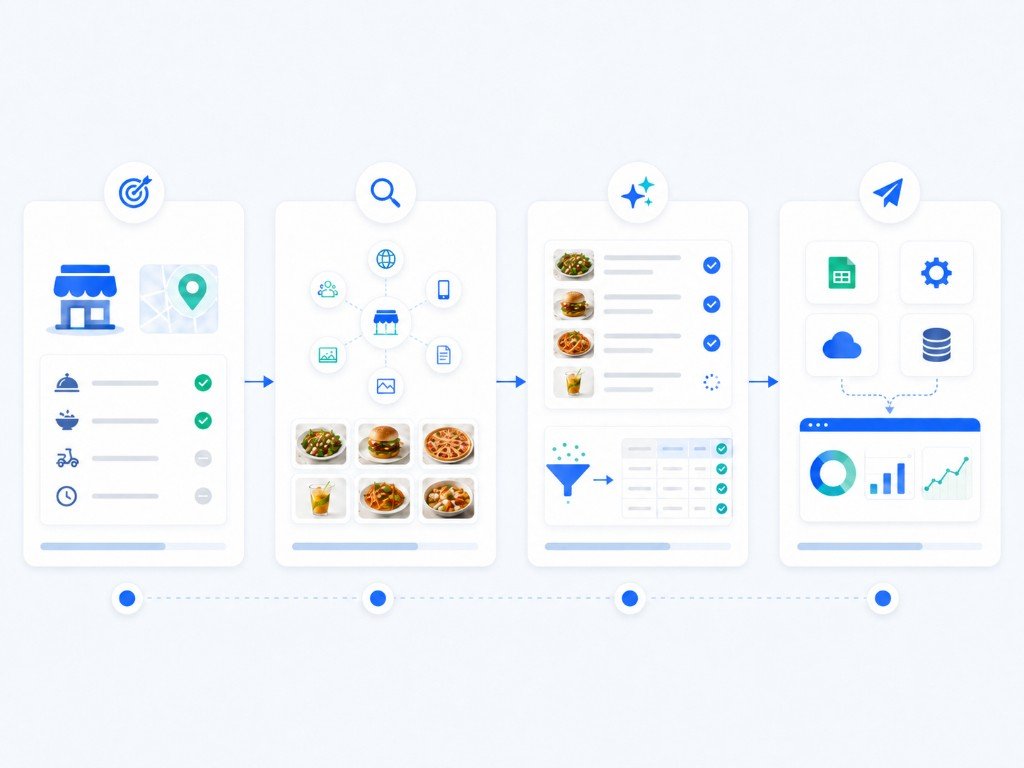
How a managed Glovo extraction project works

NenoData's existing restaurant and food-delivery services describe scoped extraction, normalization, validation and structured delivery. The following workflow applies that established approach to a proposed Glovo engagement, subject to feasibility approval.

  1. 1

    Scope and review sources

    Define markets, delivery locations, merchant types, source permissions, required fields and output expectations.

  2. 2

    Extract and structure

    Following approval, collect agreed records and preserve merchant, product, geographic and observation relationships.

  3. 3

    Normalize and validate

    Apply the approved schema, field-type checks, currency handling, missing-value rules and record validation.

  4. 4

    Deliver and maintain

    Supply the agreed dataset. Where recurring collection is approved, define scheduling, change comparison and maintenance expectations.

A representative Glovo sample should establish the field-level production specification before collection volume or recurring commitments are agreed.

What does a structured Glovo dataset contain?

A useful output separates merchant identity, product information, commercial observations and collection metadata.

The exact schema depends on whether the project covers restaurant menus, grocery catalogs or both.

Proposed field structure

Proposed Glovo dataset fields and their purpose
FieldPurpose
source_platformIdentifies Glovo
source_urlPreserves source reference
merchant_idLinks observations to a merchant where available
merchant_nameDisplayed restaurant or store name
merchant_typeRestaurant, supermarket or other category
country / cityMarket identification
delivery_locationScoped geographic context
category_nameMenu or catalog category
product_nameItem or product identity
brandGrocery brand where displayed
pack_sizeQuantity or size context
base_priceObserved listed price
promotional_priceObserved offer price where visible
currencyPrice currency
availability_statusDisplayed status where available
collected_atObservation timestamp
collection_statusCollection outcome

These are proposed analytical fields, not Glovo's official API schema.

Illustrative structured record

The following is entirely fictional and demonstrates a proposed output format.

Illustrative record — fictional, not collected Glovo data
{
  "source_platform": "Glovo",
  "source_url": "https://example.com/illustrative-source",
  "merchant_id": "EXAMPLE-MERCHANT-001",
  "merchant_name": "Example Grocery Store",
  "merchant_type": "supermarket",
  "country": "Example Market",
  "city": "Example City",
  "delivery_location": "Example Zone A",
  "category_name": "Dairy",
  "product_name": "Example Yogurt",
  "brand": "Example Brand",
  "pack_size": "500 g",
  "base_price": 4.50,
  "promotional_price": null,
  "currency": "EUR",
  "availability_status": "illustrative",
  "collected_at": "2026-09-01T09:00:00Z",
  "collection_status": "illustrative_only"
}

A genuine Glovo feasibility sample must replace this illustration before any claim of demonstrated Glovo extraction is published.

Business use cases for Glovo data

Restaurant competitor benchmarking

Compare selected restaurant menus, categories, displayed prices and available customization options within agreed markets.

QSR price intelligence

Monitor comparable menu items across selected restaurant locations and observation periods, preserving currency, product configuration and delivery context.

Promotional analysis

Study visible discount labels, displayed promotional prices and offer patterns where those fields are available through approved sources.

Quick-commerce assortment research

Compare grocery catalog breadth, product categories, pack sizes and visible availability across selected stores and markets.

Market coverage research

Organize merchant observations by country, city and delivery area to investigate visible marketplace presence.

The result represents the approved sampling scope, not necessarily a complete census of every Glovo merchant.

Downstream analytics and enrichment

Use normalized records to support internal BI, pricing analysis, product matching or structured dataset enrichment.

Refresh schedules and delivery options

NenoData's existing services document CSV, Excel, JSON, API-ready output and scoped recurring delivery. Its custom-pipeline service also describes delivery into agreed downstream systems. These are general company capabilities; their applicability to Glovo must be confirmed separately.

Glovo delivery options, intended use and Glovo-specific status
Delivery optionIntended useGlovo-specific status
CSVTabular analysisConfirm during scoping
ExcelBusiness-user reviewConfirm during scoping
JSONNested menu and catalog recordsConfirm during scoping
API-ready outputEngineering workflowsConfirm during scoping
Database-ready filesAnalytics ingestionSeparately scoped
Scheduled feedsRecurring observationsSubject to feasibility
Webhook or destination integrationAutomated downstream workflowsSeparately scoped

For recurring projects, the agreement should specify collection cadence, expected observation windows, history retention, exception handling and delivery responsibilities.

No universal real-time Glovo monitoring or guaranteed refresh interval is implied.

Scope, limitations and data quality

A production specification should establish what is included, what remains conditional and what is outside the collection scope.

Authorized access
Collection must use agreed public, permissioned or otherwise authorized sources. Authenticated partner access cannot be assumed.
Geographic coverage
Countries, cities, delivery areas and merchant lists require individual review.
Field availability
Fields may vary by merchant, country, source type, language or collection context.
Price comparability
Product size, merchant, location, currency, modifiers and promotion conditions should remain distinguishable.
Data freshness
A timestamp records when a value was observed, not the exact moment the source changed.
Missing records
Unavailable fields, missing products and collection failures should not automatically be interpreted as the same condition.
Private information
Customer identities, order histories and unrelated personal information are outside the proposed market-intelligence scope.
Maintenance
Source changes, altered catalog structures and failed collection attempts require agreed exception and maintenance processes.
Compliance
Source permissions, access conditions and applicable legal requirements must be reviewed before production approval.

The purpose of validation is to make collected records interpretable and suitable for the agreed business use case. It does not establish perfect accuracy, universal coverage or uninterrupted availability.
Managed Glovo extraction vs a self-service scraper

A self-service Glovo scraper places responsibility for source evaluation, collection scripts, schema design and maintenance with the buyer.

A proposed managed engagement defines those responsibilities through an agreed project specification.

Self-service Glovo scraper compared with a managed engagement
ConsiderationSelf-service scraperManaged engagement
Source feasibilityBuyer evaluatesReviewed during scoping
Location inputsBuyer implementsDefined in project specification
Product relationshipsBuyer structuresIncluded in approved schema
ValidationBuyer maintainsAgreed validation workflow
Price historyBuyer stores and comparesAvailable where scoped
DeliveryTool-dependentAgreed format and destination
MaintenanceBuyer-ownedDefined in engagement

Neither approach guarantees access to restricted sources or unavailable fields.

Request a representative Glovo data sample

A useful feasibility sample should demonstrate the exact records your team intends to analyze.

Include your target countries, cities, delivery areas, example merchants, required fields and preferred output format.

For recurring requirements, also specify the intended refresh cadence and whether historical price, promotion or availability comparisons are needed.

The sample review should confirm source feasibility, geographic handling, available fields, output structure and outstanding limitations before production commitments are made.

Frequently Asked Questions

What is Glovo data scraping?

Glovo data scraping refers to collecting permitted information from agreed Glovo sources and organizing it into structured datasets. Depending on source visibility and approved access, the information may include merchant listings, restaurant menus, grocery products, prices, promotions and delivery-related observations.

Can NenoData extract Glovo restaurant and grocery data?

NenoData provides general managed restaurant-menu, food-delivery and structured data-extraction services. Glovo-specific restaurant and grocery extraction requires feasibility review, an approved collection scope and representative sample validation before production capability can be confirmed.

Can Glovo prices and menus be monitored regularly?

Recurring collection can be proposed where technically feasible and approved. The collection schedule, item-matching rules, geographic inputs and historical retention requirements must be defined before production.

Why does delivery location matter?

The selected delivery location provides context for the merchant and product information observed. Comparisons should preserve this context rather than assume that a listing or price observed in one area applies to an entire city or country.

Can promotional prices and discounts be collected?

Displayed promotions may be included where available through the approved source. Promotional conditions, subscription eligibility and other restrictions must be preserved where relevant and visible.

Does Glovo offer an official API?

Yes. Glovo documents official Partner API integrations for orders, catalogs, pricing, promotions and outlet management. These integrations are designed for authorized partners and should not be confused with unrestricted public access to marketplace-wide competitor data.

Can Glovo grocery catalogs be extracted?

Grocery catalog extraction can be evaluated for selected stores and markets. Product names, brands, categories, pack sizes, displayed prices and availability are candidate fields, subject to source visibility and feasibility confirmation.

Which countries can be covered?

Coverage must be evaluated against Glovo's current operating markets and the requested cities, delivery areas and merchant types. NenoData does not claim universal Glovo market coverage.

What formats can buyers receive?

NenoData's general extraction services describe CSV, Excel, JSON and API-ready output, with additional delivery arrangements available through scoped engagements. Applicable Glovo-specific formats must be confirmed in the project specification.

How accurate and fresh will the dataset be?

Accuracy and freshness depend on source availability, agreed validation rules, collection frequency and observation context. A timestamp establishes when information was collected, not when Glovo or a merchant last updated it.

How is a Glovo project priced?

Pricing depends on source feasibility, requested markets, merchant volume, field depth, collection cadence, validation and delivery requirements. Review NenoData Pricing for general information and request a project-specific assessment.

General service information is on the NenoData Pricing page.

Start with a location-aware Glovo data sample

Tell us which Glovo markets, merchants and product categories matter to your business.

NenoData can review your requirements, evaluate the applicable source and permission boundaries, and define the next steps for a representative sample.

Whether your project focuses on restaurant menus, grocery assortment, price history or delivery-marketplace intelligence, begin with an agreed schema and clear geographic observation context.

Glovo-specific extraction, market coverage, refresh frequency and delivery commitments require technical feasibility and scope approval.