Competitor menu benchmarking
Compare menu structure, item breadth, variants, and visible add-ons across an agreed competitor set.
Structured Just Eat restaurant, menu, pricing and delivery-context data with the postcode and observation time kept attached
NenoData scopes managed Just Eat UK data projects for restaurant, pricing, market-intelligence, and data teams that need marketplace information in a consistent dataset rather than disconnected restaurant exports.
Start with the restaurants, UK postcodes or locations, menu depth, pricing fields, delivery signals, refresh requirements, and output structure you need. NenoData reviews the approved source and representative pages first, confirms field feasibility, and aligns a sample before production.
Depending on what is publicly visible and confirmed during scoping, a Just Eat dataset may include restaurant identity, menu categories and items, listed prices, variants or add-ons, promotion text, delivery fees, minimum-order information, ratings or review counts, availability signals, location context, source metadata, and observation timestamps.
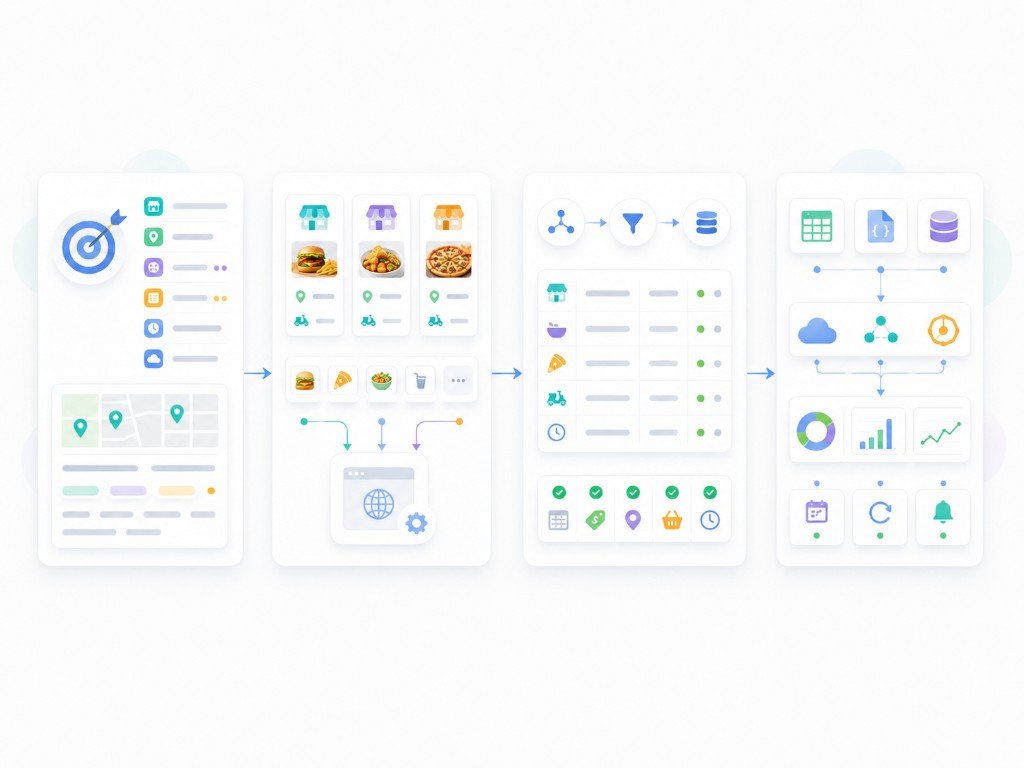
Just Eat is a location-dependent marketplace.
Its UK site tells users where they are so it can show nearby stores and restaurants, and its location pages direct users to enter a postcode to see local options. Brand pages likewise indicate that participating restaurants and estimated delivery times depend on the user's address or postcode.
That means a restaurant or menu observation is more useful when the dataset keeps the location input and collection time attached.
Without that context, an analyst can easily compare two different branches of the same chain, menus captured for different delivery areas, or prices captured in different observation windows.
The objective is not simply to export restaurant pages. It is to preserve enough context for later comparisons to remain defensible.
The final schema depends on the approved Just Eat domain, page type, location input, and representative sample.
Potential fields include:
Visible fee components should remain separate. A listing-page delivery fee should not automatically be represented as a final checkout total.
Restaurant-level extraction answers questions such as which restaurants are visible, how they are categorized, and what rating, delivery, or minimum-order signals are displayed.
Menu-level extraction goes deeper.
Depending on the representative pages and agreed scope, menu records may include:
Just Eat UK pages publicly expose menu categories, items, GBP prices, “from” prices, configurable products, promotions, and availability states. Modifier depth still needs to be tested on representative target pages.
Menu
The visible GBP price attached to an item at the location and time of collection.
Some menu items use “from” pricing, meaning a final configured item may have more than one price.
Where the public source exposes paid extras, retain the extra amount separately from the item price.
Promotion
Capture the visible promotion, qualification, or bundle language rather than assuming a normalized discounted unit price.
Delivery
Keep the displayed delivery fee as its own observed field.
Where displayed, retain these as separate components.
Store this separately from fees. Some restaurants display no minimum; others display a threshold.
Do not infer the final checkout amount simply by summing visible listing components unless that total is separately observed and validated.
Visible components ≠ automatically the final checkout total
Illustrative schema — actual fields confirmed during scoping
| Collected at | Postcode input | Restaurant | Category | Item | Listed price | Promotion | Delivery fee | Min. order | Review count |
|---|---|---|---|---|---|---|---|---|---|
| 2026-09-25 10:30 UTC | Example postcode | Example restaurant | Example category | Example item | Example GBP value | Example offer | Example value | Example value/state | Example count |
{
  "collection_timestamp": "2026-09-25T10:30:00Z",
  "source_name": "Just Eat UK",
  "source_url": "example_public_source_url",
  "postcode_input": "Example postcode",
  "restaurant_name": "Example restaurant",
  "restaurant_source_id": "example_id_if_available",
  "restaurant_address": "Example displayed address",
  "city": "Example city",
  "menu_category": "Example category",
  "item_name": "Example item",
  "item_source_id": "example_id_if_available",
  "item_description": "Example description",
  "listed_price": "Example value",
  "currency": "GBP",
  "variant_label": "Example size or option",
  "modifier_group": "Example modifier group",
  "modifier_name": "Example add-on",
  "modifier_price": "Example value",
  "promotion_text": "Example offer",
  "delivery_fee": "Example value",
  "service_fee": "Example value",
  "small_order_fee": "Example value",
  "minimum_order": "Example value or no-minimum state",
  "availability_status": "Example status",
  "estimated_delivery_time": "Example displayed ETA",
  "rating": "Example visible rating",
  "review_count": "Example visible count",
  "validation_status": "Example QA state"
}
Outputs can be scoped for CSV, Excel, JSON, API-ready records, scheduled feeds, or cloud/database delivery where the selected method is technically feasible and agreed.
A price-monitoring project needs identity + context + timestamp, not simply repeated page exports.
Use source identifiers where available. Otherwise, combine agreed fields such as source URL, restaurant name, address/location, and postcode context.
Matching may consider a source item identifier, restaurant/location key, category, raw item name, normalized name, variant, and modifier context.
Keep original source labels alongside normalized values.
A price difference without observation times does not establish when a change occurred.
Where included in scope, keep exact, variant, comparable, unmatched, or review-required states visible rather than forcing every record into a false match.
Recurring collection can create a history from the first agreed monitoring cycle onward.
Historical backfill from before the project starts should only be stated when separately verified.
Compare menu structure, item breadth, variants, and visible add-ons across an agreed competitor set.
Track listed menu prices across the same restaurants and location contexts over repeated observation windows.
Monitor visible spend-threshold offers, percentage-off promotions, bundles, and other promotion text.
Compare visible delivery, service, small-order, and minimum-order fields without collapsing them into one ambiguous fee.
Build restaurant lists around defined postcodes, cities, cuisines, or chain sets where the source supports the selected location inputs.
Compare observed restaurant and menu coverage across defined locations without representing listing visibility as consumer demand.
Track public rating and review-count signals where visible.
Add structured Just Eat restaurant, menu, price, postcode, and source-lineage fields to an internal dataset.
Normalize comparable fields across multiple approved delivery marketplaces while keeping platform and source-specific fields attached.
| Question | Restaurant level | Menu level |
|---|---|---|
| Restaurant visibility | Yes | Context |
| Restaurant identity/location | Yes | Yes |
| Cuisine/category | Where shown | Context |
| Rating/review count | Where visible | Context |
| Minimum order | Where visible | Context |
| Delivery/fee signals | Where visible | Context |
| Menu categories | Limited | Yes |
| Individual items | Limited | Yes |
| Item descriptions | No/limited | Where shown |
| Item prices | No/limited | Yes |
| Variants/modifiers | No | Where visible |
| Item availability | No/limited | Where visible |
| Best for | Market mapping, reputation, delivery economics | Menu benchmarking and item-level price monitoring |
| Requirement | Just Eat-focused workflow | Multi-platform workflow |
|---|---|---|
| Main question | What is visible on the approved Just Eat source? | How do sources differ? |
| Location context | UK postcode/location | Platform + location |
| Menu structure | Preserve Just Eat hierarchy | Shared schema + source-specific fields |
| Prices | Compare Just Eat observations | Match equivalent items first |
| Fees | Preserve Just Eat labels | Preserve platform-specific semantics |
| Restaurant matching | Primarily within one source | Cross-platform matching may be required |
| Best route | Just Eat source page | Food Delivery App Scraping |
For a Just Eat + Deliveroo request:
Provide target country/domain, UK postcodes or locations, restaurant list, menu depth, required pricing/delivery fields, refresh expectations, and desired output.
NenoData checks representative pages and confirms the field set before production.
Records are mapped to the agreed schema, checked for completeness, deduplicated where applicable, and prepared for comparison.
Delivery can be scoped for CSV, Excel, JSON, API-ready structures, scheduled feeds, or cloud/database destinations where confirmed.
Do not compare rows from different postcodes as if they represent the same marketplace state.
Keep source IDs/URLs where available and define explicit matching rules when they are not.
Maintain:
restaurant → category → item → variant/modifier
Do not merge menu price, modifier price, promotion, delivery fee, service fee, small-order fee, and minimum order.
Repeated observations need collection times.
A missing item may reflect temporary unavailability, page-state change, source-layout change, a different location context, collection failure, or genuine removal.
Uncertain item matches should remain unresolved or review-required rather than producing false price changes.
NenoData's current site supports feasibility review and sample-first scoping for sources that are not already listed.
NenoData's restaurant-menu service supports structured categories, items, prices, modifiers, promotions, availability, location context, timestamps, and source metadata where scoped.
NenoData's price-intelligence workflows support explicit comparison and lifecycle states rather than forcing uncertain records into matches.
Comparable NenoData marketplace workflows support structured files and pipeline-oriented delivery where scoped.
Projects can route into NenoData's food-delivery and Deliveroo workflows when multiple approved marketplaces are required.
This page describes a managed collection and delivery service. It should not advertise a downloadable Just Eat scraper or instant self-service tool unless NenoData separately verifies one.
Just Eat data scraping is the structured collection of approved restaurant, menu, price, promotion, delivery-context, rating, location, and timestamp fields from agreed Just Eat marketplace sources.
Potential fields include restaurant identity, address/location, postcode/search context, cuisine/category, minimum order, visible fee fields, availability, rating, review count, ETA context, source URL, and collection timestamp.
Final fields are confirmed against representative pages.
Menu categories, items, descriptions, prices, variants, modifiers, promotions, and availability can be scoped where the approved page exposes them.
Do not interpret “complete” as guaranteed access to every hidden modifier or option.
Just Eat's UK marketplace uses location to determine nearby restaurants and delivery context. The postcode or equivalent location input should remain attached to each observation.
Depending on visibility and scope: listed item price, starting/from price, modifier price, promotions, delivery fee, service fee, small-order fee, and minimum-order information.
Yes, where recurring collection is feasible and agreed. Keep restaurant/item matching fields and timestamps with every observation.
Yes where those fields are publicly displayed and confirmed during sample review.
Not necessarily. Keep visible components separate unless a final checkout total is separately observed and approved.
Public ratings and review counts may be included where visible. Individual review text is not guaranteed.
Restaurant-level extraction focuses on restaurant identity, location, cuisine, reputation, and delivery context. Menu-level extraction adds categories, items, item prices, variants, modifiers, promotions, and item availability.
Do not assume universal coverage. Target postcodes, locations, restaurant sets, and source states should be validated during scoping.
No universal real-time promise should be made. Freshness depends on the approved scope and agreed collection cadence.
Hourly monitoring can be requested, but the cadence should only be committed after source and volume feasibility are confirmed.
A combined project can be evaluated once Just Eat feasibility and cross-platform restaurant/item matching requirements are confirmed.
Not as a blanket claim. Each country, brand/domain, location model, and source structure requires individual feasibility review.
No private or account-protected customer order history should be included in this public-marketplace service.
Preserve raw source fields, identity keys, timestamps, and explicit match/exception states. Do not automatically treat ambiguous renamed items as the same product.
CSV, Excel, JSON, API-ready records, scheduled feeds, and cloud/database delivery may be scoped where technically feasible.
No self-service scraper should be implied. Position the offering as a managed NenoData workflow unless a separate tool is verified.
Yes. Start with the source, locations, fields, and intended output so feasibility can be reviewed before production.
Share the UK restaurants or chains you want to monitor, target postcodes or location inputs, menu depth, pricing and delivery fields, required refresh cadence, and preferred output.
NenoData can review the approved Just Eat source, validate representative fields, align an illustrative schema, and confirm what is feasible before production.
Include: