Rental Market Data Scraping Services for Property Teams
Nenodata helps property, proptech, and analytics teams collect structured rental listing, rent, availability, and market-signal data from approved public or permissioned sources. You define the sources, markets, fields, refresh expectations, and delivery destination; Nenodata scopes the workflow and delivers analyst-ready output on the agreed schedule.

Why rental teams need structured data collection
Rental listings, asking rents, availability signals, and property attributes change frequently across listing sites, brokerage pages, and market directories. A rent value copied manually into a spreadsheet may no longer match the visible listing when a pricing, acquisitions, or portfolio team reviews it later.
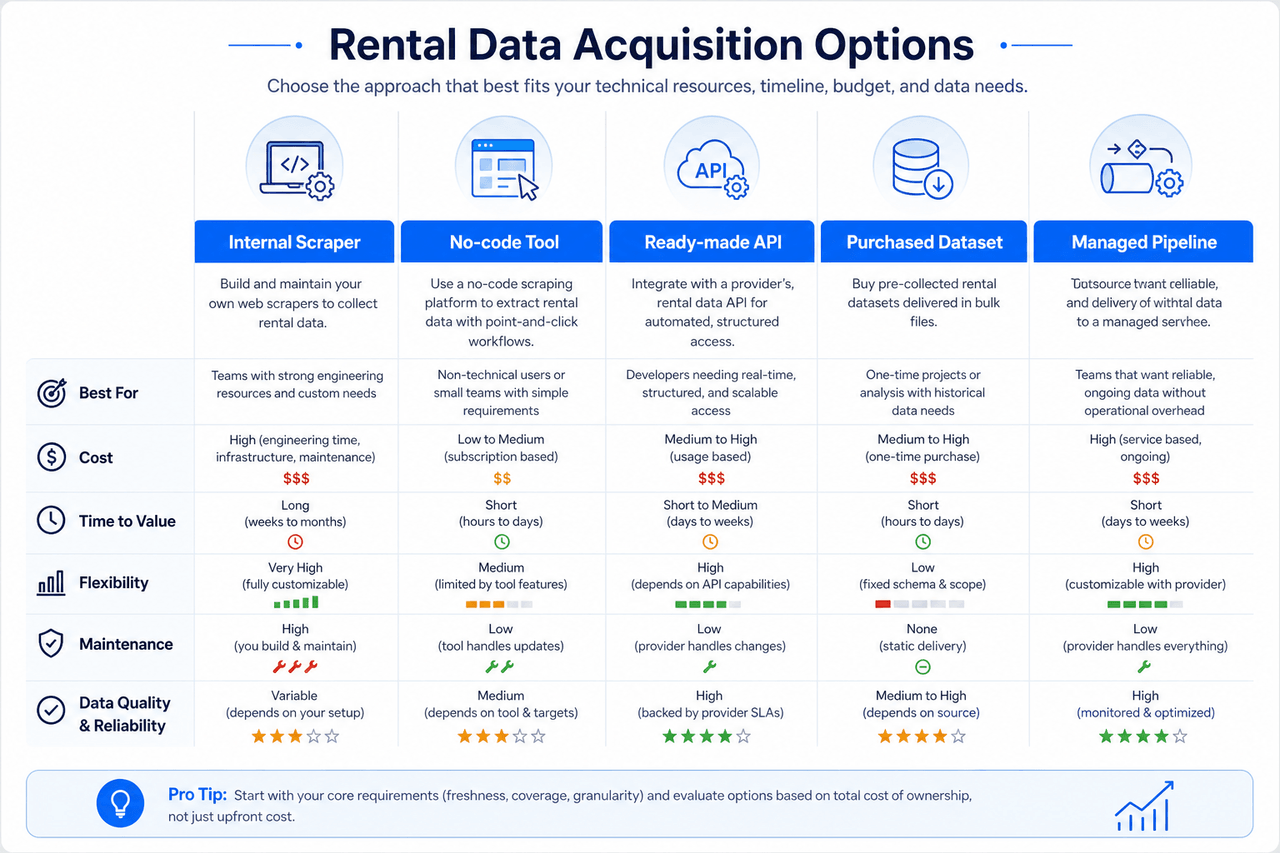
Manual collection becomes difficult when teams need to monitor units across markets, compare channels, preserve listing context, or repeat searches across neighborhoods and property types. Basic scripts struggle when page layouts change, search inputs affect results, fields are labeled inconsistently, and maintenance consumes engineering time.
Rental and property teams need stable field definitions, agreed refresh expectations, and output that can move into benchmarking, expansion analysis, portfolio monitoring, and product workflows without rebuilding the dataset each cycle.
What Nenodata provides
Nenodata configures managed rental market data workflows around the sources, markets, listing types, and fields your team defines. That includes target listing sites, search criteria, property sets, required rent and availability fields, refresh expectations, and delivery destination.
Depending on approved scope, outputs can include listing name, URL, address, rent or price fields, availability status, bedrooms, bathrooms, square footage, property type, amenities, fees, listing dates, and source metadata where those elements are publicly visible or permissioned and included in the agreed schema.
Named source support, field availability, refresh cadence, and delivery formats are confirmed during scoping and sample review rather than assumed in advance.
Learn more about web scraping services, custom real estate data extraction, and vacation rental data scraping where scoped.
Rental Market Data Scraping Services built around approved sources
Use an illustrative sample to confirm field names, source coverage, listing criteria, and output format before configuring a larger recurring workflow.

| Listing | City | Rent | Availability | Beds | Timestamp | Source URL |
|---|---|---|---|---|---|---|
| Example listing | Example city | Example value | Example status | Example value | YYYY-MM-DDTHH:MM:SSZ | Example public URL |
{
  "collection_timestamp": "YYYY-MM-DDTHH:MM:SSZ",
  "source_name": "Example rental source",
  "listing_name": "Example listing",
  "listing_id": "Example identifier",
  "listing_url": "Example public URL",
  "address": "Example address",
  "city": "Example city",
  "state_or_region": "Example region",
  "postal_code": "Example postal code",
  "property_type": "Example type",
  "bedrooms": "Example value",
  "bathrooms": "Example value",
  "square_footage": "Example value",
  "rent_amount": "Example value",
  "currency": "Example currency",
  "availability_status": "Example status",
  "listing_date_text": "Example date text",
  "fees_text": "Example fees",
  "amenities_text": "Example amenities",
  "source_url": "Example public URL"
}
Illustrative CSV-style field list
collection_timestamp,
source_name,
listing_name,
listing_id,
listing_url,
address,
city,
state_or_region,
postal_code,
property_type,
bedrooms,
bathrooms,
square_footage,
rent_amount,
currency,
availability_status,
listing_date_text,
fees_text,
amenities_text,
source_url
Field availability can vary by source, market, listing type, and project scope.
Data fields and outputs
Actual availability should be confirmed against target sources during scoping.
Listing basics
- • Listing name and identifier
- • Listing URL
- • Property type
- • Bedrooms and bathrooms where displayed
- • Square footage where shown
- • Source name
Rent and availability
- • Monthly or weekly rent where displayed
- • Currency
- • Availability status
- • Move-in date text where shown
- • Fees and deposit text where displayed
- • Collection timestamp
Location and property attributes
- • Street address where displayed
- • City, state or region, postal code
- • Neighborhood or submarket text
- • Amenities or feature text where shown
- • Pet or policy text where displayed
- • Parking or utility notes where shown
Source tracking and change signals
- • Source URL
- • Listing date or posted text
- • Last-seen timestamp
- • Price change context via timestamps
- • Search or market input context
- • Record identifier where available
Delivery formats
- • CSV or Excel for analyst workflows
- • JSON for engineering pipelines
- • API-ready structured records where confirmed
- • Scheduled feeds where scoped and confirmed
- • Database or warehouse-ready files where confirmed
Use cases
Rental pricing benchmarks
Compare asking rents and availability signals across scoped listing sources and markets to support pricing and positioning decisions.
See price intelligence solutions for broader pricing workflows.
Market expansion research
Build structured datasets from target markets to study rent ranges, inventory breadth, and listing patterns before entering new areas.
Inventory and availability tracking
Monitor listing availability and status changes across agreed property sets on a schedule once refresh cadence is confirmed.
Portfolio monitoring
Track comparable listings and rent signals around owned or managed assets to support leasing and asset-management workflows.
PropTech product data feed
Prepare cleaned rental records for internal tools, enrichment workflows, and product features once schema and delivery formats are confirmed.
Investment screening
Organize listing-level rent and property attributes into structured records that support acquisition and underwriting research.
Brokerage intelligence
Collect scoped listing results into consistent records that support brokerage research, comp review, and market reporting.
Analytics and API workflows
Deliver structured rental market data into analytics models, internal APIs, and recurring reporting pipelines where formats are agreed during scoping.
Explore API-ready data delivery patterns where scoped.
Who this is for
This service fits property managers, multifamily operators, proptech platforms, brokerage research teams, investment groups, market intelligence firms, and data teams that need structured rental listing and rent data from scoped public or permissioned sources.
It also supports organizations that want monitored rental market feeds without dedicating internal engineering capacity to maintaining brittle collection scripts across changing listing sites.
How it works
Share requirements
Define target sources, markets, property types, required fields, refresh expectations, and delivery destination so Nenodata can scope the workflow.
Extract and collect
Nenodata configures the extraction workflow around the agreed input model, including market searches, listing sets, or recurring monitored inventories.
Clean and validate
Collected records are standardized, reviewed for completeness, and prepared in the agreed structure. Inconsistent or incomplete entries can be reduced before delivery.
Deliver the feed
Receive output once or on a recurring schedule via agreed formats and destinations. Nenodata maintains the configured workflow as sources and requirements evolve.
Why choose Nenodata
Source-specific scoping
Projects begin with a review of target listing sources, markets, and fields—not a promise to collect every rental site without feasibility confirmation.
Structured output for real workflows
Records are normalized for benchmarking, portfolio review, enrichment, and downstream systems rather than delivered as inconsistent raw page dumps.
Responsible data-use framing
Collection is scoped around public or permissioned sources. Private, account-protected, restricted, or personal information should remain outside the project scope.
Built for recurring monitoring
Listing sites can change layouts and behavior. A managed workflow can include monitoring and maintenance planning beyond a one-off script.
Delivery planning before scale
Output formats, refresh cadence, and destinations are agreed during scoping. CSV, JSON, Excel, API-ready records, and scheduled feeds can be discussed before production delivery.
Integrations and delivery
Depending on approved scope, structured rental market data may flow from agreed listing sources through Nenodata extraction and validation into CSV, Excel, JSON, API-ready records, or downstream analytics workflows.
Teams often combine rental market data workflows with custom real estate extraction, price intelligence, and proptech data delivery depending on the use case.

See US real estate data scraping, MLS listing data workflows, real estate data providers and contact Nenodata to discuss formats confirmed during scoping.
FAQ
Ready to scope your rental market data workflow?
Share target sources, markets, property types, required fields, refresh needs, and preferred delivery format when you contact Nenodata so the team can scope the workflow accurately.