Saudi Arabia Data Scraping API & Web Data Extraction Services
Collect structured data from agreed Saudi Arabia web and app sources for ecommerce, pricing, marketplace, food-delivery, grocery, procurement, research, and analytics workflows.
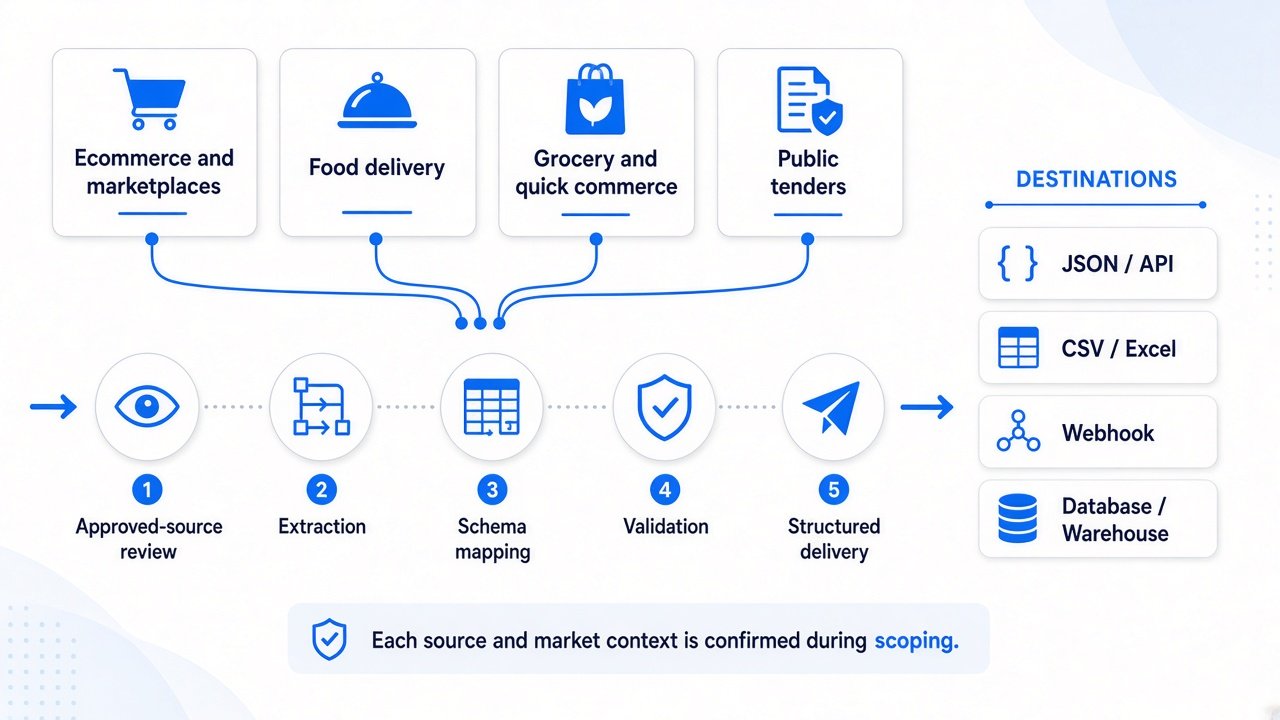
NenoData scopes each source, required fields, Saudi market or location context, schema, refresh requirements, validation rules, and delivery method before production collection begins.
Source-by-source Saudi market feasibility
Schema-mapped, validated structured records
JSON, files, API, database or warehouse delivery where scoped
Saudi Arabia data scraping is the structured collection of agreed information from web or app sources relevant to the Saudi/KSA market.
A managed workflow can turn visible product listings, prices, promotions, restaurant menus, grocery products, public procurement notices, availability signals, and other approved source fields into records that analytics systems, pricing tools, databases, applications, or research teams can use.
For NenoData, a Saudi Arabia data scraping API does not mean unrestricted access to every Saudi website or application.
Projects begin by defining:
Approved source URLs, domains, pages, or source surfaces
Saudi market or storefront requirements
Required fields
Location context where relevant
Source-language requirements
Output schema
Validation rules
Refresh requirements
Intended use
Delivery destination
Representative sources are reviewed before production configuration.
This source-by-source approach matters because two Saudi market sources can differ substantially in public visibility, geographic behavior, language, page structure, field availability, access conditions, and refresh feasibility.
The result is a scoped data workflow rather than a blanket promise to scrape the entire Saudi web.
Which Saudi source categories can NenoData scope?
A Saudi Arabia project can begin with one source or combine several source categories when each target passes feasibility and source-boundary review.
Ecommerce and marketplaces
Potential projects can focus on publicly visible product catalogs, listings, prices, sellers, promotions, availability, categories, and related marketplace fields from agreed Saudi-relevant sources.
Food-delivery projects can focus on agreed restaurant, menu, item, pricing, promotion, availability, rating, and delivery-context fields where those values are visible and collection is approved.
Grocery and quick commerce
Grocery projects can focus on agreed products, brands, pack information, prices, promotions, stock or availability signals, retailer/storefront context, delivery context, and location metadata.
Public tenders and procurement
Public procurement projects can focus on agreed publicly accessible tender or government-contract sources, including notice, buyer, deadline, category, status, award, and source-reference fields where published.
Price and market intelligence
Cross-source monitoring can structure publicly visible prices, promotions, availability, assortment, and listing-change signals for pricing and market-intelligence workflows.
Other source types can be assessed individually. A country-level service page should not be interpreted as confirmation that every Saudi website, app, marketplace, government portal, city, or data field is already supported.
Saudi ecommerce and marketplace data
Saudi ecommerce monitoring can involve much more than collecting a single displayed price.
Depending on the approved source and visible fields, an ecommerce or marketplace schema may include:
Candidate Saudi ecommerce and marketplace fields
Field group
Candidate fields
Product identity
Product title, brand, product/SKU identifier where displayed, source URL
Catalog
Category, subcategory, variant, pack or size information where visible
Pricing
Current price, list price where shown, displayed discount, currency
Promotions
Promotion label, coupon/offer text where publicly visible
Seller
Seller or merchant name where displayed
Availability
Visible stock/availability state
Marketplace context
Source, storefront or market context
Location
City/region/storefront context where the source visibly changes by location and collection is feasible
Language
Source-language value or label where retained in scope
Metadata
Collection timestamp, refresh batch, validation status
These are candidate fields rather than a universal Saudi ecommerce schema.
NenoData's current ecommerce and price-intelligence workflows are based on agreed retail or marketplace sources and source-specific field feasibility.
For competitor-price projects, matching rules should also be agreed rather than assuming that similarly named products across marketplaces are identical.
Menu prices, restaurant availability, promotions, fees, estimated delivery times, and other displayed values may depend on the platform, restaurant, location, and observation time.
A scoped Saudi food-delivery dataset may include, where publicly visible and confirmed:
Restaurant name
Restaurant/source identifier where displayed
Cuisine or category
Menu category
Menu item
Description
Modifier or option information
Listed menu price
Displayed promotional price
Promotion label
Availability
Rating/review signals
Delivery fee
Service fee where separately displayed and relevant
Estimated delivery time
Minimum-order information where displayed
Location/serviceability context
Source URL
Collection timestamp
Validation metadata
NenoData's broader Food Delivery App Scraping service supports multi-app restaurant, menu, pricing, fee, promotion, rating, and availability workflows.
That does not establish Saudi coverage for every food-delivery platform.
Specific Saudi platforms—including any named platform a buyer requests—should be checked individually for source visibility, geographic behavior, required fields, and feasibility before being represented as supported.
Related multi-platform source page: Talabat Data Scraping Services. Country/city coverage for Talabat remains scoped during feasibility review and is not automatic Saudi support.
Grocery and quick-commerce data
Grocery and quick-commerce records should use product-oriented schemas rather than restaurant-menu schemas.
Depending on source visibility and scope, candidate fields can include:
Product name
Brand
Category
SKU or product identifier where shown
Variant
Pack size or unit information
Listed price
Displayed discounted price
Promotion
Currency
Availability or stock signal
Retailer/storefront
Delivery context
Saudi market/location context
Source URL
Collection timestamp
Refresh batch
Validation status
NenoData's current Grocery Delivery App Scraping service describes structured workflows for product, price, promotion, stock, delivery, and location signals from approved public or permissioned sources.
Exact Saudi sources still require individual review.
A visible availability label should also not be converted into an inferred sales-volume or consumer-demand figure. Public listing observations and transaction data are different categories of evidence.
Saudi public tender and procurement data
Saudi procurement teams may also need structured information from publicly accessible tender and government-contract sources.
NenoData's Tender and Government Contract Data service is designed around agreed publicly accessible procurement sources and can structure fields such as:
Notice title
Opportunity/reference identifier where shown
Notice type
Issuing authority or buyer
Publication date
Submission deadline
Status
Amendment/cancellation signal
Category
Geography
Estimated value where published
Currency
Awarded supplier where published
Award date
Source URL
Public document links
Collection timestamp
Validation note
For a Saudi project, a requested procurement portal must still be assessed individually.
This page does not claim pre-verified access to every Saudi procurement system or to private supplier portals.
It also does not provide advice about procurement eligibility or tender law.
Arabic, English and Saudi market metadata
Saudi web data can contain Arabic, English, or a combination of languages.
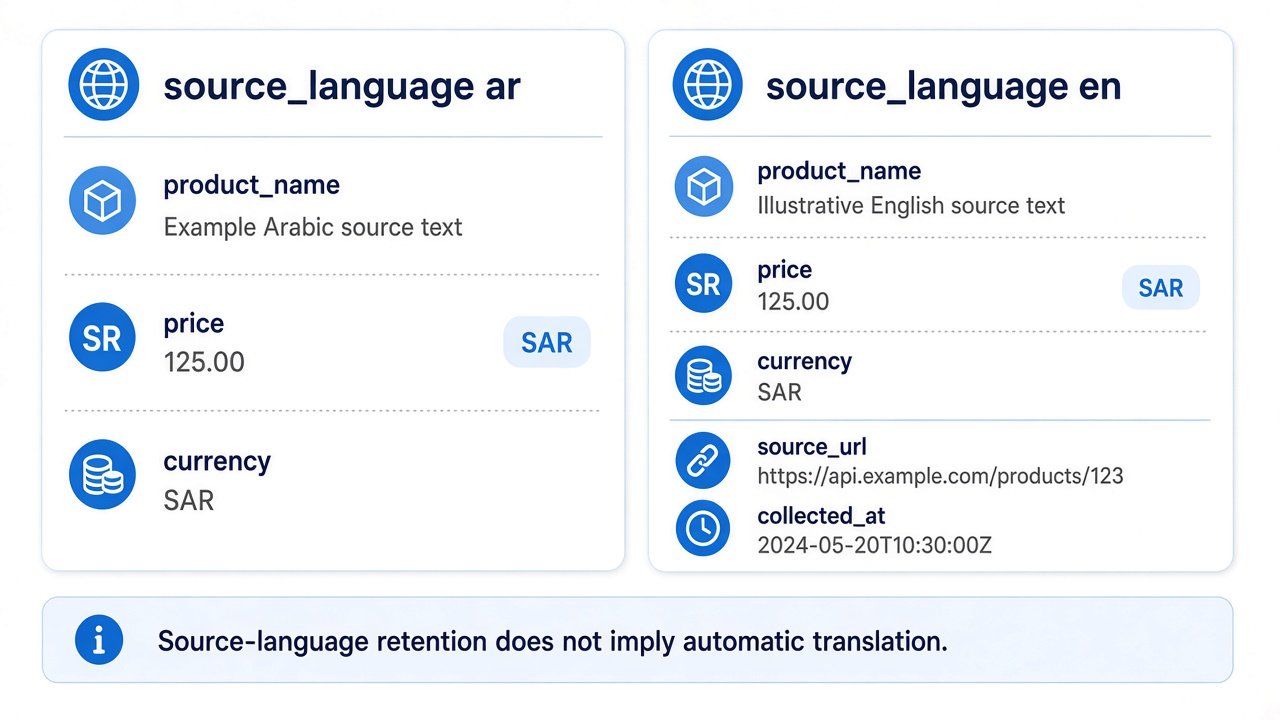
A useful extraction workflow should distinguish collecting a source-language field from translating that field.
Source-language preservation
Where an approved source exposes Arabic text and the collection workflow supports it, the original text can be treated as a source field. For example, a schema could retain: product_name, source_language, category, price, currency, source_url. The exact language metadata available depends on the source and project design.
Translation is a separate requirement
Collecting Arabic text does not automatically mean NenoData translates Arabic content into English. Translation, transliteration, multilingual matching, or bilingual normalization should only be included if separately verified and agreed for the engagement.
SAR and Saudi Riyal context
Where a source displays prices in SAR/Saudi Riyal, the currency context should remain attached to the observed value rather than being silently converted. A useful pricing record separates the numeric value from its currency and source context. For example: price = 149.00, currency = SAR, source = agreed marketplace, collected_at = observation timestamp. Currency conversion, if required, should be a separately defined transformation rather than an assumed extraction behavior.
Location-aware Saudi data collection
Saudi marketplace, food-delivery, grocery, and other dynamic sources may present different information under different geographic or storefront contexts.
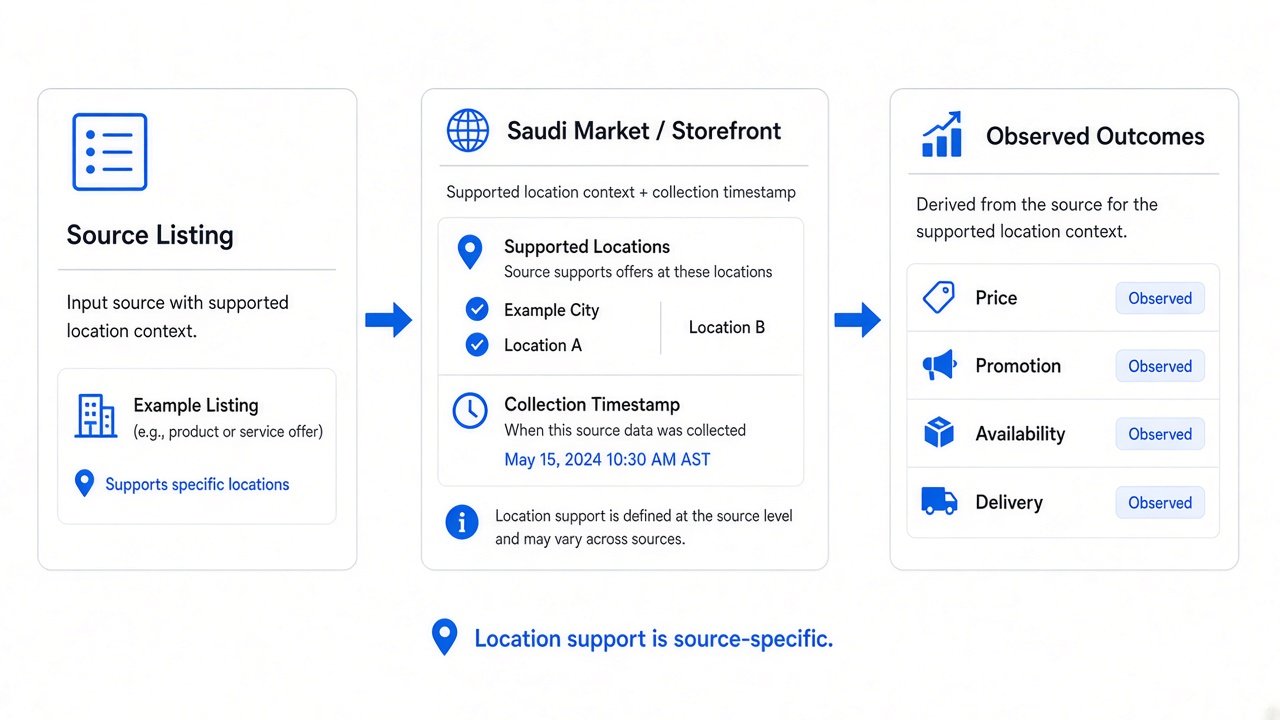
NenoData's current Geo-Targeted Web Scraping service treats geographic collection as a source-specific capability. City, country, ZIP, or other targeting is included only where the source actually changes visible content according to those inputs and the requested location method is technically feasible.
For a Saudi project, location context could therefore include an agreed:
Market
Storefront
City
Area
Region
Delivery/serviceability context
Other source-specific location input
where supported by the target source.
Why location belongs in the record
If a price, promotion, assortment, restaurant, delivery fee, or availability value depends on location, storing only the value can make the dataset misleading.
A better record keeps the observation connected to:
This helps downstream teams distinguish a genuine regional difference from two observations made under different source conditions.
Riyadh, Jeddah, Dammam, or any other Saudi city should not be advertised as supported merely because it is commercially relevant.
Requested locations should be confirmed during source feasibility review.
What does a Saudi Arabia data scraping API provide?
A NenoData Saudi data scraping API is best understood as a managed structured-data workflow.
NenoData's current Web Scraping API service defines a managed API around:
Approved sources
Schema mapping
Extraction
Validation
Structured records
Projects begin with the required sources, fields, schema, refresh needs, validation rules, response format, and destination.
For Saudi projects, those records can also retain Saudi market, location, source-language, currency, and collection metadata when those fields are relevant and supported.
This is different from an unlimited self-service endpoint that promises access to every Saudi website.
API, scheduled feed or file/database delivery?
The right delivery model depends on how the collected data will be used.
API/JSON
Programmatic consumption
Scheduled feed
Recurring monitoring
CSV/Excel
Analyst workflows
Webhook
Scoped push/event workflow
Database/Warehouse
Analytics infrastructure
Delivery behavior and cadence confirmed during scoping.
Saudi Arabia structured-data delivery options
Delivery model
Useful when
What must be scoped
JSON/API-oriented delivery
Applications need structured records programmatically
Schema, response/delivery behavior, destination
Scheduled feed
Pricing, monitoring or BI teams need recurring snapshots
Feasible cadence, batch structure, fields
CSV/Excel
Analysts need reviewable files or imports
Columns, file structure, delivery process
Webhook
Downstream systems need agreed event/push integration
Trigger and integration feasibility
Database/warehouse
Records need to enter analytics infrastructure
Destination, table/schema and loading requirements
On-demand requests
Collection needs to run around specific requests
Source feasibility and expected behavior
NenoData's current Web Scraping API and Custom Data Pipeline services support API-ready records, files, webhooks, databases, warehouses, and scheduled workflows where they are technically feasible and included in scope.
Batch, scheduled, and on-demand patterns can be considered where source-specific feasibility allows.
No Saudi-specific endpoint path, authentication scheme, SDK, sandbox, rate limit, request quota, latency guarantee, refresh frequency, uptime commitment, or SLA is implied by this page.
Illustrative Saudi structured record
The following example demonstrates how a Saudi ecommerce observation could be represented after schema mapping.
It is an illustrative schema—not a live NenoData response, production endpoint contract, customer record, or proof of coverage for a particular Saudi source.
Illustrative schema — not a live endpoint response or coverage claim.
A restaurant record would replace product fields with restaurant, menu, item, price, and delivery context.
A grocery record would use product, pack, retailer/storefront, availability, pricing, and delivery fields.
A procurement record would instead use notice, buyer, deadline, status, value, award, and source-reference fields.
The schema should follow the business question rather than forcing unrelated Saudi source categories into one raw record structure.
Normalize multiple Saudi sources into one schema
Country-level market intelligence often requires more than one source.
A multi-source Saudi pipeline can map comparable concepts into a shared schema while retaining source-specific fields where meanings differ.
For ecommerce, an illustrative normalized structure might include:
Illustrative multi-source Saudi normalization
Shared concept
Source A
Source B
Normalized field
Product
Source title
Source listing name
product_name
Brand
Displayed brand
Displayed brand
brand
Current price
Source price
Source offer price
current_price
Currency
SAR
SAR
currency
Seller
Merchant field
Seller field
seller_name
Availability
Source status
Source status
availability_status
Market context
Storefront
Locale/storefront
market_context
Source
Platform A
Platform B
source_platform
Observation time
Timestamp
Timestamp
collected_at
Normalization should not erase meaningful differences.
For example, one platform's “available” status may not mean exactly the same thing as another platform's stock label. Similarly, food-delivery fee labels or marketplace seller structures may differ by source.
Source-specific semantics should remain visible when direct normalization would be misleading.
A recurring Saudi data feed needs explicit data-quality behavior.
Required-field checks
Fields designated as required can be checked against the project's agreed validation rules.
Null and missing values
If a field is absent or cannot be collected within the approved scope, the workflow should not invent a value. Depending on project design, the record can preserve a null, exception flag, missing status, or another agreed representation.
Type and format validation
Fields such as prices, dates, identifiers, currencies, and timestamps can be checked against agreed formats where validation is included.
Deduplication
Duplicate observations can be handled using project-specific identifiers and matching rules where appropriate.
Schema changes
Source layouts and field representations can change. Where maintenance is included, extraction, mapping, and validation logic can be reviewed and updated within the agreed support scope.
Provenance
Source URL or equivalent source reference, collection timestamp, market/location context, and validation status can help downstream users understand where an observation came from and when it was collected.
Saudi Arabia data use cases
Competitor price monitoring
Track visible product prices, promotions, availability, and catalog changes from agreed Saudi retail or marketplace sources.
Marketplace assortment research
Structure products, categories, brands, sellers, and availability observations to compare marketplace coverage.
Seller monitoring
Track publicly displayed seller or merchant context where available and included in scope.
Promotion monitoring
Capture visible promotional labels and offer context without inferring undisclosed transaction performance.
Product availability monitoring
Record visible availability states over successive collection periods.
Saudi market-entry research
Combine structured public-source observations across selected ecommerce, food, grocery, procurement, or other approved sources to support market research.
Arabic/English catalog research
Retain relevant source-language values and associated metadata where supported, without assuming translation.
Compare visible values across confirmed Saudi market or location contexts where the source supports geographic variation.
Tender monitoring
Track agreed publicly accessible procurement notices, deadlines, status changes, amendments, and award fields where published.
Procurement opportunity feeds
Prepare structured public tender records for research, BI, CRM, or opportunity-monitoring workflows.
BI and warehouse enrichment
Deliver validated records into downstream analytics systems using the destination and schema confirmed during scoping.
PDPL and responsible Saudi data scope
Saudi data projects need a clear distinction between marketplace/public-source observations and personal data.
Saudi Arabia's Personal Data Protection Law, or PDPL, defines personal data broadly around data that can specifically identify an individual or make that individual identifiable directly or indirectly.
Official SDAIA materials also describe the PDPL and its implementing regulations as the central Saudi framework governing personal-data protection and obligations for entities processing personal data.
For NenoData project scoping, that means a Saudi data-extraction engagement should not casually expand from public product, restaurant, grocery, or tender records into identifiable-person data.
Typical public-market-data scope
Product listings
Visible prices/promotions
Restaurant/menu fields
Grocery listings
Public tender notices
Public source metadata
Requires separate authorization/privacy/legal review
Personal profiles
Private accounts
Private transactions
Customer order histories
Payment information
Other identifiable-person or restricted data
Service-scope guidance, not legal advice.
This service does not imply access to
Private customer accounts
Account-protected information without authorization
Customer order histories
Private transactions
Payment or card information
Personal profiles
Private account activity
Other restricted personal information outside an approved scope
PDPL is a project-scoping consideration, not a marketing certification
NenoData should not be described on this page as “PDPL certified” or as guaranteeing legal compliance unless a separately verified basis supports that claim.
The existence of publicly accessible data also does not, by itself, answer every legal question about a proposed collection and processing activity.
Projects involving personal data require appropriate legal and privacy review based on the specific sources, data fields, purpose, parties, processing operations, and applicable obligations.
This page provides service-scope information, not legal advice.
For the authoritative Saudi framework, buyers should consult current SDAIA PDPL materials and obtain appropriate legal advice for their use case when necessary.
How NenoData's Saudi Arabia data workflow works
Step 1
Define sources, market context and fields
Share representative Saudi-relevant source URLs or source surfaces, required fields, market/location requirements, source-language needs, intended use, approximate volume, cadence, and destination. NenoData identifies what must be verified rather than assuming country-wide support.
Step 2
Review feasibility and sample structure
Representative sources are reviewed for source access, field visibility, geographic behavior where relevant, and expected output structure. A representative sample can be used to confirm schema fit before production volume.
Step 3
Extract, normalize and validate
Agreed fields are collected from approved sources and mapped to the agreed schema. Depending on scope, the workflow can apply cleaning, normalization, required-field/type checks, deduplication, null rules, and exception flags.
Step 4
Deliver and maintain where scoped
Validated records are prepared for the agreed file, JSON/API-oriented, webhook, database, warehouse, or other supported destination. Where maintenance is included, source or destination changes can be handled within the agreed engagement.
Why NenoData for Saudi market data?
Source-by-source feasibility before Saudi coverage claims
NenoData's current geo-targeted and API services assess requested sources and market behavior before production commitments are made.
Sample-first schema review
Representative samples help data and business teams validate the proposed fields and downstream structure before scale.
Market and location context where supported
Location-sensitive values can retain market or storefront context when the source supports it and the collection method is feasible.
Schema-first structured delivery
Records are mapped for the customer's downstream workflow instead of being delivered only as raw page captures.
Validation and explicit exception states
Required-field checks, null handling, type checks, deduplication, and exception flags can be defined where appropriate to the project.
Multi-source normalization
Custom pipelines can combine approved sources into a shared downstream schema while retaining meaningful source-specific differences.
Flexible delivery where scoped
NenoData's current services support CSV, Excel, JSON, API-ready payloads, webhooks, databases, warehouses, BI workflows, and scheduled exports where technically feasible and agreed.
Responsible boundaries
The Saudi page remains explicit about approved sources, personal/private data, geographic feasibility, and the difference between collecting Arabic source text and translating it.
FAQ
A Saudi Arabia data scraping API is a structured workflow for collecting agreed fields from approved Saudi-relevant web or app sources and delivering them programmatically or through another structured destination. With NenoData, sources, fields, schema, validation, refresh needs, and delivery are scoped before production.
No blanket access to every Saudi website or app is promised. Each requested source must be reviewed for visibility, technical feasibility, required fields, location behavior, source boundaries, and intended use.
NenoData has broader ecommerce, food-delivery, grocery, tender, price-intelligence, geo-targeted, and API extraction capabilities. A country-level page should not turn those service categories into a claim that every Saudi platform is already supported. Specific sources are confirmed during scoping.
Agreed public or otherwise authorized ecommerce sources can be evaluated for product, category, price, promotion, seller, availability, storefront, and related fields. Exact fields and source coverage depend on feasibility.
NenoData has a current Noon-specific extraction service, but the live page scopes Noon projects by target pages, country/domain context, fields, and feasibility rather than promising universal country coverage. A Saudi Noon requirement should therefore be confirmed explicitly during scoping before production commitments are made.
This page does not claim pre-verified Amazon.sa support. Buyers should provide representative Amazon.sa targets and required fields for source-specific feasibility review.
This page does not establish production support for those platforms. Each requested Saudi food-delivery source should be assessed individually before coverage or field claims are made.
NenoData has a broader Food Delivery App Scraping service for restaurant, menu, price, promotion, fee, rating, and availability workflows. Saudi platforms and locations still require individual feasibility review.
NenoData's Grocery Delivery App Scraping service supports product, price, promotion, stock, delivery, and location workflows from approved sources. Exact Saudi sources, fields, and geographic behavior must be confirmed.
NenoData's Tender and Government Contract Data service supports structured extraction from agreed publicly accessible procurement sources. A specific Saudi tender portal must be reviewed before source coverage is confirmed.
Arabic source text can be considered as part of the source schema where the approved source exposes it and the workflow supports the field. Exact language behavior should be verified against representative targets.
Arabic extraction should not be interpreted as automatic translation. Translation, transliteration, or bilingual normalization should only be promised when separately verified and included in the project scope.
Where an approved source displays prices in SAR, currency can be retained as part of the structured observation. Currency conversion should be treated as a separate transformation requirement.
Location-specific collection can be evaluated where the source actually changes visible content according to city, area, storefront, or another geographic input and the required collection method is feasible. No Saudi city is automatically guaranteed by this country-level page.
They can on sources that present location-specific prices, promotions, availability, or assortments. Whether a particular source behaves that way must be verified. Location context should be retained when it affects the observation.
Yes, NenoData's current Custom Data Pipeline service supports multi-source consolidation from approved sources into an agreed downstream schema. Fields should only be normalized where their meanings are sufficiently comparable.
NenoData's current API and pipeline services support JSON and API-ready payloads where included in scope. CSV and Excel are also supported across relevant current services.
Database and warehouse loading are supported in NenoData's current Custom Data Pipeline service. The specific destination, table/schema design, loading method, and cadence must be agreed for the engagement.
Scheduled refresh is supported by NenoData's Web Scraping API where source-specific feasibility and scope allow. No fixed Saudi-specific refresh interval is promised by this page.
On-demand requests are an available Web Scraping API capability where feasible and included in scope. They should not be interpreted as a universal instant endpoint for every Saudi source.
Universal real-time Saudi data is not promised. Freshness depends on source behavior, scale, requested fields, collection method, cadence, and project scope.
Where maintenance is included, extraction, transformation, and validation logic can be reviewed as supported source structures evolve. Missing or changed fields can be represented through agreed null, validation, or exception rules.
The answer depends on the specific data and processing activity. Saudi PDPL governs personal-data processing and creates obligations around personal information. A public product-price dataset and a project involving identifiable people raise different considerations. NenoData should not provide a blanket legal conclusion; projects involving personal data should receive appropriate privacy/legal review.
This service does not imply access to private accounts, private order or transaction histories, payment information, personal profiles, or other restricted personal information without appropriate authorization and scope.
Yes. NenoData's current API and pipeline workflows use representative-source and sample-first review to confirm fields, schema fit, and feasibility before production configuration.
Scope a Saudi Arabia data extraction project
Share representative sources and the data your team needs so NenoData can review feasibility before production.
Include:
Target Saudi/KSA source URLs, domains, apps, or source surfaces
Ecommerce, food-delivery, grocery, procurement, pricing, or other source category
Required fields
Saudi market/storefront requirements
City/area/location requirements where relevant
Arabic or English source-field requirements
Approximate record or monitoring scope
Desired refresh pattern
Preferred JSON, CSV, Excel, API, webhook, database, warehouse, or other delivery workflow
Existing target schema
Intended analytics, pricing, research, procurement, product, or intelligence use
Any personal-data considerations that need separate review
NenoData can then assess the source, field, geographic, schema, and delivery requirements and recommend the appropriate next step for a representative sample.