Jahez Saudi Marketplace Data

Jahez Data Scraper for Restaurant, Menu, Pricing & Delivery Data

Collect structured Jahez restaurant, menu, pricing, promotion, availability, and delivery-context data from agreed source surfaces for competitive intelligence, pricing, research, and analytics.

NenoData scopes the target Jahez market, locations, source surfaces, required fields, schema, validation rules, refresh requirements, and delivery method before production collection begins.

  • Saudi-first Jahez source scoping
  • Location-aware, validated structured records
  • JSON, API, files or database delivery where scoped
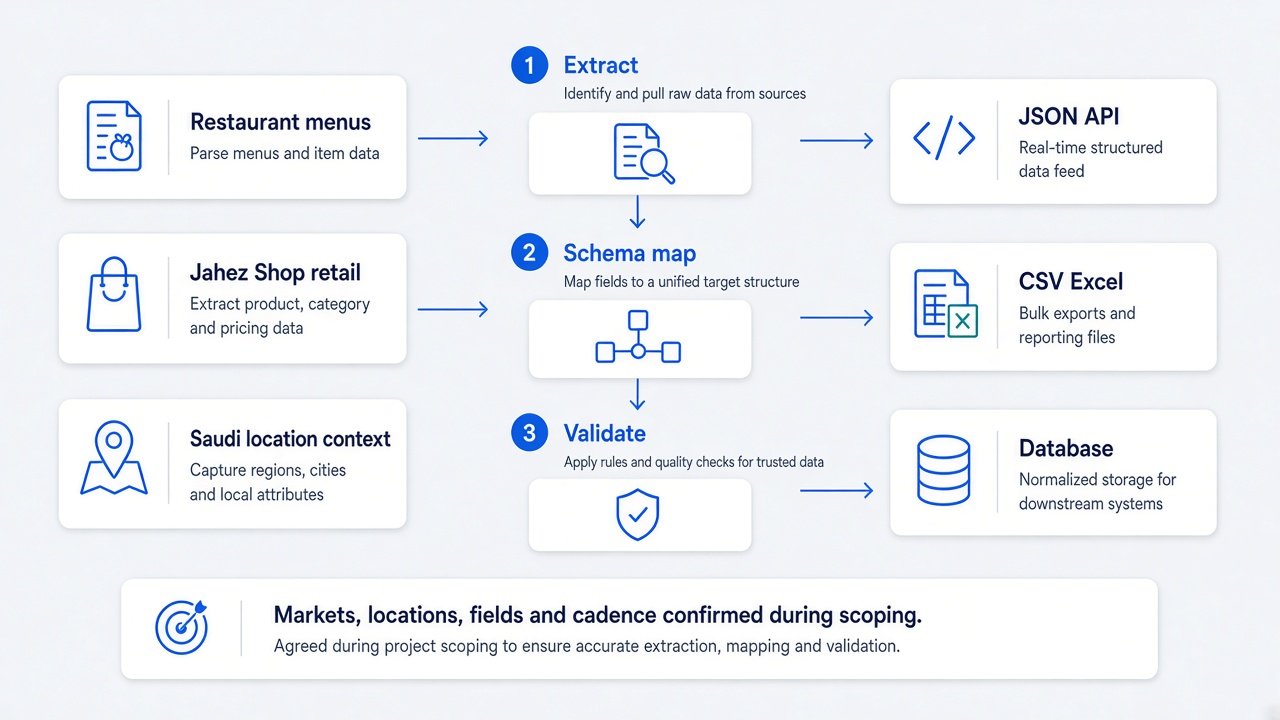
Jahez approved sources flowing through schema mapping, validation, and structured delivery for restaurant, menu, and location context

What does a Jahez Data Scraper mean at NenoData?

A Jahez Data Scraper is a managed workflow for turning agreed information from Jahez source surfaces into structured records for pricing, restaurant intelligence, market research, product analysis, BI, and other approved business uses.

Jahez originated in Saudi Arabia and operates a food-delivery platform connecting consumers with restaurants and merchants. Jahez Group also operates Jahez-branded delivery platforms in Bahrain and Kuwait. See Jahez Group's Our Brands page for corporate brand context.

For NenoData, the process starts with the exact market, source surfaces, locations, fields, schema, refresh requirements, validation rules, and destination your team needs.

Representative targets are reviewed before production configuration.

That means this service is not positioned as a generic downloadable crawler that automatically unlocks every Jahez page.

It is a managed data-extraction and delivery workflow built around approved public, permissioned, or otherwise authorized source surfaces and confirmed project feasibility.

Which Jahez markets and source surfaces can be scoped?

Saudi Arabia / KSA

Saudi Arabia is the primary market for this page.

Jahez Group identifies Jahez KSA as its Saudi on-demand delivery platform. Its current corporate reporting also describes Jahez Shop as part of the expanding KSA platform ecosystem. See the 2025 operating review and Our Brands pages for first-party context.

A Saudi project can therefore begin with representative Jahez restaurant, menu, merchant, or relevant retail/store targets and determine which requested fields and locations are feasible.

Bahrain

Jahez Group confirms that Jahez Bahrain operates as a food-delivery platform (Our Brands).

That corporate presence does not automatically prove that every field or source surface available in Saudi Arabia can also be collected in Bahrain.

Bahrain requirements should be verified separately.

Kuwait

Jahez Group also confirms Jahez Kuwait as a distinct delivery platform (Our Brands).

Kuwait source surfaces, field availability, location behavior, and extraction feasibility should likewise be reviewed independently.

What about Qatar?

Jahez Group owns Snoonu, a Qatar-based technology, ecommerce, and delivery platform.

Snoonu is a separate platform.

Jahez Group's presence in Qatar through Snoonu should therefore not be represented as Jahez-branded Qatar source coverage.

Jahez restaurant and merchant data

Restaurant-level extraction provides the entity context needed before menu, price, promotion, or delivery observations can be compared.

Depending on the approved source and fields visible during scoping, a restaurant/merchant schema may include:

Candidate Jahez restaurant and merchant fields
Field groupCandidate fields
RestaurantRestaurant/merchant name, source identifier where visible
ClassificationCuisine, restaurant category or other displayed classification
LocationMarket, city/area or serviceability context where supported
AvailabilityVisible merchant availability or serviceability state
Pricing contextCurrency and relevant market context
ReputationRating or review count only where publicly visible and verified
Source metadataSource reference, collection timestamp, refresh batch, validation status

These are candidate schema fields rather than a guarantee that every Jahez merchant or source surface exposes every value.

Restaurant identity should also remain separate from menu-item observations so downstream teams can distinguish merchant-level attributes from item-level values.

For broader restaurant-intelligence workflows, see NenoData Restaurant Data Scraping Services.

Menu extraction can structure restaurant menus into a hierarchy that is easier to compare across merchants or collection periods.

A scoped schema can evaluate fields such as:

  1. Restaurant
  2. → Menu category
  3. → Menu item
  4. → Modifier/add-on where visible

Candidate item-level fields can include:

  • Menu category
  • Item name
  • Description where visible
  • Listed price
  • Displayed promotional price
  • Promotion or offer label
  • Availability
  • Modifier or add-on information where visible
  • Restaurant/merchant reference
  • Market/location context
  • Source reference
  • Collection timestamp

NenoData's current Restaurant Menu Data Scraping service supports restaurant, category, item, modifier, add-on, pricing, promotion, availability, location, and source-metadata structures from agreed sources.

That broader capability does not prove that every field is available on Jahez.

Representative Jahez sources should determine the final production schema.

Jahez pricing and promotion monitoring

A useful Jahez pricing observation needs context.

Recording only a numeric price can become misleading if the merchant, market, location, promotion state, or observation time is lost.

Where visible and confirmed, a pricing record can distinguish:

Listed price

The displayed base or listed value associated with the menu item or product.

Promotional price

A separately displayed promotional or discounted value where the source exposes one.

Promotion or offer

Visible promotional text retained separately from the price.

Currency

Preserve the displayed market currency rather than silently converting it. For example: Saudi Arabia: SAR; Bahrain: BHD where observed; Kuwait: KWD where observed.

Observation context

Attach the value to the merchant/store, item/product, market/location, source, and collection timestamp.

A public price or promotion is an observed marketplace field.

It should not automatically be converted into a claim about sales, order volume, conversion, customer demand, or consumer preference.

Those are different business measures and require separate evidence or methodology.

Delivery, availability and location context

Jahez describes its consumer platform around finding restaurants, ordering food, and delivery.

Location is therefore an important part of many marketplace observations.

Depending on the source surface and feasibility, candidate contextual fields can include:

  • Restaurant/store availability
  • Serviceability state
  • Delivery fee where displayed
  • Estimated delivery time where displayed
  • Other visible delivery information
  • City/area context
  • Market
  • Collection timestamp

These fields must be confirmed against representative source surfaces.

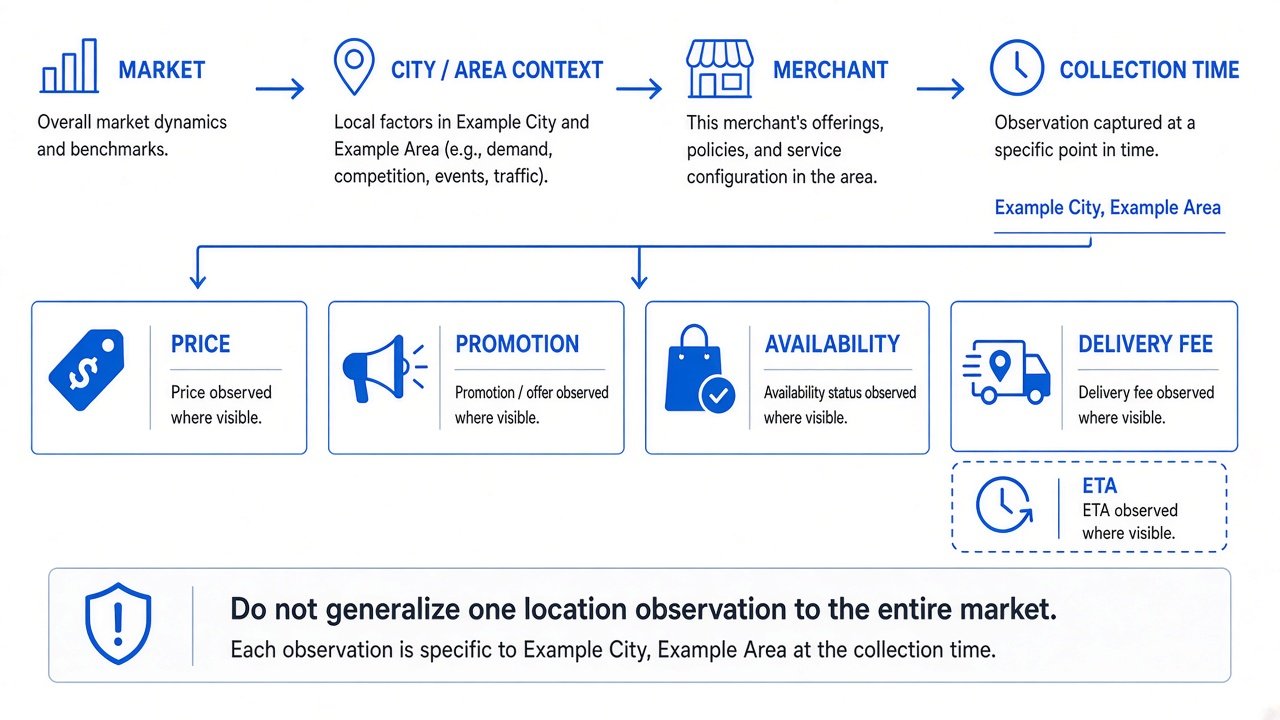
A location-aware record should preserve enough context to answer:

Where was this value observed?

rather than treating one location-specific observation as universally valid across Jahez.

For example:

source + market + location_context + merchant + observed_value + collected_at

Jahez marketplace observations tied to market, location context, merchant, and collection time

NenoData's geo-targeted workflows scope markets, sources, fields, cadence, and delivery before collection and do not imply that every source can be viewed identically from every requested location.

Saudi city coverage should therefore be confirmed during Jahez project scoping rather than inferred from Jahez's own commercial footprint.

For location-aware collection design across markets, see NenoData Geo-Targeted Web Scraping.

Where fee monitoring is the primary requirement across shipping and delivery surfaces, see NenoData Shipping & Delivery Fee Monitoring.

Jahez Shop and grocery/retail data

Jahez Group's current 2025 operating review specifically describes Jahez Shop within its KSA delivery-platform operations and states that its product range and expansion are supported by the group's dark-store and fulfilment infrastructure.

That verifies Jahez Shop as part of the current Saudi platform context.

It does not, by itself, verify that every desired Jahez Shop product field is available through an approved consumer-facing extraction surface.

Grocery and retail extraction should therefore receive an independent feasibility review.

Where visible and confirmed, a product-oriented schema may potentially include:

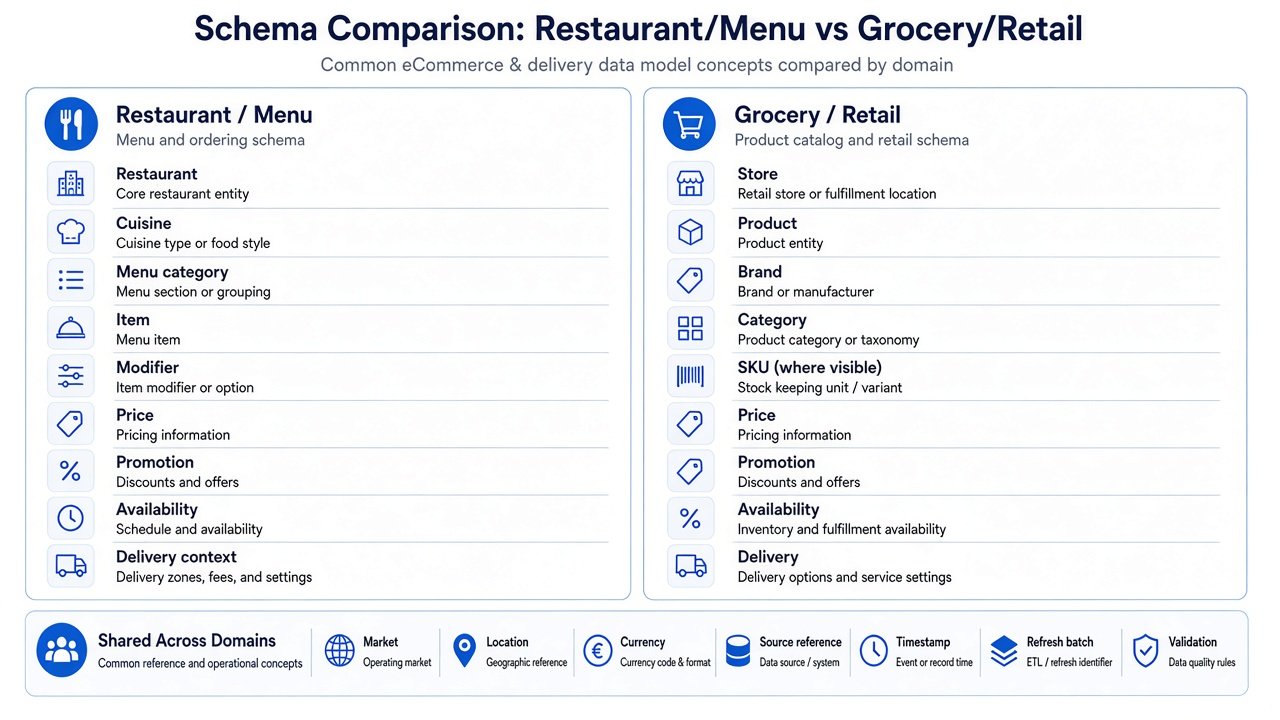
Separate Jahez restaurant menu and Jahez Shop grocery product schemas with shared validation context
Candidate Jahez Shop and grocery product fields
Field groupCandidate fields
ProductProduct name, brand, category
IdentitySKU/product ID only where visible
StoreStore/retailer context
PricingListed price, displayed discounted price, currency
PromotionVisible offer or promotion text
AvailabilityVisible availability/stock signal
DeliveryVisible delivery/serviceability context
LocationSaudi market/city/area context where supported
MetadataSource reference, timestamp, refresh batch, validation status

Do not force grocery products into the restaurant-menu schema.

A menu item and a grocery SKU are different entities and may require different identifiers, matching logic, attributes, and validation rules.

For multi-platform grocery monitoring capability (not proof of Jahez Shop field support), see NenoData Grocery Delivery App Scraping.

Saudi Arabia, Bahrain and Kuwait context

Jahez Group officially identifies Jahez operations in Saudi Arabia, Bahrain, and Kuwait.

Those three markets can still behave differently at source level.

A cross-market project should therefore define each market independently before normalizing the resulting records.

Jahez Saudi Arabia, Bahrain, and Kuwait cross-market context
ContextSaudi ArabiaBahrainKuwait
Jahez-branded operationConfirmedConfirmedConfirmed
NenoData extraction feasibilityConfirm during scopingConfirm independentlyConfirm independently
Restaurant/menu fieldsSource-specificSource-specificSource-specific
Grocery/retail fieldsVerify separatelyVerify separatelyVerify separately
Location behaviorVerifyVerifyVerify
Currency contextSAR where displayedBHD where displayedKWD where displayed
Language fieldsVerify against sourceVerify against sourceVerify against source
Refresh cadenceScope-specificScope-specificScope-specific

The presence of the Jahez brand in a country is not sufficient evidence that every restaurant, menu, retail, location, or delivery field is accessible for extraction.

Snoonu is a separate Jahez Group platform in Qatar.

Arabic and English source fields

Jahez source surfaces may contain Arabic, English, or mixed-language values depending on the market and context.

Source-language collection and translation are separate requirements.

Where Arabic or English fields are visible and supported, they can be considered for the extraction schema.

For example:

  • item_name
  • source_language
  • category
  • listed_price
  • currency
  • market
  • source_reference

But collecting Arabic source text does not automatically mean NenoData translates it into English.

Translation, transliteration, bilingual entity matching, or cross-language normalization should only be promised when those requirements have been separately verified and included in scope.

What does the Jahez Data Scraping API provide?

NenoData's Web Scraping API service uses a managed model:

  1. Approved source
  2. → Schema mapping
  3. → Extraction
  4. → Validation
  5. → Structured record

A Jahez project can follow the same architecture.

First define:

  • Target market
  • Approved source surfaces
  • Required fields
  • Locations
  • Schema
  • Validation rules
  • Refresh requirements
  • Response/delivery format
  • Destination

Representative targets can then be reviewed before production configuration.

This is a managed data API model rather than an unrestricted open-web endpoint.

The page should not imply an official Jahez API, affiliation with Jahez, or unlimited Jahez source access.

API, scheduled feed or file/database delivery?

Different buyers need Jahez observations in different downstream systems.

API/JSON

Application workflows

Scheduled feed

Recurring monitoring

CSV/Excel

Analyst workflows

Webhook

Scoped push integration

Database/Warehouse

Analytics infrastructure

Cadence and integration behavior confirmed during scoping.

Jahez structured-data delivery options
Delivery modelUseful forWhat must be confirmed
JSON/API-oriented deliveryApplications and internal data productsSchema and delivery behavior
Scheduled feedRecurring menu, pricing or promotion monitoringFeasible cadence and batch model
CSV/ExcelAnalyst and research workflowsColumns and file structure
WebhookApproved push/event workflowTrigger and integration feasibility
Database/warehouseBI and analytics infrastructureDestination and loading design
On-demand requestSpecific collection workflowsSource feasibility and expected behavior

NenoData's current Web Scraping API and Custom Data Pipeline services support structured files, API-ready payloads, webhooks, databases, warehouses, and recurring workflows where technically feasible and included in scope.

No Jahez-specific endpoint path, authentication scheme, SDK, sandbox, rate limit, request quota, latency, fixed refresh frequency, uptime figure, or SLA is implied by this page.

Universal real-time Jahez data is not promised.

Illustrative structured Jahez record

The following example shows how an agreed Saudi restaurant/menu observation could be structured.

It is illustrative—not a live Jahez response, a production NenoData endpoint contract, customer data, or proof that every field is available.

Illustrative schema — not a live Jahez response, production NenoData endpoint contract, customer record, or proof of universal field availability.

{
  "source": "jahez",
  "market": "SA",
  "source_surface": "restaurant_menu",
  "restaurant": {
    "name": "Example Restaurant",
    "category": "Example Cuisine",
    "source_id": "example-id"
  },
  "menu_item": {
    "category": "Example Category",
    "name": "Example Item",
    "description": "Example visible description"
  },
  "pricing": {
    "listed_price": "42.00",
    "promotional_price": "35.00",
    "currency": "SAR",
    "promotion_text": "Example visible offer"
  },
  "delivery_context": {
    "availability": "example-visible-status",
    "delivery_fee": "example-visible-value",
    "estimated_delivery_time": "example-visible-value"
  },
  "location_context": {
    "city": "Example City",
    "area": "Example Area"
  },
  "source_reference": "illustrative-source-reference",
  "collected_at": "YYYY-MM-DDTHH:mm:ssZ",
  "refresh_batch_id": "example-batch",
  "validation_status": "passed"
}

Unavailable fields should follow the project's agreed null or exception rules rather than being fabricated.

For grocery/retail collection, use a product-oriented structure containing fields such as product, brand, category, store, price, promotion, availability, and location where those values are verified.
Validation and source-change handling

A recurring Jahez dataset needs rules for what happens when values disappear, change format, or move within a source structure.

  • Schema mapping

    Confirmed source fields can be mapped to the customer's agreed names, types, and nesting.

  • Required-field checks

    Fields designated as required can be validated before delivery.

  • Missing/null handling

    If a requested value is absent from the approved source, the workflow should preserve an agreed null or exception state rather than inventing the value.

  • Cleaning and normalization

    Prices, currencies, timestamps, categories, source names, availability states, and other fields can be standardized according to agreed project rules.

  • Deduplication

    Duplicate observations can be handled with agreed identifiers and matching rules where applicable.

  • Source changes

    Menus, product structures, labels, and source layouts can evolve. Where maintenance is included, configured extraction, transformation, and validation logic can be reviewed as supported source structures change.

  • Provenance

    Source reference, market/location context, collection timestamp, refresh batch, and validation state help downstream teams understand when and where an observation was collected.

Normalize Jahez with HungerStation, Talabat or Careem

A broader food-delivery intelligence workflow may need comparable observations from several platforms.

NenoData already has source-specific service pages for Talabat and Careem, while its broader food-delivery and custom-pipeline services support multi-source structured workflows.

Normalization should align comparable concepts without pretending every platform uses identical semantics.

An illustrative shared schema might contain:

Illustrative Jahez cross-platform normalization
Business conceptJahezOther sourceNormalized field
RestaurantMerchant/restaurantSource restaurantrestaurant_name
Menu itemItemSource itemitem_name
PriceDisplayed priceDisplayed pricelisted_price
PromotionVisible offerSource promotionpromotion_text
CurrencyMarket currencyMarket currencycurrency
AvailabilityVisible stateSource stateavailability_status
Delivery feeVisible feeVisible feedelivery_fee
ETADisplayed valueDisplayed valueestimated_delivery_time
LocationSource contextSource contextlocation_context
PlatformJahezPlatform namesource_platform
ObservationTimestampTimestampcollected_at

Platform-specific fields should remain separate when direct normalization would change their meaning.

For HungerStation-specific workflows, see NenoData HungerStation Data Scraping Services. For Talabat-specific workflows, see NenoData Talabat Data Scraping Services. For Careem-specific workflows, see NenoData Careem Data Scraping Services. For broader multi-platform food-delivery intelligence, see NenoData Food Delivery App Scraping.

Jahez data use cases

Competitor menu benchmarking

Compare menu categories, items, visible modifiers, pricing, promotions, and availability across agreed restaurant targets.

Restaurant price monitoring

Track observed menu prices over time with merchant, location, market, currency, and timestamp context.

Promotion monitoring

Structure visible offers and promotional pricing without treating promotion exposure as evidence of sales performance.

Menu assortment analysis

Compare menu breadth and item/category changes across merchants or collection periods.

Modifier and add-on comparison

Compare modifier structures and incremental prices where those fields are visible and confirmed.

QSR pricing intelligence

Prepare structured menu observations for restaurant-brand, item, category, market, or location analysis.

Saudi restaurant market research

Collect agreed Jahez marketplace observations for defined Saudi research questions.

Location-level merchant research

Compare observed merchant or restaurant visibility between confirmed location contexts.

Delivery-fee and ETA analysis

Track visible delivery-fee and estimated-delivery-time observations where supported.

Jahez Shop price monitoring

Where retail source feasibility is confirmed, monitor visible product prices, promotions, and availability.

FMCG and category research

Structure approved Jahez Shop or retail observations for product, brand, category, pricing, assortment, and availability analysis where those fields are verified.

Cross-market comparison

Where Saudi, Bahrain, and Kuwait sources are independently confirmed, map comparable observations into a common schema while preserving market and currency context.

BI and warehouse feeds

Deliver validated records into agreed analytics infrastructure through a scoped pipeline.

Observed data vs derived analytics

A Jahez scraper should clearly distinguish what the source actually displays from what an analyst calculates later.

Observed fields

Examples may include, where verified:

  • Restaurant name
  • Menu item
  • Displayed price
  • Promotion text
  • Visible availability
  • Displayed delivery fee
  • Displayed ETA
  • Rating
  • Review count
  • Product
  • Currency
  • Location context
  • Timestamp

Derived metrics

Examples include:

  • Percentage price change
  • Cross-platform price index
  • Promotion frequency
  • Assortment overlap
  • Availability rate
  • Merchant coverage change
  • Price dispersion

Derived analytics can be useful, but they should be labelled as calculations based on observations.

Do not present as directly scraped without evidence

  • Sales volume
  • Order volume
  • Transaction count
  • Customer demand
  • Customer preferences
  • Conversion rate
  • Private merchant performance
  • Customer identity

This distinction keeps marketplace observations auditable and prevents analytical inference from being misrepresented as source data.

Responsible Jahez source boundaries

NenoData's service is scoped to approved public, permissioned, or otherwise authorized source surfaces.

It does not imply access to:

  • Private customer accounts
  • Customer identity
  • Payment details
  • Private customer orders
  • Customer order history
  • Private transaction records
  • Merchant-private operational records
  • Restricted account information
  • Unauthorized source surfaces

The service also does not imply affiliation, partnership, or endorsement by Jahez.

Jahez's commercial presence in a market does not automatically establish NenoData extraction coverage.

Similarly:

  • Saudi support does not prove Bahrain support.
  • Saudi support does not prove Kuwait support.
  • Jahez Group ownership of Snoonu does not create Jahez-branded Qatar coverage.
  • Restaurant/menu feasibility does not prove grocery/retail feasibility.
  • Ratings do not prove review-text availability.
  • A public listing does not reveal sales or order volume unless the source explicitly publishes an appropriate metric.
  • Location-specific observations should not be generalized to an entire country.
  • Universal real-time collection is not promised.
  • Refresh cadence is confirmed during scoping.

How NenoData's managed Jahez workflow works

  1. Step 1

    Define markets, sources and fields

    Share the target Jahez market, representative source surfaces, restaurants/stores, locations, required fields, intended use, approximate scope, refresh requirements, and destination. Restaurant/menu and grocery/retail requirements are separated where appropriate.

  2. Step 2

    Review feasibility and sample structure

    Representative targets are reviewed for source visibility, field availability, market/location behavior, and expected schema. A sample can be used to confirm the proposed structure before production scale.

  3. Step 3

    Extract, map and validate

    Approved fields are mapped into the agreed schema. Depending on scope, the workflow can apply cleaning, normalization, required-field/type checks, deduplication, null rules, and exception flags.

  4. Step 4

    Deliver and maintain where scoped

    Validated records are delivered through the agreed JSON/API-oriented, CSV, Excel, webhook, database, warehouse, or other supported destination. Where maintenance is included, extraction and mapping logic can be reviewed when supported source structures change.

Why NenoData for Jahez data?

Managed data delivery instead of a brittle one-off scraper

The workflow is designed around recurring structured records and downstream use rather than simply handing over raw page output.

Source-specific feasibility

Markets, locations, fields, cadence, and source boundaries are reviewed before coverage promises.

Sample-first schema review

Representative samples can confirm field structure and downstream usefulness before production configuration.

Saudi-first market context

The page treats KSA as the primary Jahez use case while keeping Bahrain and Kuwait conditional on independent source review.

Food and grocery schemas stay separate

Restaurant menus and retail products can use entity models appropriate to their source type.

Location and currency remain attached to observations

Records can preserve market/location and currency context instead of flattening values across markets.

Validation and exception handling

Required-field checks, null handling, deduplication, and exception flags can be included where appropriate.

Multi-source delivery

Approved Jahez observations can be mapped with other agreed sources into common downstream schemas while preserving meaningful source-specific differences.

FAQ

A Jahez Data Scraper is a workflow for collecting agreed fields from approved Jahez source surfaces and turning them into structured records for pricing, research, competitive intelligence, analytics, or other approved uses. NenoData provides this as a managed extraction and delivery service rather than positioning it only as a downloadable crawler.

The recommended positioning is a managed data workflow. Sources, markets, locations, fields, schema, validation, cadence, and delivery are scoped before production.

Representative Jahez restaurant sources can be assessed for restaurant identity, category/cuisine, location, availability, pricing context, and other publicly visible or otherwise authorized fields. Exact coverage must be confirmed during scoping.

Menu depth varies by source and merchant. NenoData's broader restaurant-menu service supports category, item, modifier, price, promotion, and availability structures, but the exact Jahez menu depth must be verified against representative targets.

They can be included where those structures are visible and the target sources pass feasibility review.

Modifier/add-on collection is supported by NenoData's broader menu-data service, but Jahez-specific visibility should be verified before inclusion in the production schema.

Visible listed prices, promotional prices, and offer text can be scoped where available. Records should retain merchant, location, market, currency, source, and timestamp context.

They can be considered where those values are displayed on the scoped source surface. Field availability should be confirmed against representative targets.

Marketplace observations can depend on market or location context. Requested Jahez locations should therefore be part of project scoping, and relevant context should remain attached to collected records.

Rating and review-count fields can be considered only where publicly visible and verified for the requested source. Review text should be treated as a separate field requiring independent verification.

Jahez Group's current reporting confirms Jahez Shop as part of the KSA platform. Consumer-facing product-field extraction still requires an independent source feasibility review. Grocery support should not be inferred from restaurant-menu support.

Potential fields include product name, brand, category, store, listed price, promotion, availability, location, currency, and source metadata where visible and confirmed. SKU/product IDs should only be included when actually exposed on the scoped source.

Saudi Arabia is the primary market to scope for this page. Actual source surfaces, locations, fields, and cadence still require project-level confirmation.

Jahez officially operates in Bahrain. NenoData extraction feasibility for requested Bahrain sources should be confirmed independently rather than inferred from Saudi feasibility.

Jahez officially operates in Kuwait. Requested Kuwait sources, locations, and fields likewise require independent feasibility review.

This page should not make that claim. Jahez Group owns Snoonu in Qatar, but Snoonu is a separate Qatar-based platform. Group ownership does not establish a Jahez-branded Qatar source.

Where each market is independently confirmed, comparable fields can be mapped into a common schema. Market, currency, location, source, and other meaningful differences should remain explicit.

Preserve the currency displayed by the scoped source. Saudi observations may use SAR, Bahrain observations BHD, and Kuwait observations KWD where those currencies are actually displayed. Currency conversion should be a separately defined transformation if required.

Arabic source fields can be considered where visible and supported by the workflow. Exact source-language behavior should be verified against representative targets.

Do not assume automatic translation. Translation, transliteration, or bilingual normalization should only be included when separately verified and scoped.

NenoData's Web Scraping API service supports structured API-oriented delivery from approved sources. The Jahez-specific schema and delivery model must be defined during scoping.

NenoData's current API, menu, and pipeline services support structured JSON, CSV, and Excel outputs where included in scope.

NenoData's Custom Data Pipeline service supports database and warehouse delivery where the destination and loading workflow are included in scope.

Scheduled collection can be configured where source feasibility and the engagement support it. No fixed Jahez refresh interval is promised on this page.

On-demand requests can be considered under NenoData's managed Web Scraping API where source feasibility supports the workflow.

Universal real-time Jahez collection is not promised. Freshness depends on source behavior, requested markets, locations, fields, scale, and agreed cadence.

Where maintenance is included, configured extraction, mapping, and validation logic can be reviewed as supported source structures change. Missing fields should follow agreed null or exception rules.

Comparable fields from approved sources can be mapped into a shared downstream schema. Source-specific meanings should remain separate where direct normalization would be misleading.

This page does not claim that sales volume, order volume, transactions, or customer demand are directly observable Jahez source fields. Derived analytics must remain separate from observed source data.

This service does not imply access to private customer identities, accounts, payment information, order histories, transaction records, or private merchant operational data without appropriate authorization and separate scope.

Yes. NenoData's current managed API, menu-data, and custom-pipeline services use representative samples to confirm field structure, feasibility, validation, and downstream fit before production scale.

Request a scoped Jahez data sample from approved sources to validated structured delivery

Request a scoped Jahez data sample

Share representative Jahez sources and the information your team needs so NenoData can assess feasibility before production.

Include:

  • Saudi Arabia, Bahrain, Kuwait, or another market requiring verification
  • Restaurant/menu, Jahez Shop/retail, or both
  • Representative Jahez source targets
  • Required cities/areas or location context
  • Restaurant/store list where available
  • Required fields
  • Menu/modifier requirements
  • Pricing and promotion fields
  • Delivery/serviceability requirements
  • Grocery/product requirements
  • Arabic/English source-field requirements
  • Approximate monitoring scope
  • Desired refresh pattern
  • Preferred JSON, CSV, Excel, API, webhook, database, warehouse, or other delivery workflow
  • Existing target schema
  • Intended pricing, research, analytics, product, or intelligence use

NenoData can then review the requested market, source, field, location, schema, cadence, and delivery requirements and recommend the next step for a representative sample.

Related resources: HungerStation data scraping, Food delivery app scraping, Restaurant menu data scraping, Web Scraping API.

Ready to automate your data?

Tell us what you need. We'll build a custom scraping solution and deliver a free proof-of-concept within 48 hours.