What was priced?
Menu item, variant, modifier, or another visible charge.
Collect structured Keeta restaurant, store, menu, pricing, promotion, modifier, availability, and delivery-context data from agreed source surfaces for pricing intelligence, competitive research, and analytics.
NenoData scopes the Keeta markets, locations, stores, fields, pricing context, schema, validation rules, refresh requirements, and delivery method before production collection begins.
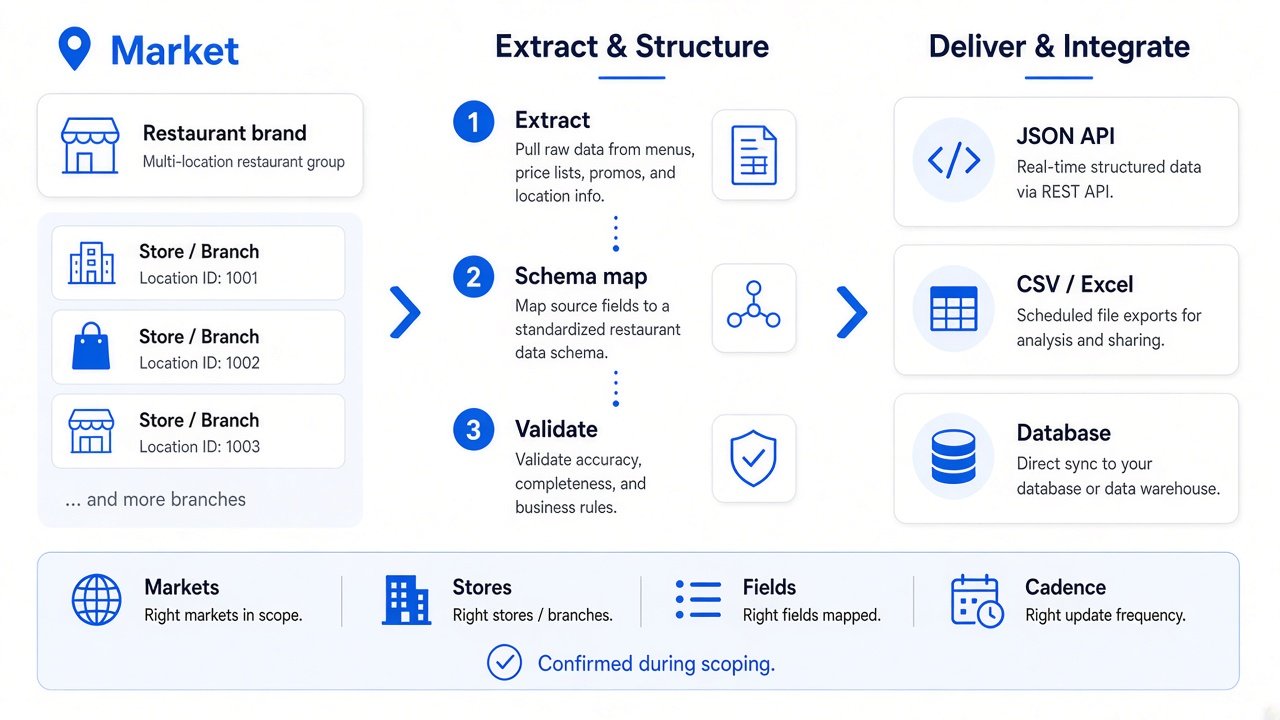
A Keeta Data Scraper is a managed workflow for turning agreed information from Keeta source surfaces into structured records for restaurant pricing, menu benchmarking, promotion monitoring, market research, competitive intelligence, and analytics.
The useful output is not simply a list of isolated prices.
A pricing observation becomes more meaningful when it retains the restaurant or brand, individual store or branch, menu item, modifier context, promotion state, location, market, currency, source reference, and collection time associated with the displayed value.
NenoData therefore scopes the source and schema before production collection.
Representative Keeta sources are reviewed for field availability, location behavior, menu depth, pricing structure, and delivery feasibility before broader coverage is agreed.
This is a managed extraction and data-delivery service built around approved public, permissioned, or otherwise authorized sources. It is not positioned as unrestricted access to every Keeta market, restaurant, store, account, or API.
Keeta operates a regional food-delivery marketplace across multiple countries. See Keeta's official global site for first-party market and brand context.
Where agreed Keeta source surfaces are accessed through consumer apps rather than the web alone, see NenoData Mobile App Scraping Services.
NenoData's extraction workflow and Keeta's official developer APIs solve different problems.
| Aspect | NenoData Keeta extraction workflow | Keeta official developer APIs |
|---|---|---|
| Primary purpose | Structured observations for pricing, research, monitoring and analytics | Merchant and service-provider integration with Keeta |
| Typical buyer | Pricing, QSR, research, intelligence, product and data teams | Authorized merchants and integration/service providers |
| Source model | Agreed public, permissioned or otherwise authorized source surfaces | Credentialed merchant-authorized data |
| Menu use | Observe scoped marketplace/menu fields where feasible | Synchronize authorized merchant menus and products |
| Store use | Preserve observed store/location context where scoped | Manage authorized store operational data |
| Orders | Private customer/order data is outside the normal extraction scope | Official API supports authorized merchant order workflows |
| Authorization | No merchant-private access is implied | Explicit merchant authorization is required |
| Output | Customer-defined structured dataset/feed | Keeta operational API |
| Affiliation | No Keeta or Meituan affiliation is implied | First-party Keeta ecosystem |
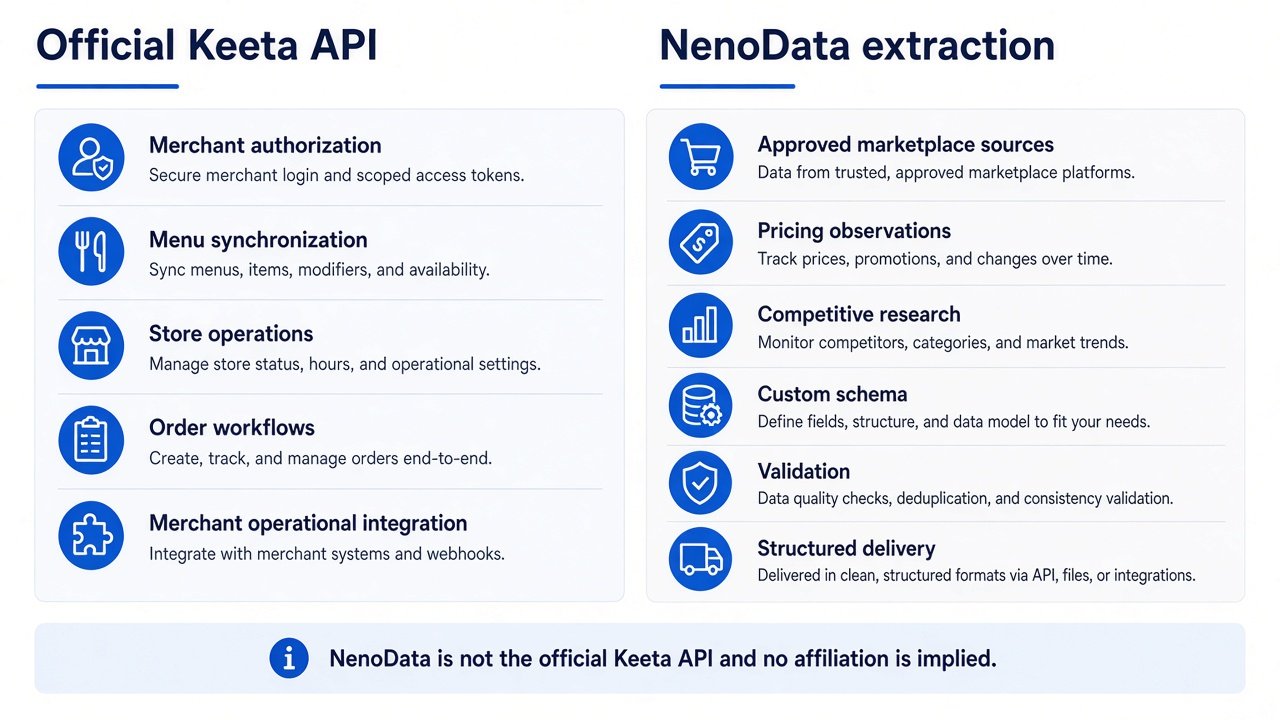
NenoData is not Keeta's official API and no Keeta or Meituan affiliation is implied.
Keeta's official developer documentation states that access to merchant products, orders, store information, and related merchant data requires explicit authorization through access tokens.
Its developer documentation covers menu synchronization, store operations, and order-management workflows. See also the basic integration guide for onboarding context.
The official menu model includes store-level menu organization, menu categories, products, SKUs or variants, and choice groups for product customization.
Those official APIs are therefore relevant when an authorized merchant wants to integrate its own operations with Keeta.
They should not be represented as an unrestricted source of competitor marketplace pricing.
NenoData does not claim to be Keeta, Meituan, an official Keeta API provider, or an endorsed Keeta integration partner.
Keeta's current official regional site (keeta-global.com) lists the markets above.
This confirms Keeta's own market presence.
It does not establish NenoData extraction coverage in all seven markets.
For NenoData, each requested market should be reviewed independently for relevant source surfaces, store/location behavior, menu visibility, pricing fields, modifier structures, promotions, fee visibility, availability/serviceability, source-language behavior, currency, collection feasibility, refresh requirements, and delivery model.
Saudi Arabia and GCC markets are the primary commercial focus of this page.
Hong Kong and Brazil can be evaluated when relevant, but should not be presented as pre-verified NenoData Keeta coverage.
Pricing intelligence starts with identifying which store produced the observation.
Keeta's official menu documentation explicitly organizes menus at the individual shop/store level.
Its merchant integration model also uses distinct store and menu entities.
That reinforces an important data-modeling principle for competitive pricing work: brand identity and store identity should not automatically be treated as the same field.
Depending on the source surface and agreed scope, candidate identity fields can include:
| Field group | Candidate fields |
|---|---|
| Platform | Keeta |
| Brand | Restaurant/chain brand where identifiable |
| Store | Store or branch name |
| Store identity | Source identifier where publicly visible and appropriate |
| Classification | Cuisine/category where visible |
| Market | Country/market |
| Location | City, area or other scoped location context |
| Source | Source reference |
| Observation | Collection timestamp, batch and validation state |
A price observed for one store should not automatically be assigned to every branch of the same chain.
For broader restaurant-intelligence workflows, see NenoData Restaurant Data Scraping Services.
Restaurant pricing can become misleading when the underlying menu structure is flattened too aggressively.
Keeta's official merchant API documentation provides evidence that its menu model conceptually distinguishes stores, categories, products, SKUs/variants, and choice groups.
For public-source extraction, however, each field still needs to be visible and feasible on the scoped source surface.
A NenoData menu schema can therefore evaluate:
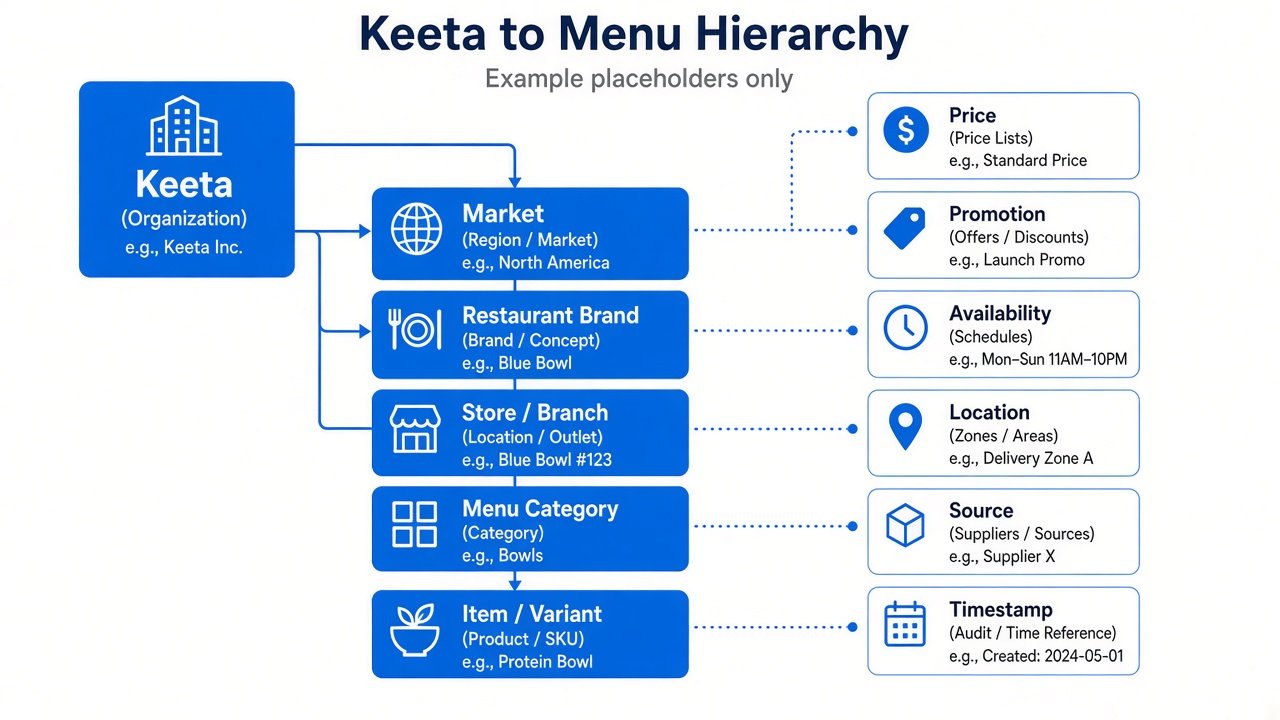
NenoData's broader Restaurant Menu Data Scraping service supports categories, items, descriptions, prices, variants/modifiers, add-ons, promotions, availability, location context, and source metadata from agreed sources.
That general capability does not guarantee that every field is visible on every Keeta menu.
The final Keeta schema should be based on representative source review.
Menu item, variant, modifier, or another visible charge.
Market, city/area context, and store/branch where supported.
Listed/base price, promotional price, or modifier/add-on price.
Preserve the source currency.
Retain the relevant availability or serviceability context where visible.
Attach a collection timestamp.
Retain source provenance.
A scoped pricing record can carry fields such as:
This makes later pricing analysis more defensible than a spreadsheet containing only restaurant, item, and price.
For broader pricing-intelligence program design, see NenoData Price Intelligence.
Restaurant menu prices can depend on required selections, sizes, variants, and add-ons.
NenoData's current menu-data service supports modifier-group, modifier-label, required/optional context, nested modifier structures, and modifier-price fields where those values are displayed by the agreed source.
For a Keeta project, modifier fields should still be verified against representative public or authorized source surfaces.
Where visible, preserve:
If a buyer wants a metric such as effective_price = base_price + required_modifier_prices, that value should be labelled as a derived calculation.
It should not be presented as though Keeta directly displayed the calculated result unless that exact value was actually shown by the source.
The calculation rule should also be documented so analysts understand which modifiers were included.
Visible Keeta promotions can be useful for competitive pricing analysis when the promotion is preserved separately from the base price.
Depending on the source, candidate fields can include:
Do not infer who funded a promotion unless the source explicitly provides that information.
Do not convert promotion visibility into a claim about sales performance or customer response.
Historical promotion analysis requires repeated observations over time unless an authorized historical source is separately available.
Menu price and delivered-order cost are not necessarily the same thing.
Where displayed and verified, a Keeta pricing workflow can keep delivery-related values separate from item pricing.
Potential contextual fields include:
These fields should not be assumed universally available.
In particular, service fees and minimum-order charges require source-level verification before they become production fields.
A delivery fee should remain a delivery field rather than being silently added to an item's listed menu price.
If the buyer wants a calculated delivered-price metric, define the formula explicitly and label the result as derived.
Where fee monitoring is the primary requirement across shipping and delivery surfaces, see NenoData Shipping & Delivery Fee Monitoring.
Store identity and location can materially affect how a pricing observation should be interpreted.
Keeta's own official API architecture is store-oriented, and its regional consumer service operates across multiple countries.
For marketplace intelligence, the safe model is therefore:
Keeta + market + location context + store + item + observed price + timestamp
rather than Keeta + item + universal price.
A location-aware project can evaluate differences such as:
Requested locations must be confirmed during scoping.
NenoData should not advertise blanket Keeta coverage for Riyadh, Dubai, Doha, Kuwait City, Manama, Hong Kong, São Paulo, or any other location solely because Keeta operates in the broader market.
For location-aware collection design across markets, see NenoData Geo-Targeted Web Scraping.
Keeta's official menu integration documentation currently supports menu language codes including English, Arabic, and Traditional Chinese and lists multiple supported currencies in its merchant integration model.
That is evidence about the official merchant API—not proof that every consumer-facing source displays all those languages or fields.
For NenoData extraction, source-language values can be preserved where they are visible and included in scope.
A record can carry fields such as:
Do not automatically promise:
But source-language preservation is not the same as translation.
Those transformations should be separately verified and scoped.
Likewise, preserve the displayed currency rather than silently converting prices.
NenoData's Web Scraping API managed extraction model can be represented as:
For a Keeta pricing project, the schema is agreed before production scale.
That can include confirmed fields for:
The resulting records can then be delivered programmatically where the agreed engagement supports API/API-ready delivery.
This is not Keeta's official merchant API.
No unauthorized merchant credentials or private operational data are implied.
Different buyers need Keeta observations in different downstream systems.
Pricing applications
Recurring monitoring
Analyst workflows
Scoped push integration
Historical analysis
Cadence and integration behavior confirmed during scoping.
| Delivery model | Useful for | What must be confirmed |
|---|---|---|
| JSON/API-oriented records | Internal pricing applications and data services | Schema and API/delivery behavior |
| Scheduled feed | Recurring competitor monitoring | Cadence and batch design |
| CSV/Excel | Pricing analysts and research teams | Columns and file structure |
| Webhook | Scoped downstream push workflow | Trigger and integration behavior |
| Database/warehouse | BI and historical analysis | Destination schema and loading model |
| On-demand workflow | Specific programmatic collection needs | Source feasibility and expected behavior |
NenoData's current managed services support structured CSV, Excel and JSON outputs, API/API-ready delivery, webhooks, and database or warehouse destinations where included in the engagement. For extraction-to-destination workflows, see NenoData Custom Data Pipelines.
Scheduled and on-demand behavior is source- and scope-dependent.
No Keeta-specific NenoData endpoint, authentication mechanism, SDK, sandbox, request limit, latency, fixed refresh interval, uptime figure, or SLA is implied.
Universal real-time Keeta collection is not promised.
This example shows how a store-level Keeta menu-price observation could be represented after schema mapping.
It is illustrative. It is not a live Keeta response, an official Keeta API payload, a production NenoData contract, or proof that every field is available.
Illustrative schema — not a live Keeta response, official Keeta API payload, production NenoData contract, or proof of universal field availability.
{
  "source_platform": "keeta",
  "market": "SA",
  "source_language": "example-language",
  "brand": {
    "name": "Example Brand"
  },
  "store": {
    "name": "Example Store",
    "source_id": "example-visible-id"
  },
  "menu_item": {
    "category": "Example Category",
    "name": "Example Item",
    "variant": "Example Variant"
  },
  "pricing": {
    "listed_price": "32.00",
    "promotional_price": "27.00",
    "currency": "SAR",
    "promotion_text": "Example visible promotion"
  },
  "modifier_context": {
    "group": "Example Modifier Group",
    "modifier": "Example Modifier",
    "modifier_price": "3.00",
    "required": "example-visible-status"
  },
  "delivery_context": {
    "delivery_fee": "example-visible-value",
    "availability": "example-visible-status",
    "estimated_delivery_time": "example-visible-value"
  },
  "location_context": {
    "city": "Example City",
    "area": "Example Area"
  },
  "source_reference": "illustrative-source-reference",
  "collected_at": "YYYY-MM-DDTHH:mm:ssZ",
  "refresh_batch_id": "example-batch",
  "validation_status": "passed"
}
Missing fields should follow the agreed null or exception rule rather than being fabricated.
Recurring pricing intelligence needs predictable handling of incomplete and changing source records.
Confirmed Keeta values can be mapped into the customer's agreed names, types, hierarchy, and downstream structure.
Fields such as store, item, price, currency, location, or timestamp can be checked according to agreed requirements.
A field that is not displayed should not receive an invented value. Depending on project rules, it can remain null or carry an exception state.
Price values can be checked for expected format and associated currency. Base, promotion, modifier, and fee values should remain separate unless a documented transformation combines them.
Where repeated observations create duplicate records, agreed identifiers or matching rules can be applied.
Menu hierarchy, field labels, modifier structures, and source behavior can change. Where maintenance is included, supported extraction and mapping logic can be reviewed as those structures evolve.
Retain source reference, store/location context, collection timestamp, refresh batch, and validation state so downstream teams can audit observations.
A historical price dataset requires historical observations.
If a Keeta project begins collecting today, repeated scoped collection can create a time series containing observations such as:
store + item + price + promotion + location + collected_at
Over time, that can support calculated metrics such as:
These are derived analytical measures built from collected observations.
NenoData should not claim pre-existing historical Keeta data unless a genuine historical dataset or authorized historical source is separately verified.
Track observed item prices across agreed competitor restaurants and stores.
Compare restaurant, branch, item, modifier, and promotion observations within a defined market.
Evaluate whether the same chain or comparable item has different observed prices across scoped stores.
Compare menu categories, assortment, item descriptions, variants, and modifier structures.
Compare visible add-on or modifier prices independently from base menu prices.
Track visible promotional prices and offer labels over recurring collection periods.
Compare displayed delivery fees separately from menu prices where fee fields are available.
Study observed availability or serviceability states across confirmed locations.
Preserve store and geographic context so pricing observations are not treated as platform-wide values.
Compare scoped restaurant/menu/pricing observations between confirmed Keeta markets.
Build a time series through recurring collection and calculate price-change metrics from timestamped observations.
Deliver validated pricing observations into downstream analytics infrastructure through the agreed format and destination.
A regional pricing workflow may need observations from several food-delivery platforms.
Comparable fields can be mapped into a common downstream schema, for example:
| Business concept | Normalized field |
|---|---|
| Platform | source_platform |
| Market | market |
| Restaurant brand | brand_name |
| Store/branch | store_name |
| Item | item_name |
| Variant | variant |
| Listed price | listed_price |
| Promotional price | promotional_price |
| Modifier | modifier_name |
| Modifier price | modifier_price |
| Currency | currency |
| Availability | availability_status |
| Delivery fee | delivery_fee |
| ETA | estimated_delivery_time |
| Location | location_context |
| Observation time | collected_at |
Normalization should not erase meaningful platform differences. For example, fee definitions, modifier structures, promotion terminology, serviceability logic, and ETA representations may differ by source. Keep source-specific fields where forcing them into a shared definition would change their meaning.
For Talabat-specific workflows, see NenoData Talabat Data Scraping Services. For Careem-specific workflows, see NenoData Careem Data Scraping Services. For HungerStation-specific workflows, see NenoData HungerStation Data Scraping Services. For Grab-specific workflows, see NenoData Grab Data Scraping Services. For broader multi-platform food-delivery intelligence, see NenoData Food Delivery App Scraping.
Pricing intelligence becomes easier to audit when source observations and calculations are kept separate.
Where publicly visible and verified, examples can include:
Examples can include:
Derived fields should include a documented formula or methodology where appropriate.
Do not label the following as public Keeta source fields unless independently verified:
NenoData's service is scoped around approved public, permissioned, or otherwise authorized sources.
It does not imply access to:
Keeta's official developer APIs require merchant authorization for merchant data.
The existence of those APIs does not make private merchant data a public extraction source.
NenoData also does not imply affiliation with or endorsement by Keeta or Meituan.
Additional boundaries:
Step 1
Share the Keeta markets, representative source targets, restaurants/brands, stores, locations, required menu depth, pricing fields, modifier requirements, delivery context, intended use, cadence, and destination.
Step 2
NenoData reviews representative targets for source feasibility, menu structure, store/location behavior, required fields, and proposed schema. A representative sample can be reviewed before broader production configuration.
Step 3
Approved values are mapped into the agreed schema. Cleaning, normalization, required-field checks, null handling, deduplication, price validation, and exception flags can be applied according to the project rules.
Step 4
Validated records are delivered through the agreed JSON/API-oriented, CSV, Excel, webhook, database, warehouse, or other supported workflow. Where maintenance is included, supported extraction and mapping logic can be reviewed as source structures evolve.
Store, item, location, currency, promotion state, source, and timestamp can remain attached to the observed price.
The schema can distinguish a chain from an individual store or branch where the source supports that distinction.
Base item prices and modifier/add-on prices can remain separate where those values are visible.
Calculated price metrics do not have to masquerade as raw Keeta fields.
Keeta's commercial footprint is not converted into an unsupported NenoData coverage promise.
Representative source and schema review can identify field gaps before a recurring feed is configured.
Missing values, duplicates, format issues, and source changes can follow defined rules.
Structured observations can be prepared for analyst files, APIs, databases, warehouses, or other agreed workflows.
A Keeta Data Scraper is a managed workflow for collecting agreed information from approved Keeta source surfaces and structuring it for pricing intelligence, restaurant research, competitive monitoring, analytics, or other approved uses.
Depending on source visibility and scope, candidate fields can include restaurant/store identity, menu items, variants, listed prices, promotional prices, modifiers, modifier prices, promotions, availability, delivery context, location, currency, source reference, and timestamps.
Representative Keeta restaurant sources can be assessed for restaurant, store, menu, pricing, availability, and related visible fields. Exact coverage is confirmed during scoping.
Menu depth varies by store and source surface. NenoData's broader menu service supports categories, items, modifiers, add-ons, pricing, promotions, and availability, but complete Keeta menu coverage should not be assumed without representative review.
Yes, where the item and price are visible and the source is feasible. A useful record should preserve store, item, market/location, currency, source, and timestamp context.
They can be included where visible and scoped. Keeta's official merchant API demonstrates that its underlying menu model supports choice groups and product options, but public-source visibility still requires independent verification.
Where the source exposes the necessary modifier structure, base price and modifier price can remain separate. Any calculated effective price should be labelled as derived.
A defined calculation can be applied when the required inputs exist. The formula should be documented, and the result should be labelled as calculated rather than presented as a raw Keeta field.
Visible promotional prices and promotion text can be monitored where supported by the scoped source.
Where displayed, delivery fees can remain separate from menu prices. Service fees or minimum-order fees require separate source verification.
A store-level dataset is designed to preserve the location and store associated with each observation, allowing differences to be measured if the collected records show them. The page should not assume such differences exist before observing them.
Where supported, market, city/area or another scoped location context is stored alongside the store, item, price, source, and collection timestamp.
They can be treated as separate fields where the source exposes separate signals. Do not infer one from the other without a defined source rule.
ETA or displayed delivery-time information can be included where visible and confirmed for the requested source.
Keeta's current official site lists Saudi Arabia, UAE, Kuwait, Qatar, Bahrain, Hong Kong, and Brazil. NenoData feasibility must be confirmed independently for every requested market.
Comparable confirmed fields can be mapped into a common schema. Market, currency, location, source language, and source-specific semantics should remain explicit.
The source-displayed currency should be retained. Currency conversion should be a separately defined transformation rather than silently replacing the observed value.
Where source-language fields are visible and supported, they can be included in the schema.
Translation should not be assumed. Arabic, Chinese, Portuguese, or other translation/transliteration requirements need separate verification and scope.
Only where publicly visible and verified for the scoped source. Review text should be independently verified.
NenoData supports API/API-ready structured delivery where included in scope. The Keeta-specific schema and delivery behavior must be defined during scoping.
NenoData's current managed extraction services support JSON, CSV, and Excel output where scoped.
Database and warehouse delivery can be scoped through NenoData's managed extraction and pipeline services.
Scheduled recurring collection can be configured where source feasibility supports the required cadence. No fixed Keeta refresh frequency is promised by this page.
On-demand behavior can be evaluated where the source and project architecture support it.
Recurring timestamped collection can build a price-history dataset over time. Do not imply that NenoData already possesses historical Keeta data unless independently verified.
Universal real-time Keeta data is not promised. Freshness depends on source behavior, fields, markets, locations, scale, and agreed cadence.
Where maintenance is included, configured extraction, mapping, and validation logic can be reviewed as supported source structures evolve.
Missing source values should follow the agreed null or exception rule. They should not be invented.
Comparable fields from approved sources can be mapped into a shared downstream schema while retaining source-specific differences where necessary.
No. NenoData's managed extraction service should not be represented as Keeta's official developer API or as an affiliated Keeta service.
Keeta's official documentation covers authorized merchant/service-provider integrations for menus, stores, orders, and related operational workflows. Access to merchant data requires explicit merchant authorization.
The official API is designed around authorized merchant operational data. It should not be assumed to provide unrestricted competitor marketplace pricing.
This service does not imply access to customer identities, payment details, private accounts, order histories, private transactions, or unauthorized merchant operational information.
Yes. NenoData's current menu and managed extraction services support representative sample review so source feasibility, fields, menu depth, schema, and delivery structure can be assessed before broader production collection.
Share representative Keeta sources and the pricing or restaurant intelligence your team needs.
Include:
NenoData can review source, field, location, pricing, schema, cadence, and delivery feasibility before recommending the next step for a representative sample.
Related resources: Talabat data scraping, Careem data scraping, HungerStation data scraping, Restaurant menu data scraping, Web Scraping API.
Tell us what you need. We'll build a custom scraping solution and deliver a free proof-of-concept within 48 hours.